





Preparing for a job interview starts with understanding the questions you are most likely to hear. The most common interview questions and answers are designed to help employers evaluate your experience, communication style, motivation, and fit for the role.
The best way to prepare is not to memorize scripts. Instead, learn the intent behind each question and practice answering with structure, relevance, and authenticity. In this guide, you will find the common interview questions, why they are asked, and how to answer them effectively.
The Most Common Interview Questions and Answers
Below are 10 of the most common interview questions and answers candidates should prepare for before an interview.
1. Tell me about yourself.
This is often the first question in an interview. It is your chance to give a concise professional summary and connect your background to the job's needs.
How to answer: Use a simple Present-Past-Future structure.
- Present: Share your current role and focus.
- Past: Mention relevant experience or achievements.
- Future: Explain why this role is the next step.
Example: "I’m currently a marketing manager focused on campaign strategy and performance. In my previous role, I led content improvements that increased organic traffic by 40%. I’m excited about this opportunity because it would let me apply that experience in a growth-focused environment."
2. Why do you want to work here?
Employers ask this to see whether you have researched the company and understand how you fit.
How to answer: Mention one or two specific reasons you are interested in the company, such as its mission, products, reputation, or growth. Then connect those reasons to your skills and goals.
Example: "I’m drawn to your company because of its focus on customer experience and product innovation. My background in process improvement and client communication would allow me to contribute quickly in this role."
3. What are your greatest strengths?
This question helps interviewers understand what you do well and how that matches the role.
How to answer: Choose strengths that are relevant to the job description. Back each one with a short example.
Simple framework: Claim + Evidence + Result
- Claim: State the strength.
- Evidence: Give a brief example.
- Result: Share the outcome.
Example: "One of my strengths is project management. In my last role, I coordinated a cross-functional launch that finished two weeks ahead of schedule."
4. What is your greatest weakness?
This question is designed to test self-awareness and growth, not perfection.
How to answer: Choose a real but manageable weakness and show how you are improving it.
Framework: Past-Present-Future
- Past: Mention the challenge honestly.
- Present: Explain what you are doing to improve.
- Future: Show how the improvement helps you now.
Example: "I used to hesitate when delegating because I wanted to make sure everything was done correctly. Over time, I started using clearer task ownership and check-ins, which has helped me trust the process and work more efficiently."
5. Why are you leaving your current job?
Interviewers want to understand your motivation and whether you will be a positive addition to the team.
How to answer: Keep the response professional and forward-looking. Focus on what you are moving toward, not what you are escaping.
Example: "I’ve learned a lot in my current role, but I’m looking for a position with more growth opportunity and broader responsibility. This role is a strong match for the direction I want to take my career."
6. Where do you see yourself in five years?
This question helps employers gauge your ambition and whether your goals align with the role.
How to answer: Emphasize growth, skill development, and long-term value to the company.
Example: "In five years, I’d like to be highly effective in this area, contributing to bigger projects and taking on more leadership responsibility as I grow with the team."
7. Describe a challenging situation or conflict at work and how you handled it.
This is one of the most common behavioral interview questions and answers categories because it shows how you work under pressure.
How to answer: Use the STAR method.
- Situation: Set the context.
- Task: Explain your responsibility.
- Action: Describe what you did.
- Result: Share the outcome.
Example: "On a cross-functional project, two teams had different priorities and deadlines. I set up a shared timeline, clarified ownership, and created weekly check-ins. As a result, we delivered the project on time and improved communication for future work."
8. What are your salary expectations?
Interviewers ask this to see whether your expectations align with the role and budget.
How to answer: If possible, wait until you understand the full scope of the role. If you must give a number, provide a researched salary range based on the job title, location, and your experience.
Example: "I’d like to learn more about the responsibilities before discussing compensation in detail, but based on my research and experience, I’d expect something in the range of X to Y."
9. What questions do you have for me?
This is your opportunity to show engagement, curiosity, and preparation. A strong answer can help you stand out.
How to answer: Prepare several thoughtful questions in advance.
| Category | Example Questions |
|---|---|
| Role and impact | What would success look like in this role after 90 days? What are the biggest challenges this position would solve? |
| Team and culture | How does the team collaborate day to day? What does the company do to support professional development? |
| Growth and goals | What are the team’s main priorities this year? How is success measured here? |
10. How did you hear about this position?
This question is usually straightforward, but it still matters because it tells the employer how people find their openings.
How to answer: Be direct and honest. If someone referred you, mention their name. If you found the job on a board or company website, say so clearly.
Example: "I found the opening on your careers page while researching roles in this field, and I was excited to apply because the position aligns closely with my background."
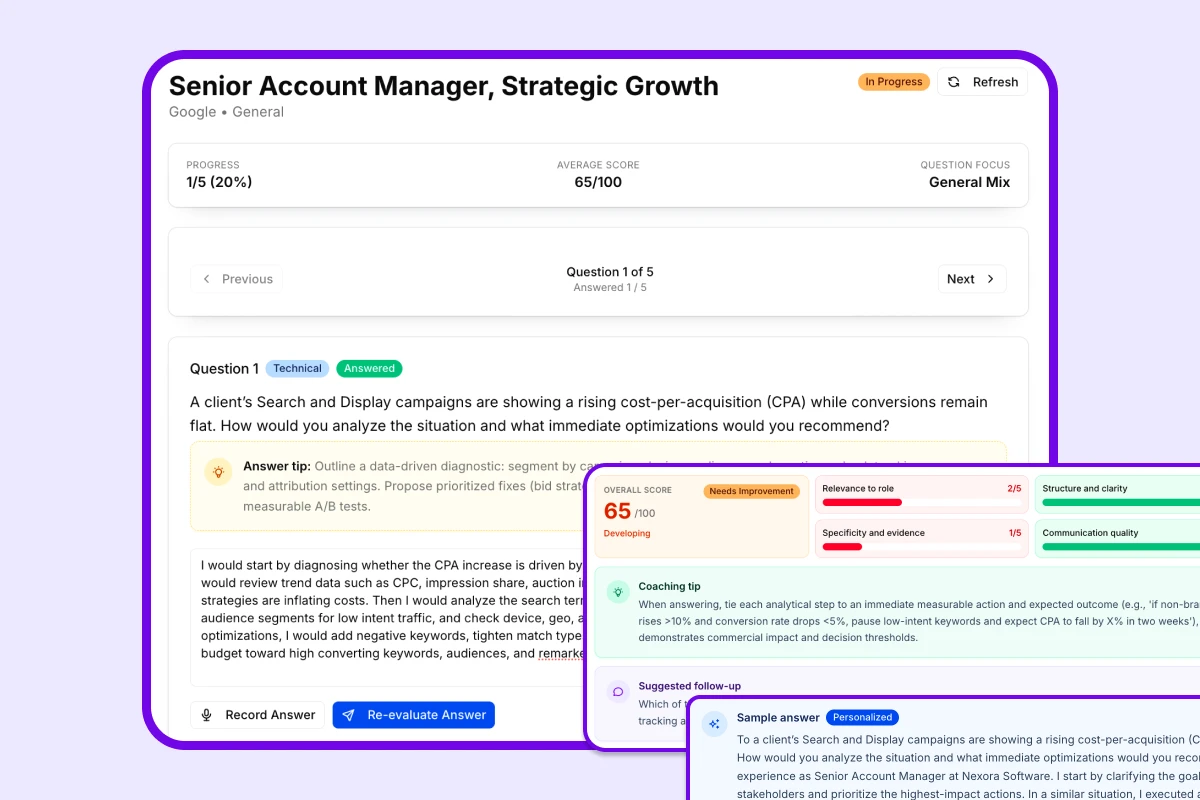
AI Interview Prep
Got the interview? Now make sure you're ready.
Practice the exact questions likely to come up for your target role. Get scored on clarity, structure, and relevance — so you walk in sharp, not winging it.
Other Common Interview Questions and Answers to Prepare For
Depending on the role, you may also hear these common interview questions:
- Why should we hire you?
- What motivates you?
- What is your ideal work environment?
- Tell me about a time you failed.
- Describe a time you led a project.
- How do you handle stress and deadlines?
- What would your coworkers say about you?
- Why are you interested in this industry?
These questions often assess the same core areas: communication, professionalism, problem-solving, and fit.
How to Prepare Strong Interview Answers
If you want to answer common interview questions well, focus on preparation, clarity, and relevance.
1. Match your answers to the job description
Look for repeated themes in the posting, such as leadership, collaboration, problem-solving, or technical skill. Build answers that reflect those priorities.
2. Use a simple structure
Strong answers are easier to follow when they have a beginning, middle, and end. Use frameworks like:
- Present-Past-Future for introductory questions
- Claim + Evidence + Result for strengths
- STAR for behavioral questions
3. Keep your answers concise
Most answers should take about 60 to 90 seconds. If you are telling a behavioral story, stay focused on the details that matter.
4. Practice aloud
Reading answers is not the same as saying them. Practice with a friend, record yourself, or do mock interviews so your delivery sounds natural.
5. Stay positive and professional
Even when discussing weaknesses, conflict, or leaving a job, keep the tone constructive. Interviewers are looking for maturity and good judgment.
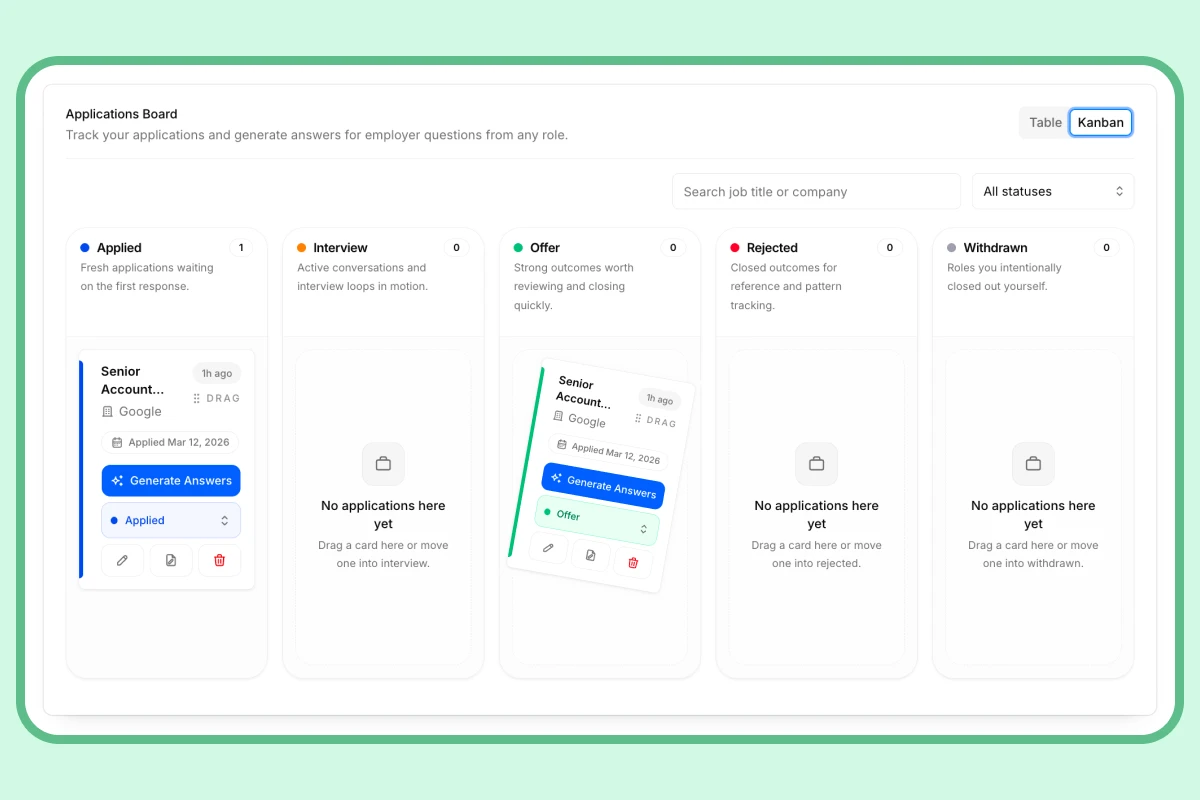
Application Tracker
Applying to 10+ jobs? You need a real system.
No more spreadsheets or lost threads. Track every role, stage, deadline, and follow-up in one dashboard — so you always know exactly where you stand.
Interview Answer Examples by Question Type
Here is a quick way to think about the most common interview questions and answers by category:
- Introductory questions: Tell me about yourself, How did you hear about this role?
- Motivation questions: Why do you want to work here? Why are you leaving your current job?
- Self-assessment questions: What are your strengths? What is your weakness?
- Behavioral questions: Tell me about a challenge, conflict, or failure.
- Planning questions: Where do you see yourself in five years?
- Closing questions: What questions do you have for me?
Knowing the category can help you answer with the right level of detail and tone.
Final Tips for Interview Success
The most common interview questions and answers are not about having perfect lines. They are about showing that you are prepared, self-aware, and a strong fit for the role.
Before your interview, review the job description, prepare several examples from your experience, and practice answering out loud. If you can explain your background clearly and connect it to the employer’s needs, you will be in a strong position.
Frequently Asked Questions
What are the most common interview questions?
The most common interview questions usually include "Tell me about yourself," "Why do you want to work here?" "What are your strengths?" "What is your weakness?" and "Where do you see yourself in five years?"
What is the best way to answer common interview questions?
The best approach is to use a clear structure, keep your answers relevant to the job, and include a short example when possible.
How should I answer behavioral interview questions?
Use the STAR method to explain the situation, your responsibility, the actions you took, and the result.
How long should my interview answers be?
Most answers should be around 60 to 90 seconds. Behavioral answers can be a little longer if needed, as long as they stay focused and clear.
What should I avoid saying in an interview?
Avoid negative comments about previous employers, vague answers, overexplaining, and unprepared responses.
Explore this category
Interview Prep
Browse the full interview prep category for more related playbooks, examples, and tactical guides.
Browse Interview Prep articles →One workflow. Resume to offer.
Build ATS-ready resumes, track every application, and practice interviews — all in one place. Free to start, no credit card needed.
✓ Free plan forever · ✓ No card needed
Related articles
The Complete Guide to Behavioral Interview Questions: How to Prepare and Answer with Confidence
Behavioral interview questions are a critical part of the hiring process, designed to predict your future performance based on past experiences. This guide breaks down the most common types, provides actionable strategies for crafting compelling answers, and helps you turn interview anxiety into confidence.
Interview Question: Why Should We Hire You for This Position? Answer Guide
Use this guide to build a strong answer to "Why should we hire you for this position?" with a simple framework, practical examples, and tips for tailoring your response to the role and company.
Interview Questions Can You Work Under Pressure? Answers, Examples, and Strategy
Interview questions can you work under pressure are a common way employers assess stress management, adaptability, and decision-making. Use this guide to build a strong answer with examples, STAR-based structure, and common mistakes to avoid.