






The common interview question “What are your biggest strengths?” appears straightforward, yet it frequently stumps candidates. An effective reply is more than a simple inventory of positive attributes. It is a targeted articulation of the specific abilities, work habits, and personal qualities that drive your professional effectiveness.
For related next steps, use common interview questions guide, behavioral interview questions guide, and situational interview questions guide.
The most compelling responses accomplish three objectives.
- Select strengths that align with the position
- Substantiate them with a concrete illustration
- Demonstrate their value to the prospective employer.
This manual details how to construct a powerful response to What Are Your Biggest Strengths, provides effective illustrations, and advises on avoiding clichéd answers.
Answer-First Summary
When responding to “What are your biggest strengths?” during an interview, select 2-3 strengths pertinent to the job requirements. For every strength, provide a brief, specific instance from your background and clarify the outcome it generated. Conclude by linking that strength to the position, enabling the interviewer to visualize the concrete benefit you offer.
How to Select Appropriate Strengths for an Interview?
The most effective examples of biggest strengths originate from the job posting itself. Begin with the competencies the employer explicitly seeks, not merely your personal favorites.
1. Analyze the job description
Identify recurring demands, duties, and keywords. These typically highlight the most crucial strengths.
- Client-facing position: communication, relationship-building, empathy
- Dynamic setting: adaptability, multitasking, self-motivation
- Analytical position: problem-solving, critical thinking, attention to detail
- Leadership position: delegation, decision-making, team coordination
2. Correlate those needs with your background
Consider:
- Which of my strengths have most frequently contributed to my success?
- For which strengths can I provide tangible evidence?
- Which are most applicable to this specific role?
3. Opt for a balanced combination
A robust answer often incorporates a blend of:
- A technical skill: project management, data analysis, software proficiency
- An interpersonal skill: communication, teamwork, collaboration
- A work ethic strength: adaptability, resilience, time management
Which Strengths Are Most Advantageous to Cite in an Interview?
No single answer is ideal for every scenario, but certain strengths are widely valued due to their broad applicability.
Commonly appreciated strengths
- Communication
- Problem-solving
- Collaboration and teamwork
- Leadership
- Attention to detail
- Time management
- Adaptability
- Self-motivation
- Critical thinking
- Creativity
- Resilience
- Discipline
- Public speaking
- Project management
Select strengths you can validate with actual proof. A strength only becomes persuasive when you can illustrate it in practice.
What Distinguishes a Powerful Answer From a Vague One?
A generic answer informs the interviewer of your self-perception. A powerful answer validates it.
Vague answer
“I’m a great problem-solver.”
Enhanced answer
“A primary strength of mine is structured problem-solving. In my previous role, we experienced a 15% rise in customer churn. I spearheaded an analysis of the onboarding process, pinpointed where users disengaged, and collaborated with the team to enhance the tutorial sequence. This adjustment decreased churn by 20% the following quarter.”
The second response succeeds because it incorporates:
- a defined strength
- an actual scenario
- a precise action taken
- a quantifiable result
- a link to business value
This framework mirrors the STAR method:
- Situation
- Task
- Action
- Result
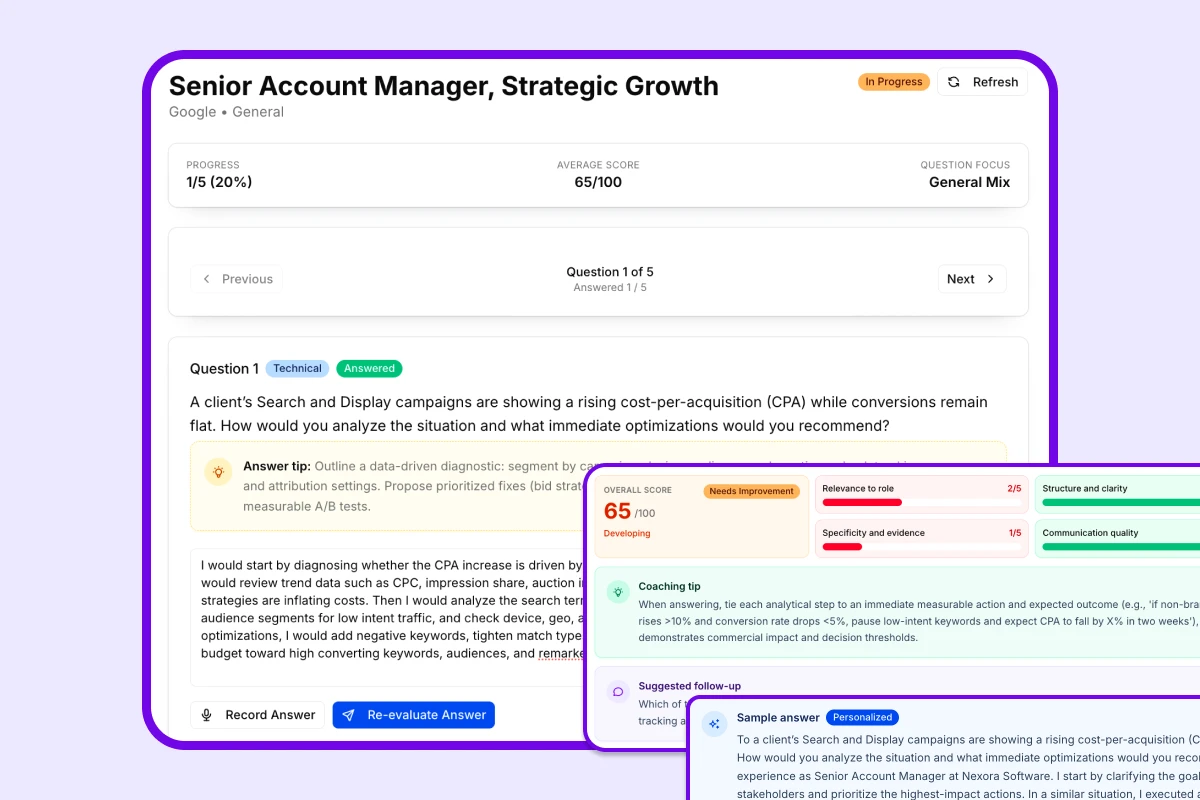
AI Interview Prep
Got the interview? Now make sure you're ready.
Practice the exact questions likely to come up for your target role. Get scored on clarity, structure, and relevance — so you walk in sharp, not winging it.
How to Structure an Outstanding Strength Response?
Employ this straightforward format:
Strength + Example + Result + Relevance
Illustration:
“A key strength is organization. In my last position, I handled concurrent deadlines across various teams. I developed a tracking system that enhanced visibility and enabled us to complete projects punctually. That same organizational skill would allow me to remain dependable and systematic in this role.”
This maintains a clear, logical flow.
What Are Effective Examples for This Question?
Below are several sample responses you can tailor.
Example 1: Communication
“My greatest strength is communication. In my prior role, I frequently acted as the primary liaison between our sales and product teams. I ensured updates were unambiguous, deadlines were mutually understood, and potential problems were flagged promptly. This approach minimized misunderstandings and kept both teams synchronized.”
Example 2: Problem-solving
“A significant strength is problem-solving. When our team began consistently missing deadlines on routine reports, I examined the workflow, identified several manual steps causing delays, and proposed a streamlined process. This enhancement accelerated turnaround time and decreased error rates.”
Example 3: Adaptability
“I am highly adaptable. During a major product launch in my last job, priorities shifted rapidly. I successfully pivoted between tasks, maintained focus, and supported the team where assistance was most critical. This flexibility was instrumental in keeping the project on track.”
Example 4: Leadership
“My foremost strength is leadership. I excel at guiding teams toward common objectives and proactively eliminating obstacles. On a recent cross-functional project I led, we adhered to the schedule because I maintained transparent communication and clearly defined everyone’s responsibilities.”
How Many Strengths Should You Discuss?
For most interviews, 2-3 strengths is optimal.
- One strength may seem overly limited
- Two strengths provides balance
- Three strengths demonstrates versatility without appearing scattered
If the interviewer requests elaboration, you can delve into a second or third strength. Preparing multiple options is preferable to relying on a single rehearsed reply.
How to Avoid Appearing Arrogant?
The strategy is to center your strengths on impact and contribution, rather than self-praise.
Less effective
“I’m an excellent leader and always hit deadlines.”
More effective
“My strength lies in guiding teams toward defined objectives. On a recent project, I maintained alignment through regular syncs and clear task ownership, which resulted in delivery two weeks ahead of schedule.”
This version projects confidence without boastfulness by focusing on outcomes and collective value.
What If Your Top Skill Isn't an Obvious Fit for the Job?
If your best strength isn't directly mentioned in the job description, identify its transferable component.
For instance:
- Creative writing can translate to clear communication or compelling messaging
- Customer service can translate to empathy and conflict resolution
- Teaching can translate to presentation skills and patience
- Research can translate to analytical rigor and attention to detail
The aim is not to fabricate relevance, but to logically show how the strength can still contribute to success in the new role.
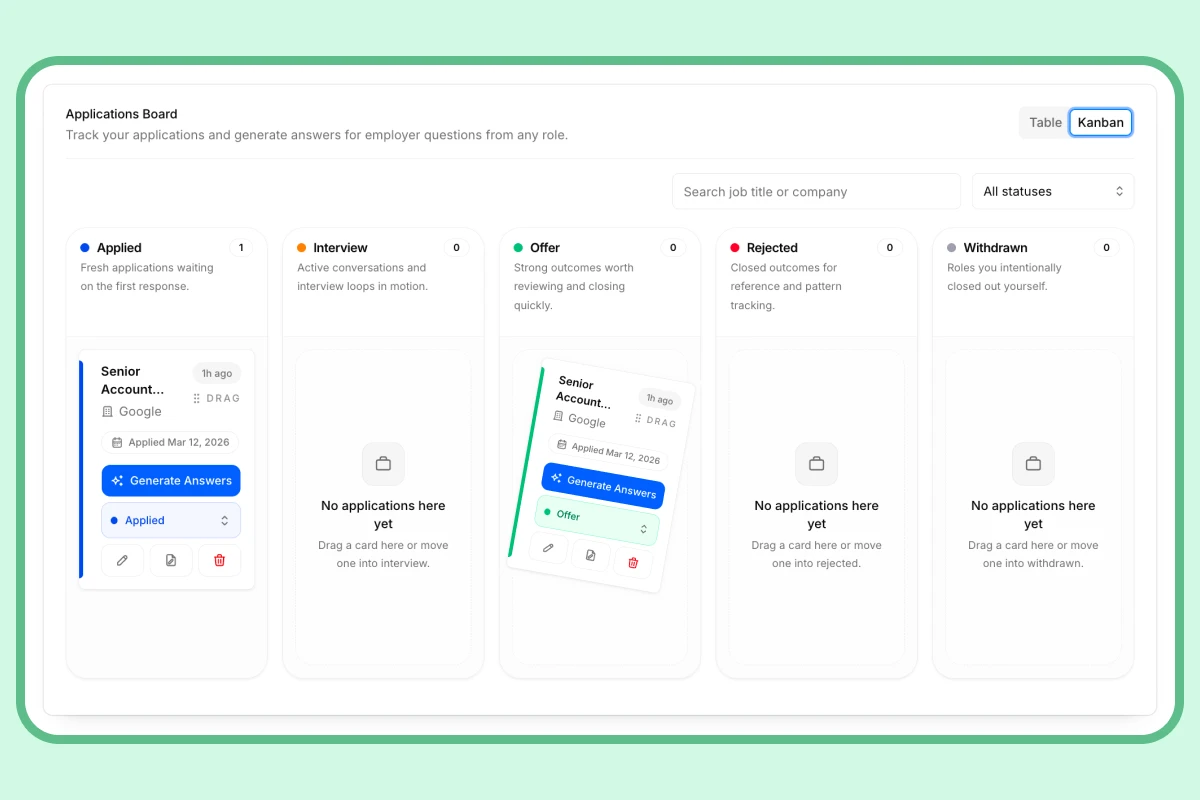
Application Tracker
Applying to 10+ jobs? You need a real system.
No more spreadsheets or lost threads. Track every role, stage, deadline, and follow-up in one dashboard — so you always know exactly where you stand.
Should You Reference the Same Strengths on Your Resume?
Yes, when appropriate. Your resume and interview responses should reinforce a cohesive professional narrative.
If your resume emphasizes project management, your interview example should demonstrate project management in practice. This consistency builds credibility and makes you more memorable.
What's the Best Method for Providing Examples Concisely?
Use an abbreviated STAR method format and limit your answer to 60-90 seconds.
| Step | Content | Approx. Time |
|---|---|---|
| Strength | State the strength clearly. | 10 seconds |
| Situation | Provide brief context. | 15 seconds |
| Action | Describe what you did. | 20 seconds |
| Result | Share the outcome. | 15 seconds |
| Relevance | Connect it to the role. | 10 seconds |
Illustration of a concise answer
“A major strength is attention to detail. In my previous position, I reviewed weekly reports before they were sent to leadership, catching errors that would have skewed our performance metrics. This diligence prevented confusion and ensured data accuracy. I would apply that same thoroughness to this role.”
What Are Key Tips for Answering This Question?
Consider these practical tips:
- Scrutinize the job description before the interview
- Select strengths you can validate with examples
- Incorporate metrics where possible
- Remain succinct and specific
- Choose strengths pertinent to the role
- Practice aloud to ensure a natural delivery
- Be prepared to discuss an additional strength if prompted
How Should You Respond If Asked About Weaknesses As Well?
This question sometimes pairs with “What are your weaknesses?” If so, keep your strengths answer robust and your weakness answer genuine yet constructive.
An effective weakness is:
- authentic
- not a fundamental requirement for the role
- accompanied by a clear plan for improvement
Sample pair
Strength: “A primary strength is attention to detail. I maintained an exceptionally low error rate in reporting by implementing a meticulous review process before any data was shared with leadership.”
Weakness: “I occasionally assume too much responsibility because I’m committed to quality. I’ve been addressing this by delegating tasks earlier and utilizing project management tools to track ownership more effectively.”
Final Preparation Checklist
- I have selected 2-3 strengths relevant to the job.
- I have a genuine example for each strength.
- I can articulate the result or impact.
- I can link each strength to the role.
- My answer is clear and under 90 seconds.
- I have a thoughtful weakness answer prepared if needed.
Final Takeaway
A compelling answer to “What are your biggest strengths?” is not about appearing impressive. It is about demonstrating relevance, providing evidence, and articulating value.
By choosing pertinent strengths, supporting them with concrete examples, and linking them to the job, you transform a standard interview question into a persuasive argument for your candidacy.
Explore this category
Interview Prep
Browse the full interview prep category for more related playbooks, examples, and tactical guides.
Browse Interview Prep articles →One workflow. Resume to offer.
Build ATS-ready resumes, track every application, and practice interviews — all in one place. Free to start, no credit card needed.
✓ Free plan forever · ✓ No card needed
Related articles
How Do You Sell Yourself During an Interview: A Pragmatic Playbook
Selling yourself in an interview isn't about boasting; it's a strategic process of aligning your proven skills with the employer's needs. This playbook provides the concrete frameworks, scripts, and preparation tactics you need to communicate your value with confidence and authenticity.
How to Answer What Are Your Greatest Strengths in an Interview
Learn how to answer "What are your greatest strengths?" with a concise, tailored response that highlights relevant skills, proves them with examples, and shows fit for the job.
Situational Interview Questions: Examples, Answers, and STAR Method Tips
Situational interview questions ask how you would handle hypothetical, job-related scenarios to evaluate problem-solving, judgment, and critical thinking. This guide explains what they are, how they differ from behavioral questions, and how to answer them with a simple framework and real examples.