





Writing a resume can feel overwhelming, especially when you are trying to make one document do two jobs at once: impress a human reader and pass an applicant tracking system. The good news is that resume writing becomes much easier when you treat it like a strategy problem instead of a blank-page problem.
Answer-first summary: To write a resume that gets results, start by gathering your work history, skills, and measurable accomplishments. Then choose a clean reverse-chronological format, tailor your summary and bullet points to the job description, and use ATS-friendly keywords naturally throughout the document. Finish by editing for clarity, consistency, and impact.
What Is the First Step in Writing a Resume?
The first step is preparation. Before you open a template or start typing, collect the raw information you may need.
Build a master resume list
Make one complete list of:
- Job titles
- Company names
- Employment dates
- Education
- Certifications
- Skills
- Projects
- Awards
- Measurable results from your recent work.
This master list helps you build targeted resumes faster. Instead of rewriting everything from scratch each time, you can pull the most relevant details for each application.
Study the job description
Read the job post carefully and highlight:
- Required skills
- Preferred skills
- Tools and technologies
- Repeated phrases
- Core responsibilities
These phrases often become your best resume keywords. If the role asks for project management, data analysis, or customer success experience, those exact terms should appear naturally in your resume when they honestly match your background.
Choose the right resume format
For most job seekers, the reverse-chronological resume is the best option. It places your most recent experience first and makes your career history easy to scan.
Other formats can work in special cases:
- Functional resume: May help if you are changing careers or have limited work history
- Combination resume: Can work if you want to highlight skills and experience equally
In most cases, the reverse-chronological format is the safest choice because it is familiar to recruiters and easy for ATS software to read.
How Should You Structure a Resume?
A strong resume follows a predictable structure. That makes it easier for hiring managers to find what they need quickly.
1. Contact information
Keep this section simple and professional.
Include:
- Full name
- Phone number
- Professional email address
- City and state
- LinkedIn profile
- Portfolio, GitHub, or website if relevant
Do not include unnecessary details like a full street address, personal social links, or an unprofessional email handle.
2. Professional summary
Your summary should be two to three lines that explain who you are, what you do, and what value you bring.
Example:
Results-driven marketing manager with 8+ years of experience leading SaaS launches, digital campaigns, and cross-functional projects. Known for increasing lead generation, improving conversion rates, and building scalable growth strategies.
Use a summary if you already have professional experience. If you are a recent graduate or career changer, you can use a short objective instead, but a summary is usually stronger.
3. Work experience
This is the most important section on most resumes.
For each role, include:
- Job title
- Company name
- Location
- Dates of employment
Then add bullet points that focus on achievements, not just duties.
How do you write strong resume bullet points?
A good bullet point answers three questions:
- What did you do?
- How did you do it?
- What changed because of it?
Use strong action verbs and measurable outcomes whenever possible.
Weak example:
- Responsible for social media accounts.
Strong example:
- Grew Instagram following by 40% in 6 months through a targeted content calendar and influencer partnerships, increasing website traffic by 15%.
Weak example:
- Managed team projects.
Strong example:
- Led a cross-functional team of 5 to launch Project X ahead of schedule, saving $200K and increasing market share by 10% in Q3.
If you are short on numbers, use scale, frequency, scope, or business impact. Even simple details can make a bullet stronger.
4. Skills section
Add a concise list of skills that match the role you want.
You can group them by category:
- Technical skills
- Tools and software
- Languages
- Leadership skills
This section should reflect the job description. If the employer mentions Excel, Salesforce, SQL, Python, or stakeholder management, use those terms only if they genuinely apply to you.
5. Education
List your education in reverse order, starting with the most recent or highest degree.
Include:
- Degree name
- Major
- School name
- Graduation year, if helpful
You can include GPA if it is strong and relevant, especially if you are a recent graduate.
6. Optional sections
Add only what strengthens your candidacy.
Possible sections include:
- Certifications
- Projects
- Awards and honors
- Volunteer work
- Professional affiliations
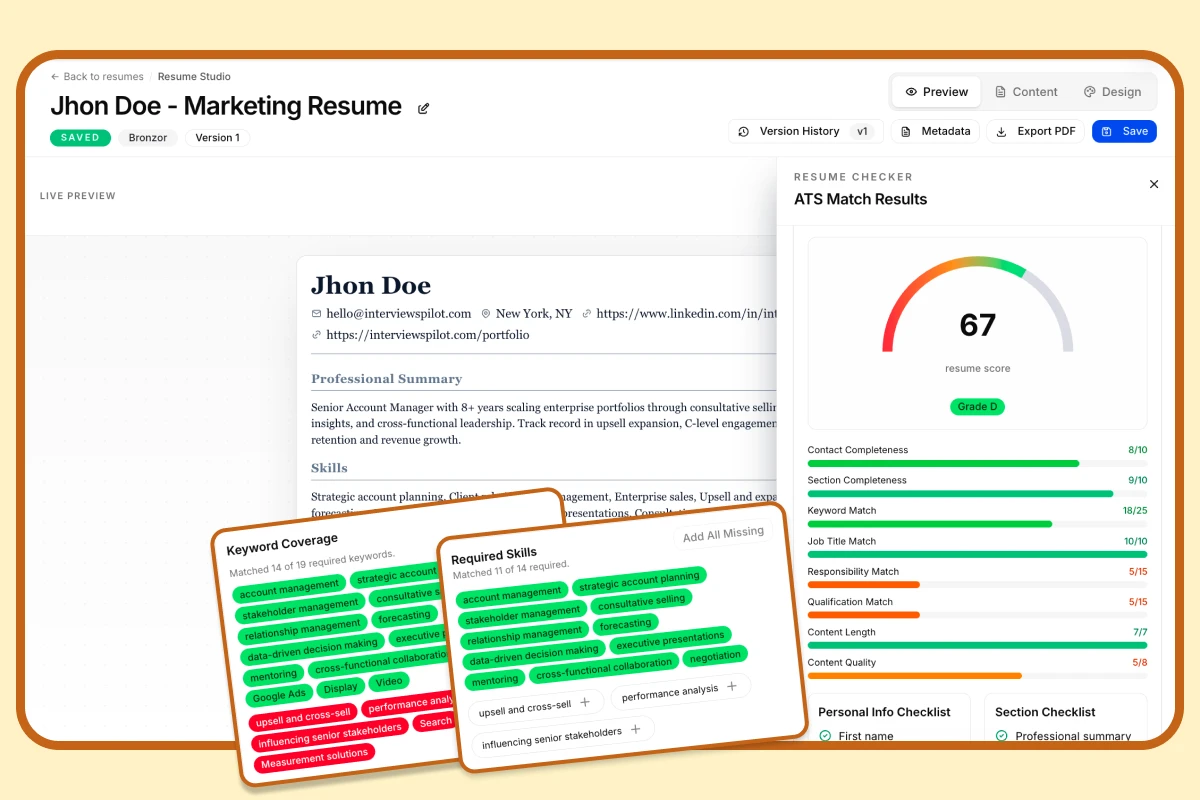
Free ATS Score
Your resume might be invisible to recruiters
Most resumes are filtered out before a human ever sees them. Get your free ATS score and see exactly where your resume falls short — before you hit send.
How Do You Write a Resume for ATS Optimization?
ATS resume optimization matters because many companies use software to scan resumes before a human ever sees them. Your goal is to make the document easy to parse and easy to match to the job description.
Use the right keywords
ATS systems look for relevant terms from the posting. Include those keywords naturally in:
- Your summary
- Skills section
- Work experience bullets
- Certifications or project descriptions
Do not stuff your resume with repeated keywords. That looks unnatural and can hurt readability.
Keep the layout simple
Use a straightforward format with:
- Standard section headings
- A single-column layout when possible
- Clear fonts like Arial, Calibri, or Georgia
- Consistent spacing
- Clean bullet points
Avoid design elements that can break parsing, such as:
- Text boxes
- Icons
- Graphics
- Tables that carry important content
- Hidden text
Save in the right file type
Unless an employer asks for something different, submit your resume as a PDF or DOCX file. PDF files often preserve formatting better, while DOCX files can be safer for older systems.
What Are Good Resume Tips for Tailoring Your Resume?
Tailoring is one of the most important resume tips you can follow. A generic resume rarely performs well.
Match your resume to the role
Before each application, adjust:
- Your summary
- Your top skills
- Your most relevant bullet points
- Your headline or title if appropriate
You do not need to rewrite the entire document every time. Instead, make sure the most relevant information appears first and matches the language of the posting.
Prioritize relevance over volume
A strong resume is not just a list of everything you have done. It is a focused marketing document.
If a bullet does not support the job you want, consider removing it or moving it lower. Your goal is to show fit, not completeness.
Use the top third of page one well
Hiring managers often skim quickly. Make sure your most important details appear near the top:
- Name and contact information
- Strong summary
- Most relevant experience
- Key skills
What Resume Examples Should You Use as a Model?
Looking at resume examples can help you understand structure and phrasing, but do not copy them line for line. Use examples as a guide for tone, formatting, and bullet style.
Resume examples by situation
Different job seekers need different approaches:
- Experienced professionals: Focus on impact, growth, and leadership
- Recent graduates: Highlight education, internships, and projects
- Career changers: Emphasize transferable skills and relevant achievements
- Technical candidates: Include tools, systems, and project outcomes
When reviewing examples, pay attention to how they present achievements. Strong resumes usually show numbers, scope, or business outcomes.
What Common Resume Mistakes Should You Avoid?
Even a strong background can be weakened by avoidable mistakes.
Avoid these problems
- Spelling or grammar errors
- Inconsistent date formats
- Long paragraphs
- Too much jargon
- Overused phrases like “hardworking” or “team player”
- Generic duties with no results
- Missing keywords from the job description
- Unclear job titles or formatting
Don’t make it harder to scan
If your resume is crowded or confusing, a recruiter may stop reading quickly. Keep it concise, readable, and easy to navigate.
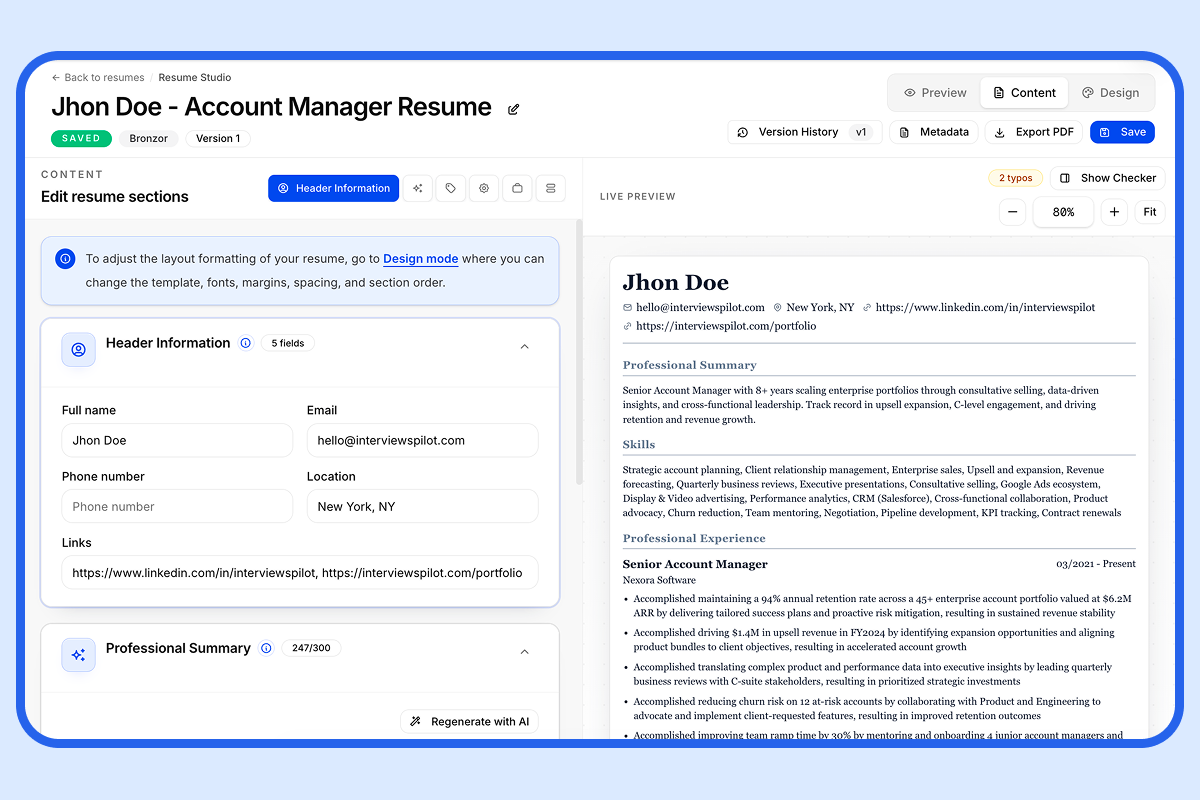
AI Resume Builder
Stop sending the same resume to every job
Paste any job description and InterviewsPilot rewrites your resume around it — keywords, bullets, and summary aligned to what recruiters are actually scanning for.
How Long Should a Resume Be?
The right length depends on your experience.
- Entry-level: Usually 1 page
- Mid-career: 1 to 2 pages
- Senior professionals: 2 pages is common, sometimes more if the role requires it
The rule is simple: include enough detail to prove fit, but not so much that the document becomes cluttered.
Resume Example: Before and After
Here is a simple example of how to turn a basic bullet into a stronger one.
Before:
- Helped with customer support and email responses.
After:
- Resolved 50+ customer inquiries per day with a 95% satisfaction rating while improving response time through a streamlined email workflow.
The second version is more effective because it shows scale, speed, and outcome.
What Is the Best Final Checklist Before You Apply?
Before submitting your resume, run through this checklist:
- Is the resume tailored to the job?
- Is the format clean and readable?
- Are keywords included naturally?
- Are all dates, titles, and company names accurate?
- Do bullets show measurable results?
- Is the top third of the page strong?
- Are there no spelling or grammar errors?
- Does the file name look professional?
Conclusion
Learning how to write a resume is really about learning how to present your experience clearly and persuasively. The best resumes are focused, easy to read, and tailored to one specific role. Start with a master list, study the job description, use a clean structure, write impact-driven bullets, and optimize for ATS without losing readability. If you keep your resume relevant and results-oriented, it becomes a much stronger tool in your job search.
Explore this category
Resume
Browse the full resume category for more related playbooks, examples, and tactical guides.
Browse Resume articles →One workflow. Resume to offer.
Build ATS-ready resumes, track every application, and practice interviews — all in one place. Free to start, no credit card needed.
✓ Free plan forever · ✓ No card needed
Related articles
How to Optimize Your Resume for ATS: Tips, Examples, and a Practical Checklist
Use this ATS resume optimization guide to format your resume correctly, match keywords from job descriptions, and avoid common mistakes that prevent applications from being read properly.
How to Read a Job Description: Tips, Examples, and ATS Resume Optimization
Learn how to read a job description like a recruiter. This guide explains the key sections of a posting, how to judge whether you qualify, and how to use job description keywords to improve ATS resume optimization with real examples tips.
Keywords for Resume: How to Find and Use ATS-Friendly Terms
Resume keywords help your experience match the language employers are searching for. This guide shows how to identify the right terms, place them naturally, avoid common ATS mistakes.