






Crafting the bullet points under each job on your resume is a balancing act. Too few, and you undersell your experience. Too many, and you risk losing the reader’s attention. The most widely recommended range is 3 to 5 bullet points per job on a resume, with the exact number depending on role relevance, seniority, and how recent the position is. For a neutral baseline on structure and formatting, CareerOneStop's resume guidance is a useful noncommercial reference.
For related next steps, use resume skills section guide.
This guide explains the rule, when to bend it, and how to decide which bullets deserve space. It also covers how bullet points affect recruiter scanning and ATS resume optimization.
What Is the Ideal Number of Bullet Points per Job on a Resume?
The ideal number is usually 3 to 5 bullet points. That range works well because it balances clarity, detail, and readability.
Why this range is so common:
- Recruiter scan time is short. Recruiters often spend only a few seconds on an initial review, so a concise block of bullets is easier to digest.
- ATS systems prefer clean structure. Standard bullet formatting helps software parse experience more reliably.
- It supports achievement-focused writing. Three to five bullets gives enough room to show impact without turning the resume into a task list.
In short, the goal is not to list everything you did. The goal is to show the most relevant, high-value parts of your experience.
How Many Bullet Points per Job on Resume Should Recent Roles Have?
Recent roles should usually get the most space because they are the most relevant to your current candidacy.
A good rule of thumb:
- Current or most recent role: 4 to 5 bullets
- Mid-career roles: 2 to 4 bullets
- Older roles: 1 to 3 bullets
Why this works:
- Your most recent experience is the strongest evidence of what you can do now.
- Hiring managers care more about current skills, tools, and scope than about very old responsibilities.
- A resume should function like a highlight reel, not a full work history.
If a role is especially important to the job you want, it can justify more bullets within the recommended range. If it is less relevant, reduce the number and keep only the most meaningful achievements.
Should Older Jobs Have Fewer Bullet Points?
Yes. Older roles should usually have fewer bullet points than recent ones.
A practical approach is:
- 10+ years ago: 1 to 2 bullets, sometimes 3 if highly relevant
- 5 to 10 years ago: 2 to 3 bullets
- Recent roles: 4 to 5 bullets
This creates a natural hierarchy in your resume. It signals to recruiters that your most recent experience matters most, while still showing enough history to support your career story.
If an older position includes a major accomplishment that is still relevant, keep it. If the bullets only repeat generic duties, cut them.
Does the Number of Bullet Points Vary by Career Level?
Yes, but not dramatically. Career level affects how much depth you need to show.
| Career Level | Suggested Bullet Count | Why It Works |
|---|---|---|
| Entry-Level | 3 to 4 | Focus on internships, projects, transferable skills, and early wins |
| Mid-Career | 4 to 5 | Show growth, ownership, and measurable results |
| Senior Manager / Director | 4 to 5 | Emphasize leadership, scale, and business impact |
| Executive | 5 to 6 max | Use only if each bullet captures major strategic outcomes |
For most candidates, the 3 to 5 rule still holds. The main difference is that senior candidates may need to demonstrate larger scope, while entry-level candidates may rely more on projects and internships to fill out their experience.
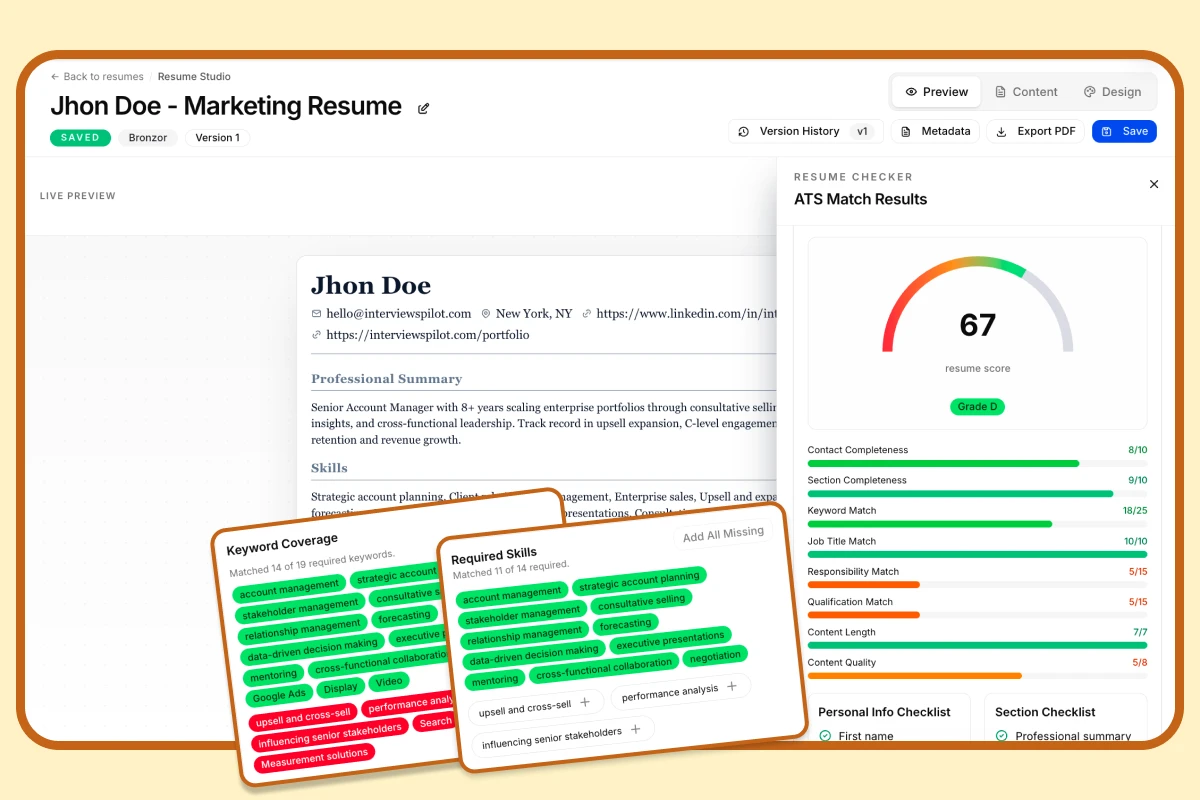
Free ATS Score
Your resume might be invisible to recruiters
Most resumes are filtered out before a human ever sees them. Get your free ATS score and see exactly where your resume falls short — before you hit send.
How Do I Decide Which Bullet Points to Keep?
When space is limited, use a simple filter. Keep the bullets that are:
- Most relevant to the job description
- Most measurable
- Most impressive in scope or outcome
- Most recent
- Most unique
A good question to ask is: Would this bullet help me get hired for this specific role? If not, it probably does not need to stay.
This is especially important when tailoring a resume for different applications. The best bullet points are not the longest; they are the ones that match the target role most closely.
Should Bullet Points Focus on Responsibilities or Results?
They should focus on results whenever possible.
A strong bullet point usually follows this pattern:
Action verb + what you did + result or impact
Examples:
-
Weak: Responsible for managing social media accounts.
-
Stronger: Grew Instagram followers by 150% in 12 months through a targeted content strategy and consistent engagement.
-
Weak: Wrote code for new product features.
-
Stronger: Developed 3 user-facing features in React that increased session time by 15%.
-
Weak: Handled customer service inquiries.
-
Stronger: Resolved 50+ customer inquiries per day while maintaining a 98% satisfaction rating and reducing escalation rates by 25%.
Results-based bullets help recruiters understand your value faster, and they often include the keywords that ATS systems look for.
What Makes a Bullet Point Strong Versus Generic?
A generic bullet lists a duty. A strong bullet proves impact.
Strong bullets usually include at least one of the following:
- A metric
- A business result
- A scale indicator
- A specific tool, project, or system
- A clear outcome
Examples of weak vs. strong bullets
-
Weak: Assisted with marketing campaigns.
-
Strong: Supported 6 product launch campaigns that generated a 22% lift in lead volume.
-
Weak: Worked with a development team.
-
Strong: Collaborated with a 7-person engineering team to deliver a mobile checkout redesign that improved conversion by 11%.
-
Weak: Managed internal reports.
-
Strong: Automated weekly reporting workflows, reducing manual prep time by 8 hours per week.
If a bullet does not show action, scale, or result, it is probably too generic.
How Do Bullet Points Affect ATS Parsing and Recruiter Scanning?
Bullet points matter for both machines and humans.
For ATS systems
ATS software works best with clear formatting and standard structure. Bullet points help break information into readable chunks, especially when they are written with common symbols and simple formatting.
To improve ATS resume optimization:
- Use standard bullet symbols
- Avoid text boxes and graphics
- Keep section headings clear
- Include relevant keywords naturally
- Use plain, readable formatting
For recruiters
Recruiters scan quickly. Bullets create white space and make it easier to spot achievements, job titles, and relevant keywords.
Your first few bullets under each role matter most. Put your strongest, most relevant accomplishment near the top so it is seen during a fast scan.
Is It Okay to Use More Than 5 Bullet Points per Job?
Usually, no. More than 5 bullets per job can start to reduce readability.
There are a few exceptions:
- Long tenure at one company. If you stayed for many years and advanced through multiple roles, you may need more space. In that case, consider splitting the experience into separate positions.
- Academic or research CVs. These often require more detail than a standard industry resume.
- Highly complex executive roles. Senior leaders may need a slightly longer list if each bullet reflects major business impact.
Even then, keep the writing tight. If a bullet does not add a new and important point, cut it.
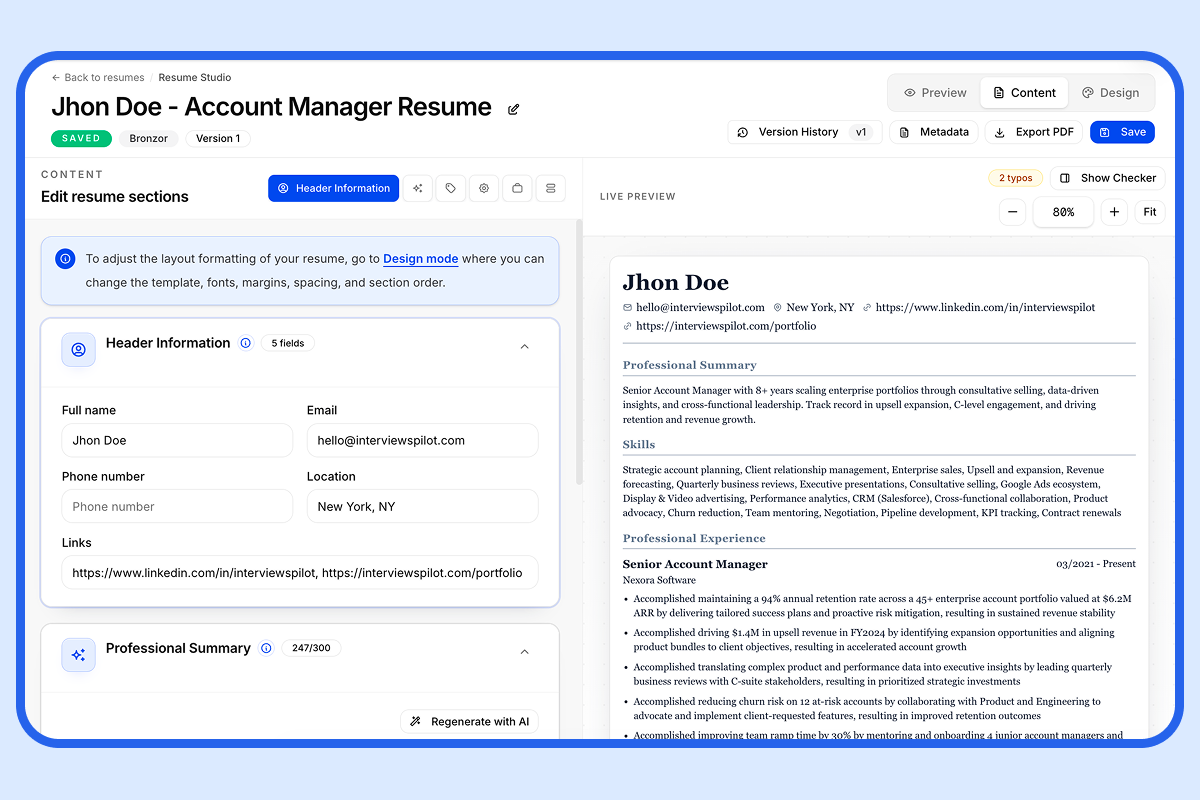
AI Resume Builder
Stop sending the same resume to every job
Paste any job description and InterviewsPilot rewrites your resume around it — keywords, bullets, and summary aligned to what recruiters are actually scanning for.
How Should Entry-Level Candidates Handle Bullet Points?
Entry-level candidates can still follow the same framework.
If you do not have long job histories, use bullets from:
- Internships
- Class projects
- Freelance work
- Volunteer work
- Campus leadership roles
The key is to make each bullet meaningful. Even without decades of experience, you can show impact by describing outcomes, tools used, or responsibility gained.
For entry-level resumes, 3 to 4 bullets per relevant role is often enough.
What Are Some Good Resume Bullet Point Examples?
Here are a few examples that show the difference between generic and strong bullets.
Example 1: Marketing
- Generic: Managed email campaigns.
- Improved: Managed email campaigns that increased open rates by 28% and drove 1,200 new leads in Q2.
Example 2: Operations
- Generic: Helped improve processes.
- Improved: Redesigned an intake workflow that reduced processing time by 35% and improved team throughput.
Example 3: Customer Support
- Generic: Answered customer questions.
- Improved: Resolved an average of 45 customer tickets per day while maintaining a 97% satisfaction score.
Example 4: Software Engineering
- Generic: Built product features.
- Improved: Built and shipped 5 product features that improved user retention by 9% over 6 months.
These examples show the best pattern: action, context, and measurable impact.
What Is the Best Way to Prioritize Bullets on a Resume?
A simple priority order can help:
- Put the most relevant bullet first
- Put the highest-impact bullet second
- Keep the rest in descending order of relevance or strength
- Remove anything repetitive or vague
This ordering helps both ATS review and human scanning. If a recruiter only reads the first two bullets, they should still understand your value.
How Can I Make My Resume More ATS-Friendly?
If your goal is to improve ATS resume optimization, focus on structure and clarity:
- Use standard job titles when appropriate
- Mirror important keywords from the job description
- Keep formatting simple
- Use bullet points instead of dense paragraphs
- Avoid tables, columns, and decorative elements that can confuse parsing
- Keep accomplishments specific and measurable
ATS systems are not impressed by design tricks. They respond best to clean formatting and relevant content.
Final Answer: How Many Bullet Points per Job on Resume Should You Use?
The best answer is usually 3 to 5 bullet points per job on a resume.
Use more bullets for recent and relevant roles, and fewer bullets for older positions. If you need to choose, prioritize:
- Relevance
- Results
- Quantifiable impact
- Clarity
- ATS-friendly formatting
The strongest resumes do not try to say everything. They say the right things well.
Quick Decision Guide
Use this simple rule:
- Recent, important role: 4 to 5 bullets
- Typical role: 3 to 4 bullets
- Older or less relevant role: 1 to 3 bullets
- More than 5 bullets: Only if absolutely necessary
If you want one takeaway, it is this: quality beats quantity every time. Five strong achievement-focused bullets will almost always outperform eight generic ones.
Explore this category
Resume
Browse the full resume category for more related playbooks, examples, and tactical guides.
Browse Resume articles →One workflow. Resume to offer.
Build ATS-ready resumes, track every application, and practice interviews — all in one place. Free to start, no credit card needed.
✓ Free plan forever · ✓ No card needed
Related articles
The Biggest Resume Mistakes to Avoid: A 2026 Pragmatic Playbook
Your resume is your first interview. Avoid the common pitfalls—from missing contact details to vague duties—that get your application instantly rejected. This playbook details the biggest mistakes and provides clear, actionable solutions to craft a resume that gets noticed.
How to Tailor Your Resume to a Job: Step-by-Step Tips, Examples, and ATS Optimization
Tailoring your resume is one of the most effective ways to improve your odds of getting noticed. This guide shows you how to analyze a job description, rewrite your summary and bullets, and optimize your resume for ATS and recruiters with clear examples and a simple checklist.