






Your resume is a strategic document, not a biography. In a competitive job market flooded with applications, even minor errors can be disqualifying. This guide cuts through the noise to outline the most critical resume mistakes that actively sabotage your candidacy and provides a pragmatic, step-by-step playbook for fixing them. We'll focus on modern pitfalls, especially concerning Applicant Tracking Systems (ATS), and how to structure your resume for maximum impact. For a neutral baseline on structure and formatting, CareerOneStop's resume guidance is a useful noncommercial reference.
For related next steps, use ATS optimization checklist.
What are the biggest resume mistakes to avoid?
The most damaging resume mistakes are those that prevent your application from ever being seen by a human. These include technical errors like missing information or formatting that breaks ATS parsing, and substantive failures like failing to communicate your achievements. Research from leading career platforms consistently highlights a core set of errors. For instance, a common mistake is "listing duties instead of achievements," which fails to demonstrate your impact. Another critical error is the inclusion of an "outdated career objective" statement, which uses valuable space without providing value to the recruiter. The cumulative effect of these mistakes is a resume that is generic, unpersuasive, and likely to be rejected in the initial screening phase.
How can I fix spelling and grammar errors on my resume?
Spelling and grammar errors are not minor oversights; they signal carelessness and a lack of attention to detail, directly undermining your professional credibility. To fix this:
- Never rely solely on spellcheck. Basic spellcheck misses context errors (e.g., "manager" vs. "manger").
- Read your resume aloud. This forces you to process each word and often catches awkward phrasing or missing articles.
- Use a dedicated grammar tool as a second layer of defense, but understand its suggestions rather than accepting them blindly.
- Have a trusted peer or mentor review it. A fresh set of eyes will catch errors you've become blind to.
The goal is perfection. As noted in career advice, these errors are easily avoidable with proper tools and review processes, yet they remain a top reason for early rejection.
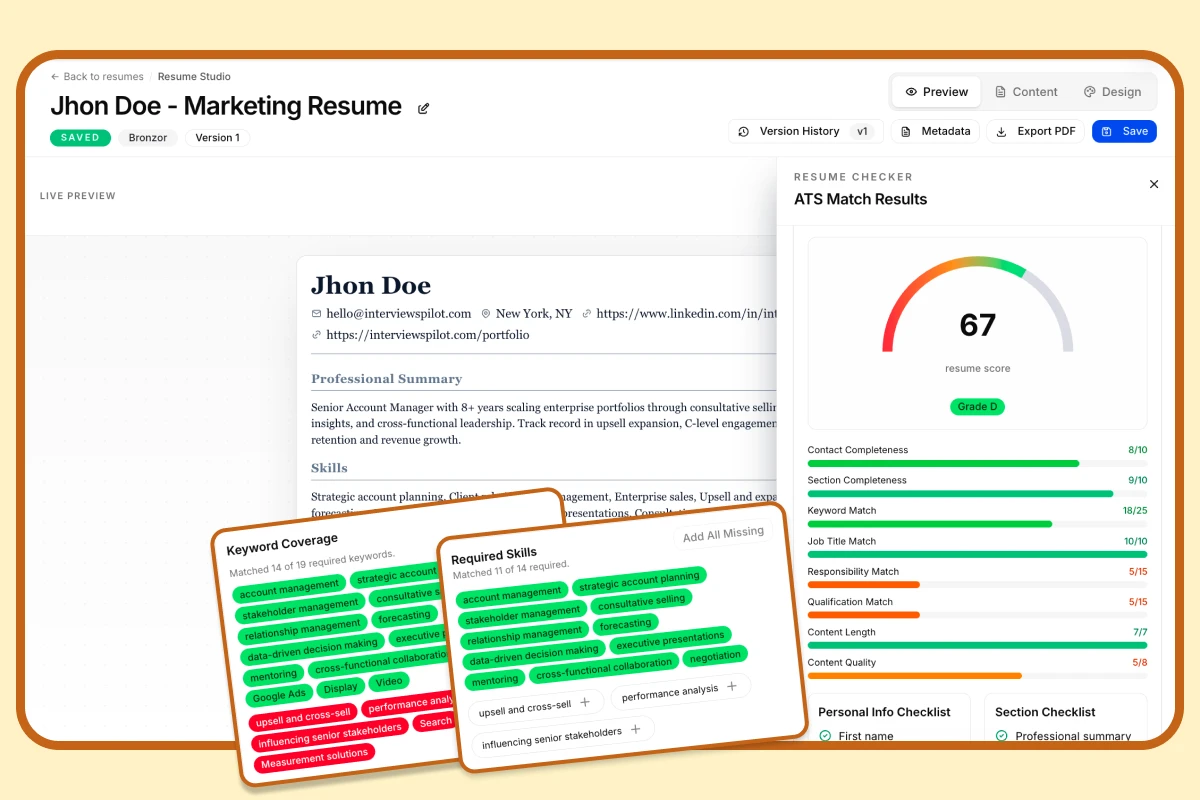
Free ATS Score
Your resume might be invisible to recruiters
Most resumes are filtered out before a human ever sees them. Get your free ATS score and see exactly where your resume falls short — before you hit send.
Should I include a career objective on my resume?
No, you should not include a traditional career objective. This section is considered outdated because it is typically self-focused (e.g., "Seeking a challenging role to grow my skills...") and does nothing to convince the employer of your value. It wastes prime real estate at the top of your document.
Instead, use a Professional Summary. This is a 3-5 line section that functions as your elevator pitch. A strong summary should:
- State your target title (e.g., "Senior Project Manager").
- Highlight years of relevant experience.
- Showcase 1-2 key achievements or areas of expertise with metrics if possible.
- Align directly with the job description.
Example of a weak objective vs. a strong summary:
| Outdated Objective | Modern Professional Summary |
|---|---|
| "Seeking a position in marketing where I can utilize my skills and contribute to company growth." | "Data-driven Marketing Manager with 8+ years of experience specializing in SaaS growth marketing. Proven track record of increasing qualified leads by 150% and reducing CAC by 30% through integrated campaign strategies." |
The summary immediately tells the recruiter who you are and what you can do for them, making the objective statement obsolete.
What is a target title and why is it important?
A target title is the specific job title you are applying for, ideally placed prominently near the top of your resume, such as in your professional summary or in a dedicated line below your contact information. Its importance is twofold:
- For ATS: Many systems are configured to scan for and rank resumes based on a match between the applicant's stated target role and the open position. Omitting it can lower your match score.
- For Human Recruiters: It provides immediate context. A recruiter scanning hundreds of resumes can instantly categorize your application, reducing cognitive load and ensuring your experience is evaluated against the correct role.
Your target title should mirror the title on the job posting as closely as possible. If you are qualified for adjacent roles, tailor a separate resume for each target title.
How do I write a strong professional summary for my resume?
A strong professional summary is a concise, powerful argument for your candidacy. Follow this structure:
- Opening Identifier: Start with your professional title and specialization (e.g., "Certified Financial Analyst specializing in risk modeling").
- Scope of Experience: Briefly state your years of experience and the scale or context of your work (e.g., "with 10 years of experience in Fortune 500 fintech").
- Key Achievement Hook: Integrate your most impressive, quantifiable result (e.g., "noted for building models that reduced portfolio risk by 22%").
- Relevant Skill Highlight: Mention a core, relevant skill or methodology (e.g, "proficient in Monte Carlo simulation and regulatory compliance frameworks").
Keep it tight, avoid first-person pronouns ("I," "me"), and ensure every word adds value. This section sets the tone for the entire resume.
Why should I focus on achievements instead of duties?
Listing duties describes what you were supposed to do; listing achievements proves how well you did it. Recruiters hire for outcomes, not responsibilities. A duty-focused bullet point is passive and generic, while an achievement-focused one is active and compelling.
The Formula for Achievement Bullets: Use the Action + Task + Result + Metric framework.
- Weak (Duty): "Responsible for managing social media accounts."
- Strong (Achievement): "Developed and executed a content calendar for Instagram and LinkedIn, increasing follower engagement by 45% and generating 350+ qualified leads per quarter."
This shift from responsibilities to results is consistently emphasized as one of the most important differentiators between a good resume and a great one. It provides concrete evidence of your performance and potential.
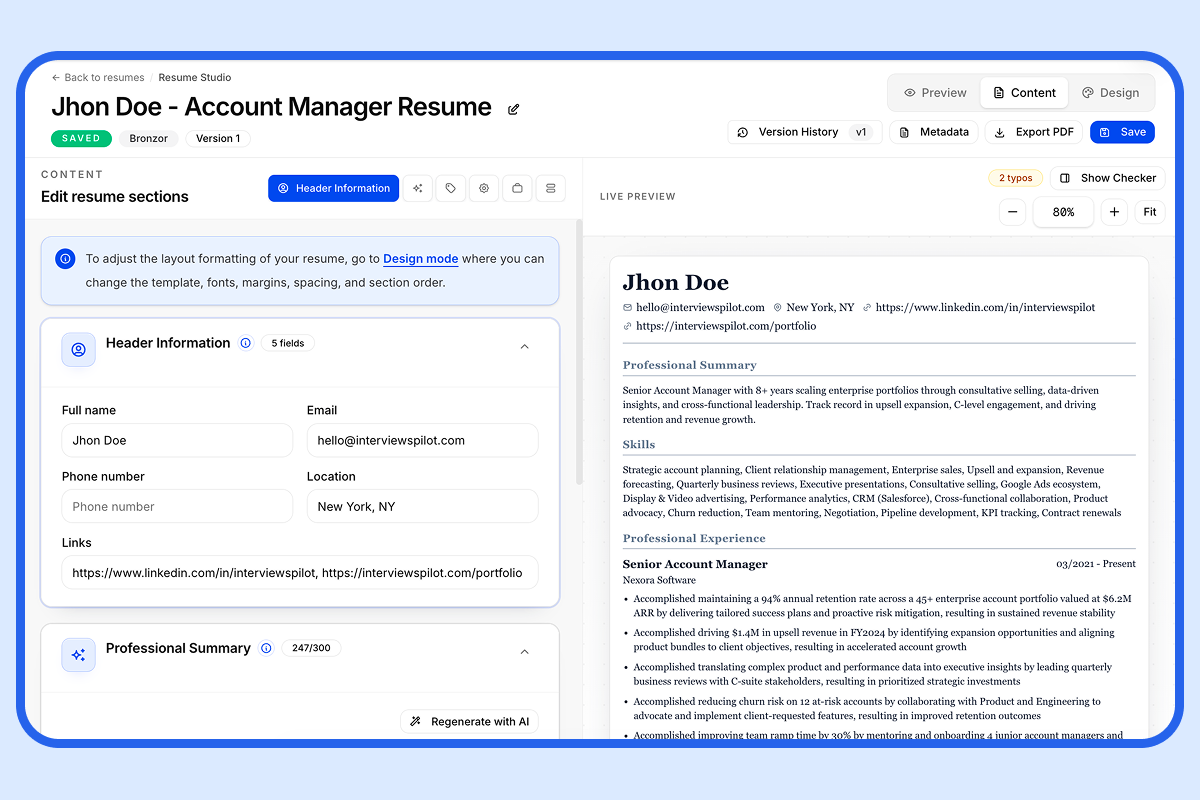
AI Resume Builder
Stop sending the same resume to every job
Paste any job description and InterviewsPilot rewrites your resume around it — keywords, bullets, and summary aligned to what recruiters are actually scanning for.
What contact information should I include on my resume?
Incomplete or incorrect contact information is a surprisingly common and fatal error. Your resume must include:
- Full Name (as it appears professionally)
- Phone Number (with voicemail set up professionally)
- Professional Email Address (use a simple variant of your name, e.g., first.last@gmail.com)
- City and State (Full street address is no longer necessary)
- LinkedIn Profile URL (Customize your public URL and ensure your profile is updated and consistent with your resume)
- Portfolio or Personal Website URL (If relevant to your field)
Omitting your location can raise red flags for location-based searches in an ATS, and not including your LinkedIn profile misses a key opportunity to provide a richer narrative of your career.
How can I optimize my resume for ATS systems?
ATS optimization is non-negotiable for most corporate roles. Your goal is to make your resume easily parsable and relevant.
Core ATS Optimization Checklist:
| Do | Don't |
|---|---|
| Use standard, clean section headings (e.g., "Work Experience," "Skills," "Education"). | Use fancy graphics, icons, or text boxes. |
Submit as a .docx or .pdf file (check job posting instructions). | Use headers or footers for critical info (some systems can't read them). |
| Incorporate keywords from the job description naturally into your summary and bullet points. | "Keyword stuff" by creating a hidden block of text or listing irrelevant terms. |
| Use standard fonts (e.g., Arial, Calibri, Times New Roman). | Use custom or decorative fonts. |
| Spell out acronyms on first use (e.g., "Key Performance Indicator (KPI)"). | Assume the ATS knows every acronym in your industry. |
Think of the ATS as a gatekeeper that scores your resume on relevance. Your content must be both machine-readable and human-compelling.
What are examples of good resume bullet points with metrics?
Metrics transform subjective claims into objective evidence. They answer the "so what?" for every task you list.
By Function:
- Sales: "Exceeded annual sales quota by 125% for three consecutive years, securing 15+ new enterprise accounts worth an average of $50K in annual contract value."
- Marketing: "Launched an email nurture campaign that increased click-through rates by 22% and contributed to a 15% rise in marketing-sourced revenue."
- Operations: "Streamlined the vendor onboarding process, reducing average completion time from 14 days to 5 days and cutting administrative costs by $18,000 annually."
- Customer Service: "Managed a team of 12 support agents, improving average customer satisfaction (CSAT) scores from 88% to 95% within one fiscal year."
- Project Management: "Led the cross-functional rollout of a new CRM, completing the project 2 weeks ahead of schedule and 10% under the $200K budget."
The key is to quantify your impact wherever possible—using percentages, dollar amounts, timeframes, or scale counts. If hard numbers aren't available, use qualitative metrics like "recognized for..." or "selected to..." to indicate esteem.
Final Checklist: Before You Hit "Submit"
Run through this final audit to ensure your resume avoids the biggest mistakes:
- Contact Info: Name, phone, email, location (City, State), and LinkedIn URL are present and correct.
- Target Title: The job title you want is clearly stated.
- Professional Summary: A strong, 3-5 line summary replaces any outdated objective statement.
- Achievement-Focused Bullets: Every bullet point under experience starts with a strong action verb and includes a quantifiable result or clear outcome.
- Keyword Alignment: You have naturally integrated key terms and skills from the job description.
- Spelling & Grammar: The document has been proofread aloud and by another person. Zero errors.
- Formatting: Clean, simple layout with standard headings. No graphics, columns, or unusual fonts that could break ATS parsing.
- Tailoring: The resume is specifically customized for this role and company.
By systematically avoiding these common yet critical mistakes, you transform your resume from a simple list of jobs into a compelling case for your next career opportunity. The goal is not just to be considered, but to be shortlisted.
Explore this category
Resume
Browse the full resume category for more related playbooks, examples, and tactical guides.
Browse Resume articles →One workflow. Resume to offer.
Build ATS-ready resumes, track every application, and practice interviews — all in one place. Free to start, no credit card needed.
✓ Free plan forever · ✓ No card needed
Related articles
How Long Should a Resume Be? The Definitive, Data-Backed Guide for 2026
Forget rigid rules. The ideal resume length is determined by your experience, industry, and the ATS. This guide provides clear, evidence-based guidelines for entry-level to executive professionals.
How Many Bullet Points per Job on Resume? A Practical Guide
The usual rule is 3 to 5 bullet points per job on a resume. This guide shows when to use fewer or more, how to prioritize recent roles, and how to write bullets that are clear, results-driven, and ATS-friendly.
How to Tailor Your Resume to a Job: Step-by-Step Tips, Examples, and ATS Optimization
Tailoring your resume is one of the most effective ways to improve your odds of getting noticed. This guide shows you how to analyze a job description, rewrite your summary and bullets, and optimize your resume for ATS and recruiters with clear examples and a simple checklist.