





Tailoring your resume to a job is one of the highest-impact actions you can take during a job search. Instead of sending the same document to every employer, you adjust your resume to match the role, the job description, and the language the company uses. That makes it easier for applicant tracking systems (ATS) to recognize your fit and for recruiters to quickly see why you belong on the shortlist.
What does it mean to tailor your resume to a job?
Tailoring your resume means customizing the content so it reflects the specific skills, experience, and outcomes a hiring team wants for one role. You are not inventing new experience. You are choosing what to emphasize, what to reorder, and what language to use so your background lines up with the opening.
A tailored resume usually includes:
- A targeted title or headline
- A summary written for the role
- Keywords pulled from the job description
- Skills grouped by relevance
- Work experience bullets reordered for fit
- Quantified achievements that mirror the employer’s priorities.
The goal is simple: make it obvious that you are a strong match.
Why is tailoring your resume important?
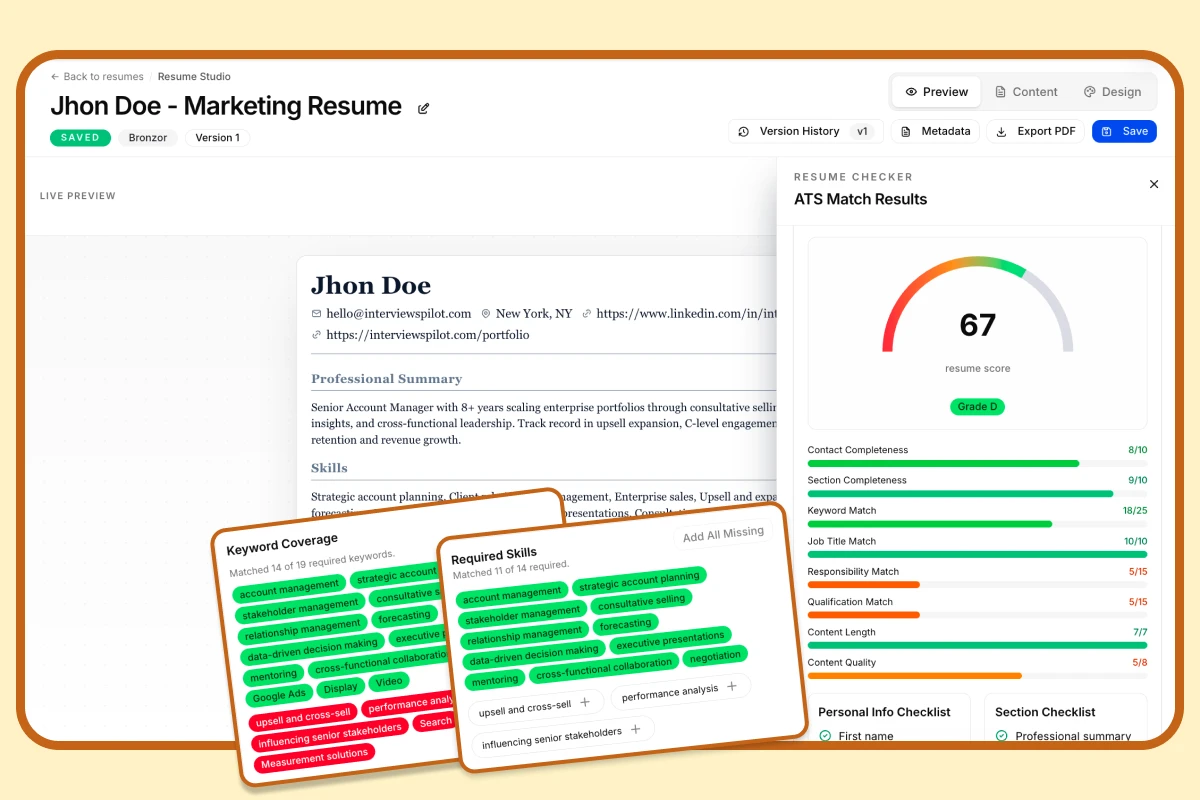
Most employers use ATS software to screen applications before a person sees them. If your resume does not contain the right terms or is formatted poorly, it may never reach a recruiter. Even when a human reviews it, a generic resume can look unfocused compared with one that speaks directly to the role.
InterviewsPilot and other career resources emphasize a data-backed point: tailored resumes perform better than generic ones because they align more closely with job descriptions and recruiter expectations. The practical takeaway is that customization is not optional if you want to improve response rates.
How do you analyze a job description?
Start with the job posting and treat it like a checklist.
- Highlight repeated terms. Words that appear more than once are usually important.
- Identify hard skills. Look for software, tools, methods, certifications, and technical requirements.
- Note soft skills carefully. Collaboration, communication, leadership, and problem-solving often matter just as much.
- Separate required from preferred. Required items should appear prominently in your resume if you genuinely have them.
- Look for the business goal. Is the company hiring to grow revenue, improve operations, support customers, or manage risk?
What keywords should you pull from the posting?
Use the exact language from the listing whenever possible. For example, if the job says “statistical analysis,” include that phrase instead of substituting only “data analysis.” If it says “cross-functional collaboration,” use that wording in at least one relevant bullet if it fits your experience.
This matters for both ATS resume optimization and recruiter scanning.
Free ATS Score
Your resume might be invisible to recruiters
Most resumes are filtered out before a human ever sees them. Get your free ATS score and see exactly where your resume falls short — before you hit send.
How should you structure a tailored resume?
A reverse-chronological resume is still the safest format for most applicants, but the way you write each section should change based on the role.
| Resume Section | How to Tailor It |
|---|---|
| Headline / Title | Match the target role as closely as truthfully possible. |
| Summary | Write 2–3 lines that reflect the employer’s priorities. |
| Skills | Include the most relevant keywords from the job description. |
| Experience | Put the strongest match first in each job entry. |
| Education / Certifications | Surface required or preferred credentials early. |
What belongs in the summary section?
Your summary should answer one question: “Why are you a fit for this role?”
Example summary for a marketing role:
Marketing professional with 5+ years of experience creating data-informed campaigns, improving engagement, and supporting cross-functional teams. Skilled in content strategy, campaign analysis, and stakeholder communication.
That is much stronger than a generic statement like “Hardworking professional seeking new opportunities.”
How do you tailor your experience section?
Your work history should be edited with the target job in mind.
What should you do with bullet points?
- Move the most relevant bullets to the top
- Rewrite bullets to emphasize the same skills the employer wants
- Include numbers, percentages, budgets, timeframes, or volume where possible
- Use action verbs that show ownership and impact
Generic vs tailored resume examples
Generic bullet point:
Managed social media accounts.
Tailored example for a Social Media Manager role:
Developed and executed a content calendar that increased Instagram engagement by 45% and grew followers by 12,000 in six months.
Tailored example for a Brand Marketing role:
Aligned social media strategy with brand campaigns, contributing to a 15% increase in brand sentiment among target audiences.
These examples show how the same experience can be framed differently depending on the job.
How do you optimize a resume for ATS?
ATS optimization is about making your resume easy for software to read and match.
ATS resume optimization tips
- Use standard section headings such as Work Experience, Skills, and Education
- Avoid tables, text boxes, icons, and complex graphics
- Save and submit the file type the employer prefers
- Include keywords naturally in context, not only in a keyword list
- Use the exact wording from the job description when it fits your experience
- Keep formatting clean and consistent
What should you avoid?
Do not keyword stuff your resume. Overloading it with repeated phrases can hurt readability and may look unnatural to recruiters. The best resumes balance keyword match with clear, credible writing.
How do you tailor your resume for recruiters too?
An ATS-friendly resume still needs to impress a human.
Recruiters often spend only a few seconds on an initial scan, so your resume should make relevance obvious fast.
Focus on:
- Clear formatting
- Strong action verbs
- Quantified achievements
- Relevant accomplishments near the top
- Easy-to-read spacing and consistent style
A recruiter should be able to understand your fit almost immediately.
AI Resume Builder
Stop sending the same resume to every job
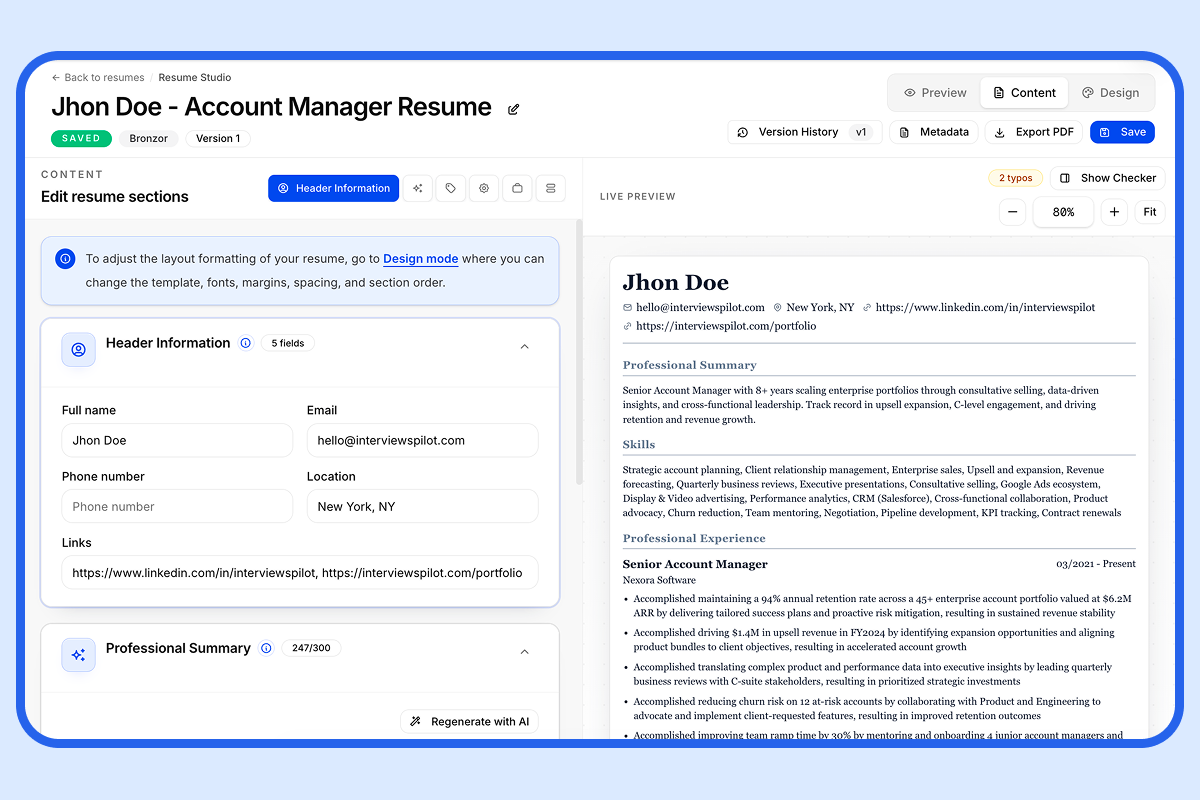
Paste any job description and InterviewsPilot rewrites your resume around it — keywords, bullets, and summary aligned to what recruiters are actually scanning for.
What is a simple step-by-step process for tailoring your resume?
Here is a practical process you can repeat for each application.
- Start with a master resume. Keep a full version of your background in one place.
- Study the job description. Pull out the required skills, tools, and responsibilities.
- Create a copy for that application. Never edit your master file directly.
- Rewrite the summary. Make it specific to the role.
- Update the skills section. Place the most relevant keywords first.
- Reorder experience bullets. Lead with the most relevant accomplishments.
- Quantify results. Add numbers wherever you can.
- Check for language match. Use the company’s terminology when appropriate.
- Proofread carefully. Confirm names, dates, formatting, and attachments.
What are common mistakes when tailoring a resume?
Here are some of the most common errors:
- Sending the same resume to every employer
- Ignoring keywords in the job description
- Using vague bullets with no measurable outcomes
- Failing to update the summary
- Overloading the document with jargon
- Using a format that ATS cannot read well
- Forgetting to rename the file before submitting it
What are examples of strong tailoring choices?
Example 1: Data analyst role
If a posting emphasizes SQL, dashboards, and reporting, your resume should surface those tools early and highlight projects with measurable insights.
Example 2: Project manager role
If the job stresses timelines, cross-functional collaboration, and stakeholder communication, your bullets should focus on delivery, coordination, and results.
Example 3: Customer support role
If the listing emphasizes response time, satisfaction scores, and problem resolution, your experience should show service metrics and customer outcomes.
In each case, the best version of your resume is the one that mirrors the job’s priorities most clearly.
How do you know if your resume is tailored well enough?
Use this quick self-check:
- Does the summary reflect the target job?
- Are the most important keywords included naturally?
- Do the top bullets in each role match the posting?
- Is the format clean and ATS-friendly?
- Can a recruiter understand your fit in seconds?
If the answer to most of these is yes, your resume is in good shape.
Final takeaway
Tailoring your resume to a job is not about rewriting your entire career story for every application. It is about making smart, strategic edits so the most relevant parts of your background are easy to see, easy to scan, and easy to match to the role.
If you consistently analyze each job description, use the right keywords, and highlight measurable results, you will create stronger applications and improve your chances of getting interviews.
Explore this category
Resume
Browse the full resume category for more related playbooks, examples, and tactical guides.
Browse Resume articles →One workflow. Resume to offer.
Build ATS-ready resumes, track every application, and practice interviews — all in one place. Free to start, no credit card needed.
✓ Free plan forever · ✓ No card needed
Related articles
The Biggest Resume Mistakes to Avoid: A 2026 Pragmatic Playbook
Your resume is your first interview. Avoid the common pitfalls—from missing contact details to vague duties—that get your application instantly rejected. This playbook details the biggest mistakes and provides clear, actionable solutions to craft a resume that gets noticed.
How Long Should a Resume Be? The Definitive, Data-Backed Guide for 2026
Forget rigid rules. The ideal resume length is determined by your experience, industry, and the ATS. This guide provides clear, evidence-based guidelines for entry-level to executive professionals.
How Many Bullet Points per Job on Resume? A Practical Guide
The usual rule is 3 to 5 bullet points per job on a resume. This guide shows when to use fewer or more, how to prioritize recent roles, and how to write bullets that are clear, results-driven, and ATS-friendly.