





What is the PAR Method?
The PAR Method is a structured, three-component framework designed to help job candidates articulate their professional achievements with clarity and impact. It stands for Problem, Action, and Result. Unlike more complex models, PAR provides a straightforward template for crafting resume bullet points, answering behavioral interview questions, and building a narrative of tangible success in your cover letters and career conversations.
For related next steps, use ATS optimization checklist.
Why is the PAR Method Important for Interviews?
Interviewers use behavioral questions to predict future performance. They want evidence of how you think, act, and deliver. The PAR Method provides that evidence in a digestible story. It forces you to move beyond listing generic duties (“managed a team”) to showcasing specific instances where you identified a challenge, took initiative, and created value. This shift from responsibilities to achievements is what makes candidates stand out.
Answer-First Summary: The PAR Method is a career tool used to structure stories of professional achievement. By framing an answer around a specific Problem, the Actions you took to address it, and the quantifiable Results of those actions, you provide interviewers with concrete proof of your skills and impact, significantly improving your performance in behavioral interviews.
How Does the PAR Method Differ from the STAR Method?
You may have heard of the STAR method (Situation, Task, Action, Result). While both are excellent frameworks, PAR is often praised for its simplicity and efficiency. STAR’s four components can sometimes lead to redundancy, as the “Situation” and “Task” often describe the same context. PAR condenses this into a single “Problem” (or “Project”) component, creating a more streamlined and focused narrative. This makes it easier to recall and apply during high-pressure interviews, and often leads to more concise, punchy answers that keep the interviewer engaged.
When Should You Use the PAR Method vs. STAR?
Choosing between PAR and STAR is a matter of preference and context.
- Use PAR when you want a faster, more direct framework. It’s excellent for resume bullet points, quick interview answers, and when the “task” within a situation is inherently obvious (the problem itself defines the task).
- Use STAR when the interviewer’s question explicitly sets up a complex “Situation” that requires separate explanation from the “Task” you were assigned within it. STAR can provide more narrative depth for very intricate scenarios.
Ultimately, both frameworks aim for the same goal: a structured story ending with a measurable result. PAR is the streamlined version.
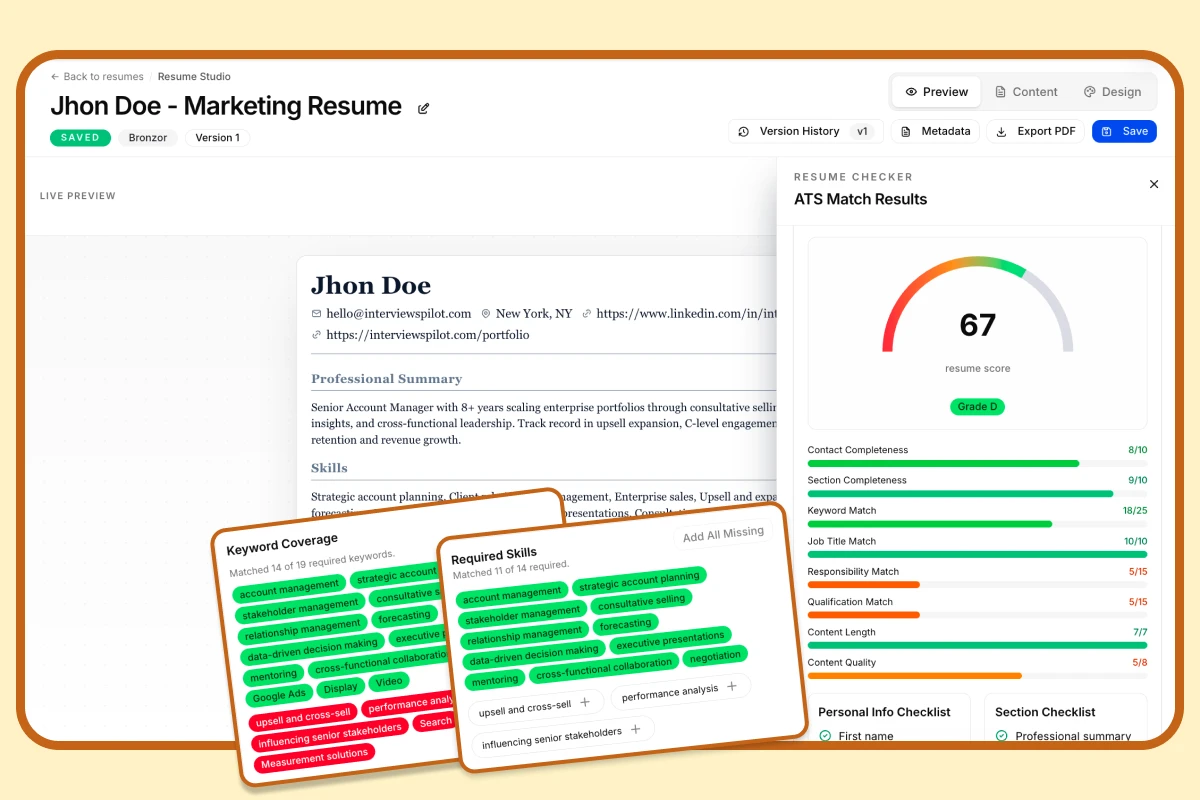
Free ATS Score
Your resume might be invisible to recruiters
Most resumes are filtered out before a human ever sees them. Get your free ATS score and see exactly where your resume falls short — before you hit send.
How to Structure a PAR Response for a Behavioral Interview Question
Let’s break down the three components with an example. Imagine an interviewer asks: “Tell me about a time you improved a process.”
- Problem (P): Define the specific challenge or opportunity. Be concise.
- Example: “Our manual client onboarding process was taking 10 days per client, causing frustration and delaying revenue.”
- Action (A): Describe the specific steps you took. Use active verbs and focus on your contribution.
- Example: “I led a project to map the workflow, identified three redundant approval steps, and designed a new digital checklist system using our existing CRM. I coordinated with the sales and legal teams to implement it.”
- Result (R): State the measurable outcome. Quantify everything possible.
- Example: “The new process cut onboarding time to 3 days, a 70% reduction. This improved client satisfaction scores by 40% and allowed the team to onboard 15 more clients per quarter.”
This structure ensures your answer is logical, evidence-based, and memorable.
Can You Reorder the PAR Components?
While the P-A-R sequence is the standard and most logical flow (challenge → solution → outcome), you can adapt it for different mediums.
- In a Resume Bullet Point: You might start with the Result to grab attention, then briefly explain the Problem and Action.
- Example: “Reduced client onboarding time by 70% by analyzing a manual 10-day process and implementing a digital checklist system.”
- In an Interview Answer: Stick to the classic P-A-R order. It builds a natural story that is easy for the interviewer to follow.
The framework is flexible, but the core elements must always be present and clear.
What Makes a Strong “Result” Component?
The “Result” is the payoff. A strong result is:
- Quantified: Use numbers, percentages, timeframes, and dollar amounts.
- Specific: Avoid vague claims like “improved efficiency.” Say “increased output by 25%.”
- Meaningful: Connect the result to a business goal (revenue, cost savings, customer satisfaction, risk reduction).
- Attributable: Clearly link the result to your actions.
If a result isn’t inherently numerical, find a way to quantify it. For example, “improved team morale” can become “reduced voluntary team turnover by 15% and increased employee satisfaction survey scores by 2 points.”
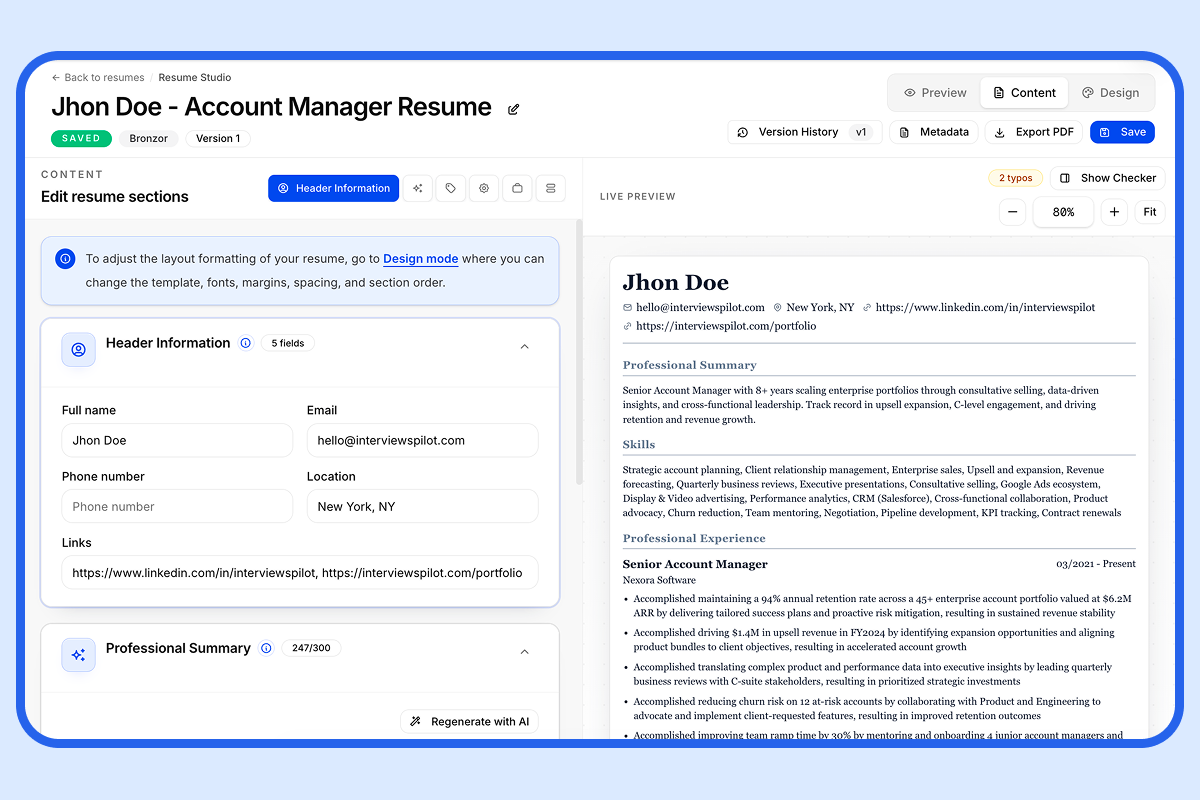
AI Resume Builder
Stop sending the same resume to every job
Paste any job description and InterviewsPilot rewrites your resume around it — keywords, bullets, and summary aligned to what recruiters are actually scanning for.
How Many PAR Examples Should You Prepare?
Before an interview, prepare 3-5 strong PAR stories that cover different core competencies. Tailor these to the job description. One story might showcase leadership, another problem-solving, a third project management. With 3-5 well-prepared examples, you can adapt and pivot them to answer a wide variety of behavioral questions, ensuring you’re never caught without a relevant, structured answer.
Is the PAR Method Suitable for All Jobs and Industries?
Yes. The PAR framework is universal because it describes the fundamental cycle of work: identify a issue, intervene, and create an outcome. It is effective for:
- Leadership Roles: Demonstrating strategic impact and decision-making.
- Technical Roles: Showcasing problem-solving and innovation.
- Creative Roles: Highlighting project execution and audience impact.
- Early-Career Roles: Proving initiative and learning agility even with smaller-scale problems.
The scale of the “Problem” and “Result” will vary, but the structure remains powerfully applicable.
How to Quantify Results When They Aren’t Numerical
Not all outcomes are hard numbers. Use these techniques to quantify softer results:
| Soft Result | Quantification Technique |
|---|---|
| Improved Communication | Number of conflicts resolved, feedback scores from surveys, stakeholder testimonials. |
| Enhanced Team Morale | Reduction in turnover rate, increase in engagement survey metrics, number of positive recognition events initiated. |
| Strengthened Client Relationship | Renewal rate increase, expansion of contract scope, direct positive feedback quoted. |
| Developed a New Process | Time saved per instance, number of people adopting it, error rate reduction. |
Always ask yourself: “What measurable change occurred because of my action?”
Can the PAR Method Be Used in Cover Letters?
Absolutely. A cover letter is your first narrative. Using a PAR statement can instantly demonstrate your value.
- Structure: Briefly describe a Problem relevant to the target company, outline your proven Action skills, and cite a past Result that proves you can deliver what they need.
- Example: “I understand your company is looking to reduce customer churn. When I faced similar retention challenges, I analyzed feedback data and redesigned the support escalation pathway, which increased customer retention by 18% within six months.”
This moves the letter from “I have skills” to “I have solved your type of problem before.”
Final Checklist: Implementing the PAR Method
To successfully use the PAR Method:
- Audit Your Career: Identify 5-7 key achievements from your past roles.
- Frame Each as PAR: Write them out using the Problem, Action, Result structure.
- Quantify: Scrutinize each Result line and add numbers wherever possible.
- Adapt for Resume: Condense your best PAR stories into powerful bullet points.
- Prepare for Interviews: Memorize the narrative flow of your 3-5 key stories.
- Practice: Answer common behavioral questions aloud using your PAR framework.
By adopting the PAR Method, you equip yourself with a clear, compelling way to communicate your professional worth. It turns your experience into evidence, making you a more confident and competitive candidate.
Explore this category
Resume
Browse the full resume category for more related playbooks, examples, and tactical guides.
Browse Resume articles →One workflow. Resume to offer.
Build ATS-ready resumes, track every application, and practice interviews — all in one place. Free to start, no credit card needed.
✓ Free plan forever · ✓ No card needed
Related articles
The SAR Method: A Concise Framework for Impactful Resumes and Interviews
The SAR Method is a streamlined framework for structuring professional achievements. By focusing on Situation, Action, and Result, it helps you transform generic duties into compelling evidence of your skills and impact, making it ideal for resumes and concise interview responses.
The Biggest Resume Mistakes to Avoid: A 2026 Pragmatic Playbook
Your resume is your first interview. Avoid the common pitfalls—from missing contact details to vague duties—that get your application instantly rejected. This playbook details the biggest mistakes and provides clear, actionable solutions to craft a resume that gets noticed.
Chronological Resume: Structure, Examples, Tips, and ATS Optimization
A chronological resume presents your work history in reverse-chronological order, making it the standard choice for professionals with steady career growth. This guide explains the format, compares it with functional and hybrid resumes, and shows how to optimize every section for recruiters and ATS software.