





Answer-First Summary: The SAR Method (Situation, Action, Result) is a concise three-part framework for writing achievement-focused resume bullets and answering behavioral interview questions. Use it by naming the challenge, explaining the action you personally took, and ending with a measurable result. It is especially useful when you need a shorter alternative to STAR.
In the competitive landscape of job hunting, how you articulate your experience can be the difference between landing an interview and being overlooked. The SAR Method (Situation, Action, Result) is a powerful, streamlined framework designed to help you do just that. It transforms vague job descriptions into clear, compelling narratives of your professional impact, making it an essential tool for both resume writing and interview preparation.
What is the SAR Method and how does it differ from the STAR Method?
The SAR Method is a three-part structure for communicating professional achievements. It breaks down as follows.
- Situation: The context or challenge you faced. This sets the stage by describing the specific circumstances, problem, or environment.
- Action: The specific steps you took to address the situation. This focuses on your personal initiative, skills, and decision-making process.
- Result: The quantifiable or qualitative outcome of your actions. This highlights the impact, value, or benefit you delivered.
This framework is often compared to the more widely known STAR Method (Situation, Task, Action, Result). The key difference is the omission of the "Task" component. While STAR asks you to explicitly state the assigned duty or objective ("My task was to..."), SAR moves directly from the Situation to your Action. This creates a more direct and concise narrative that emphasizes your proactive contributions over a passive description of responsibilities. The STAR method's detailed structure is excellent for longer-form behavioral interview answers, whereas SAR's brevity is particularly effective for resume bullet points where space is at a premium; MIT CAPD's STAR method overview is a useful reference for the fuller behavioral storytelling version.
Free ATS Score
Your resume might be invisible to recruiters
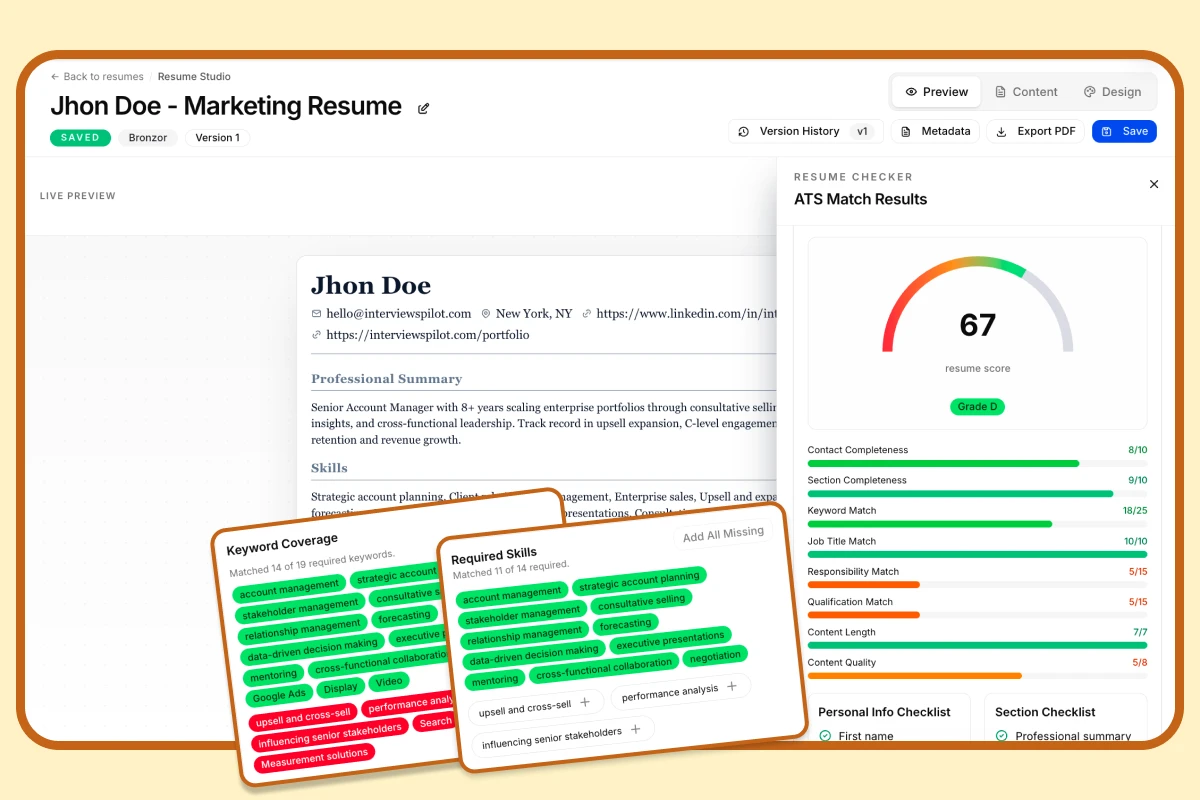
Most resumes are filtered out before a human ever sees them. Get your free ATS score and see exactly where your resume falls short — before you hit send.
How do you structure a SAR statement for resume bullet points?
Using the SAR Method on your resume is about converting a simple duty into a demonstrated achievement. A strong SAR bullet point is active, specific, and results-oriented.
Formula: Action Verb + Specific Action + to achieve/address + Quantifiable Result.
Here is a comparison of a weak duty statement versus a strong SAR-formatted achievement:
| Weak Duty Statement | Strong SAR Achievement |
|---|---|
| Responsible for social media content. | Situation: Low audience engagement on company social channels. Action: Researched platform algorithms and developed a data-driven content calendar focused on video and interactive polls. Result: Increased follower growth by 40% and boosted post engagement by 150% within one quarter. |
| Handled customer service inquiries. | Situation: Faced recurring customer complaints about a software bug. Action: Documented issue patterns, collaborated with the engineering team to prioritize a fix, and created a proactive communication template for affected users. Result: Reduced related support tickets by 80% and improved customer satisfaction scores by 25 points. |
As demonstrated, the SAR structure forces you to answer the critical question: "So what?" It provides the evidence of your capability that hiring managers are seeking.
AI Resume Builder
Stop sending the same resume to every job
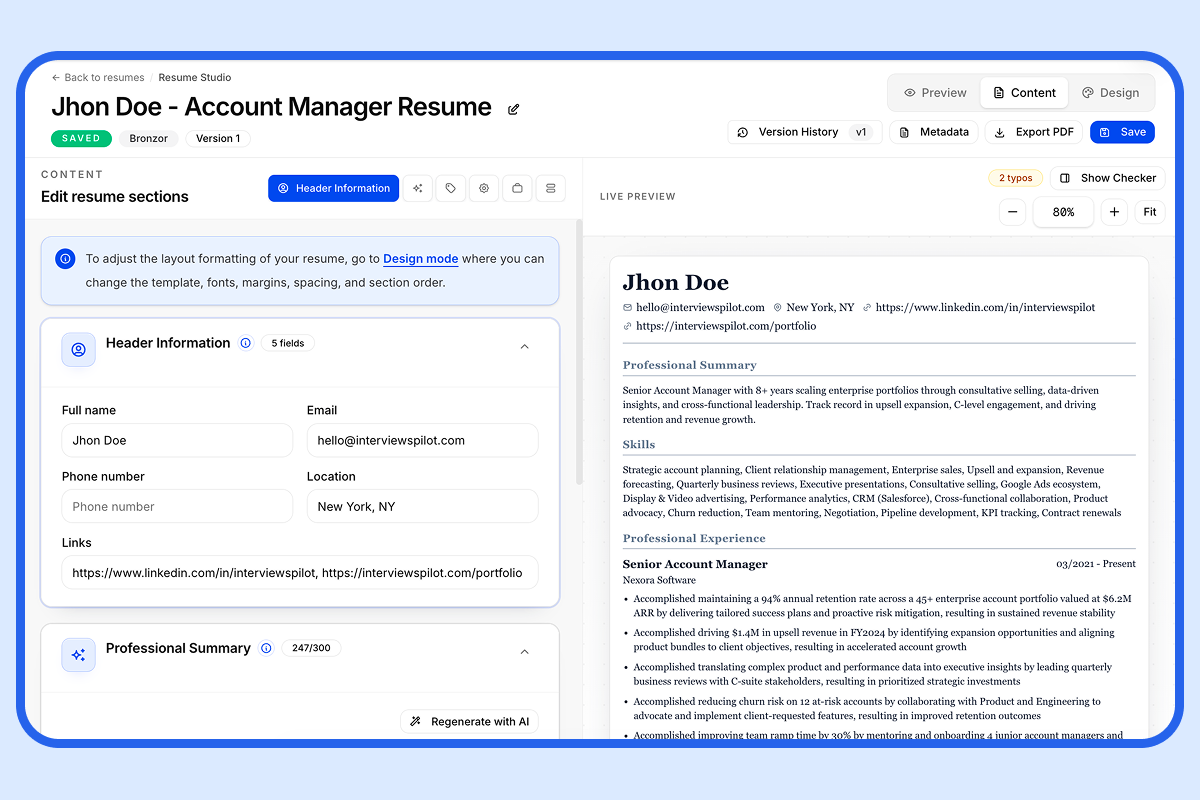
Paste any job description and InterviewsPilot rewrites your resume around it — keywords, bullets, and summary aligned to what recruiters are actually scanning for.
What are examples of the SAR Method in behavioral interviews?
While concise for resumes, the SAR framework can also effectively structure longer interview answers. The principle remains the same, but you expand each section with more narrative detail.
Example Interview Question: "Tell me about a time you improved a process."
- Situation: "In my previous role as an operations coordinator, our team was manually tracking inventory spreadsheets across three warehouses. This led to frequent discrepancies, shipping delays of about 15%, and weekly reconciliation meetings that took hours."
- Action: "I took the initiative to research affordable inventory management software. After presenting a cost-benefit analysis to my manager, I led the implementation of a new cloud-based system. I mapped our old processes to the new software, trained a team of 8 on its use, and created simplified reference guides."
- Result: "Within two months, we eliminated the manual spreadsheets. Inventory accuracy improved to 99.8%, shipping delays were reduced by 90%, and those weekly meetings were cut down to a 15-minute check-in. This saved the team an estimated 20 hours of administrative work per week."
This answer follows the SAR flow: it establishes a clear problem, details your specific and leadership-oriented actions, and concludes with strong, measurable outcomes. Resources like the Utah Department of Workforce Services provide similar structured examples for interview preparation.
Why use SAR over STAR for resumes?
The choice between SAR and STAR often comes down to format and focus. Here’s why SAR is frequently the superior choice for your resume:
- Conciseness: Resume real estate is precious. Removing the explicit "Task" statement allows you to start with your action verb and impact faster, packing more value into a single line.
- Emphasis on Proactivity: SAR inherently highlights what you did. By moving from Situation straight to Action, it frames you as a problem-solver who took initiative, rather than someone who simply completed an assigned task.
- Results-Driven: The structure naturally culminates in the Result, ensuring every bullet point ends with a punchy, impactful statement of your contribution. This aligns perfectly with what hiring managers scan for: evidence of performance and value.
For a detailed, step-by-step narrative in an interview, the STAR method (as recommended by sources like MIT and Harvard Business Review) provides a comprehensive structure to fully explain your thought process. SAR is the distilled, high-impact version for your written application.
How is the SAR Method integrated into modern career tools?
The principles of the SAR Method are increasingly baked into career technology designed to help job seekers. For instance, AI-powered resume builders utilize this framework to help users generate stronger bullet points. By prompting you for the Situation/Action/Result components, these tools guide you in transforming basic responsibilities into achievement-oriented statements. This integration underscores the method's practical utility in the contemporary job search, providing a structured approach to a critical task. Similar frameworks, like the CAR (Challenge, Action, Result) method, are also used in coaching and video content, highlighting the universal appeal of this action-result narrative structure.
Key Advantages and Considerations
Advantages of the SAR Method:
- Demonstrates Problem-Solving: It showcases your ability to analyze a situation and take effective action.
- Provides Concrete Evidence: It moves beyond claims ("I'm a good leader") to proof ("I led X which resulted in Y").
- Engages the Reader: A well-crafted SAR story is more compelling to read than a list of duties.
- Versatile: It's effective for resumes, cover letters, LinkedIn profiles, and interview answers.
Consideration:
- The primary trade-off for conciseness is the potential de-emphasis of the specific task or goal you were given. In some contexts, clarifying the original objective (as in STAR) is important. Always tailor your approach to the medium and the story you need to tell.
In summary, the SAR Method is a pragmatic, powerful tool for any professional. By forcing you to articulate the challenge, your action, and the resulting impact, it ensures your experience is presented not as a list of past duties, but as a portfolio of future potential. Whether you're refining your resume or preparing for your next behavioral interview, applying the SAR structure will bring clarity, focus, and undeniable impact to your professional narrative.
Explore this category
Resume
Browse the full resume category for more related playbooks, examples, and tactical guides.
Browse Resume articles →One workflow. Resume to offer.
Build ATS-ready resumes, track every application, and practice interviews — all in one place. Free to start, no credit card needed.
✓ Free plan forever · ✓ No card needed
Related articles
The PAR Method: A Practical Framework for Interview Success
The PAR Method is a three-part framework for structuring your professional achievements. By clearly defining a Problem, detailing your Actions, and quantifying the Results, you can create concise, powerful narratives that impress recruiters and hiring managers.
The Complete Guide to Behavioral Interview Questions: How to Prepare and Answer with Confidence
Behavioral interview questions are a critical part of the hiring process, designed to predict your future performance based on past experiences. This guide breaks down the most common types, provides actionable strategies for crafting compelling answers, and helps you turn interview anxiety into confidence.
The Biggest Resume Mistakes to Avoid: A 2026 Pragmatic Playbook
Your resume is your first interview. Avoid the common pitfalls—from missing contact details to vague duties—that get your application instantly rejected. This playbook details the biggest mistakes and provides clear, actionable solutions to craft a resume that gets noticed.