





The Salary Expectations Interview question can feel tricky because it often comes early, before you have full context about the role or the offer. The good news: with the right preparation, you can answer clearly, protect your value, and keep the conversation moving.
For related next steps, use common interview questions guide, behavioral interview questions guide, situational interview questions guide, tell me about yourself guide, professional introduction examples, greatest strengths answer guide, and weakness interview question guide.
This guide covers Salary Expectations Interview examples, practical Salary Expectations Interview tips, and the job interview preparation steps that help you respond with confidence.
Quick Answer: What Should You Say?
When asked about salary expectations, your best move is usually to avoid naming a number too early. Instead, try to.
- Learn more about the role
- Ask for the budgeted range if appropriate
- Use market research to guide your answer
- Share a narrow, realistic range only when needed.
If you must give a number, base it on your experience, location, and the role’s responsibilities.
Why Do Employers Ask About Salary Expectations?
Employers ask this question to see whether your expectations fit their budget and to understand how you value the role. It can also help them assess how well you understand the market.
Your goal is not just to answer quickly. Your goal is to answer in a way that keeps you in consideration for the job while preserving room to negotiate.
How Should I Prepare Before the Interview?
Good job interview preparation makes this question easier to handle. Before the interview, gather:
- A target salary range based on your experience
- Market data for your role and location
- Details about bonuses, equity, and benefits
- Your minimum acceptable offer
- A fallback response if the interviewer pushes for a number
Research tools such as CareerOneStop's salary finder, employer-posted ranges, and public labor-market data can help you build a realistic target.
What Salary Expectations Interview Examples Can I Use?
Here are flexible response examples you can adapt to your situation.
Example 1: Early in the process
"I’m excited to learn more about the role before discussing salary. Could you share the range budgeted for this position?"
Example 2: When asked directly by a recruiter
"Based on my research and experience, I’m targeting a base salary in the range of $X to $Y, depending on the full compensation package."
Example 3: When you want to defer
"I’d like to understand the responsibilities and expectations a bit better before naming a number. What range have you set for this role?"
Example 4: When you already know the posted range
"I saw that the posted range is $X to $Y. Based on my background and the scope of the role, I’d be looking toward the higher end of that range."
Example 5: When speaking with a hiring manager
"I’m very interested in the impact I could make here. I’d be open to discussing a competitive package that reflects the role, team goals, and overall compensation structure."
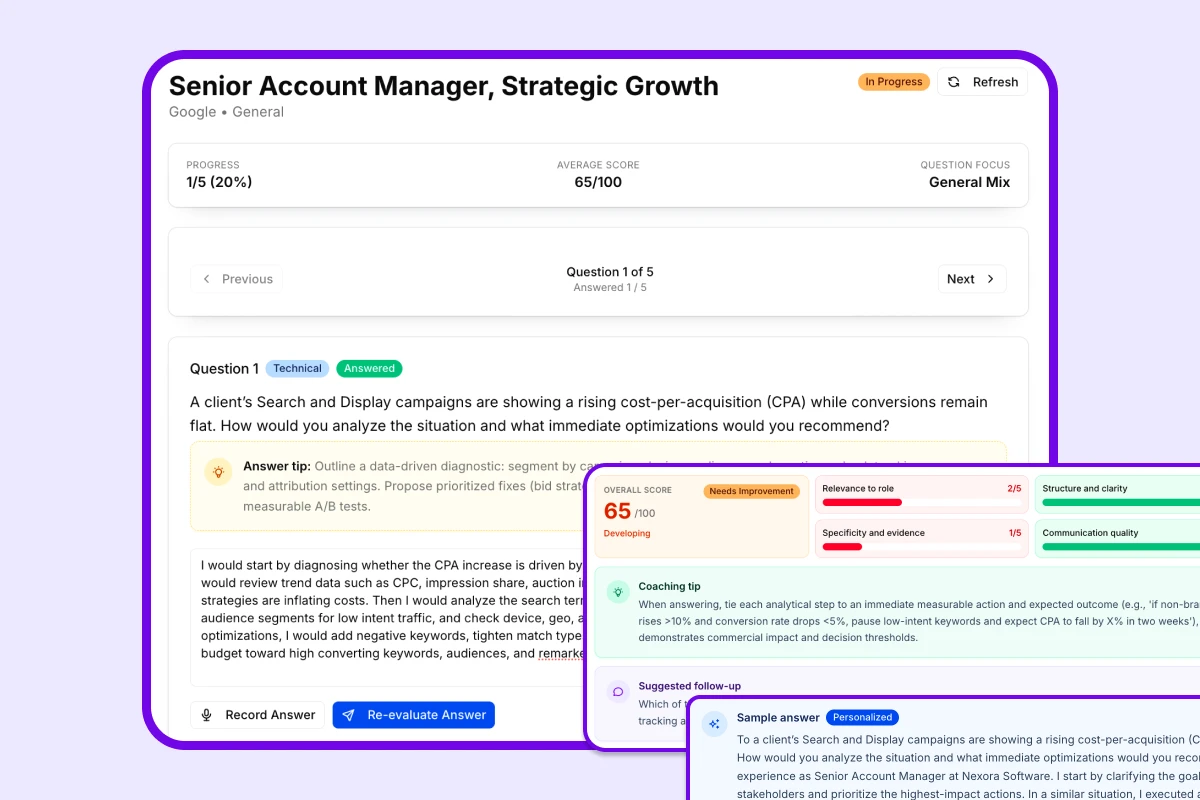
AI Interview Prep
Got the interview? Now make sure you're ready.
Practice the exact questions likely to come up for your target role. Get scored on clarity, structure, and relevance — so you walk in sharp, not winging it.
How Do I Answer Based on Who Is Asking?
Different interviewers have different goals, so your answer should change slightly.
Recruiter
Recruiters often want to know whether you fit the budget.
Try:
"I’d love to learn more about the full scope first, but I’m generally targeting a range of $X to $Y. Does that align with the budget for this role?"
Hiring Manager
Hiring managers care about the value you can bring.
Try:
"I’m focused on finding the right fit for the role and the team. I’m confident we can align on compensation once we’ve discussed the scope in more detail."
HR or Internal Recruiter
HR may be handling process and policy.
Try:
"I’m looking for a competitive offer that matches the role, location, and responsibilities. If you can share the approved range, I can tell you whether we’re aligned."
Should I Give a Number or a Range?
In most cases, a range is safer than a single number.
Use a range when:
- You want flexibility
- You are early in the process
- You are still gathering information
- You expect the employer to make the first concrete offer
Use a single number when:
- You have strong market data
- You already have a competing offer
- You are in late-stage negotiations
- You are certain about your minimum acceptable salary
Keep ranges narrow. For example, a range like $95,000 to $105,000 is clearer than $80,000 to $120,000.
How Do I Research a Realistic Salary Range?
A strong answer depends on good research. Compare at least a few sources so your expectations are grounded in the market.
Helpful sources include:
- Payscale
- Salary.com
- BLS data
- Professional associations
- Current job postings
- Conversations with people in similar roles
Adjust your target based on:
- Location
- Years of experience
- Industry
- Company size
- Required technical or leadership skills
- Total compensation, not just base salary
How Can I Stay Flexible Without Undervaluing Myself?
You do not need to sound rigid to protect your value. A good answer shows openness while still setting boundaries.
You can say:
"I’m flexible, but I’d want the overall package to reflect the role’s responsibilities and current market rates."
Or:
"I’m open to discussion depending on the full compensation structure, including bonus and benefits."
This keeps the conversation collaborative without signaling that you’ll accept anything.
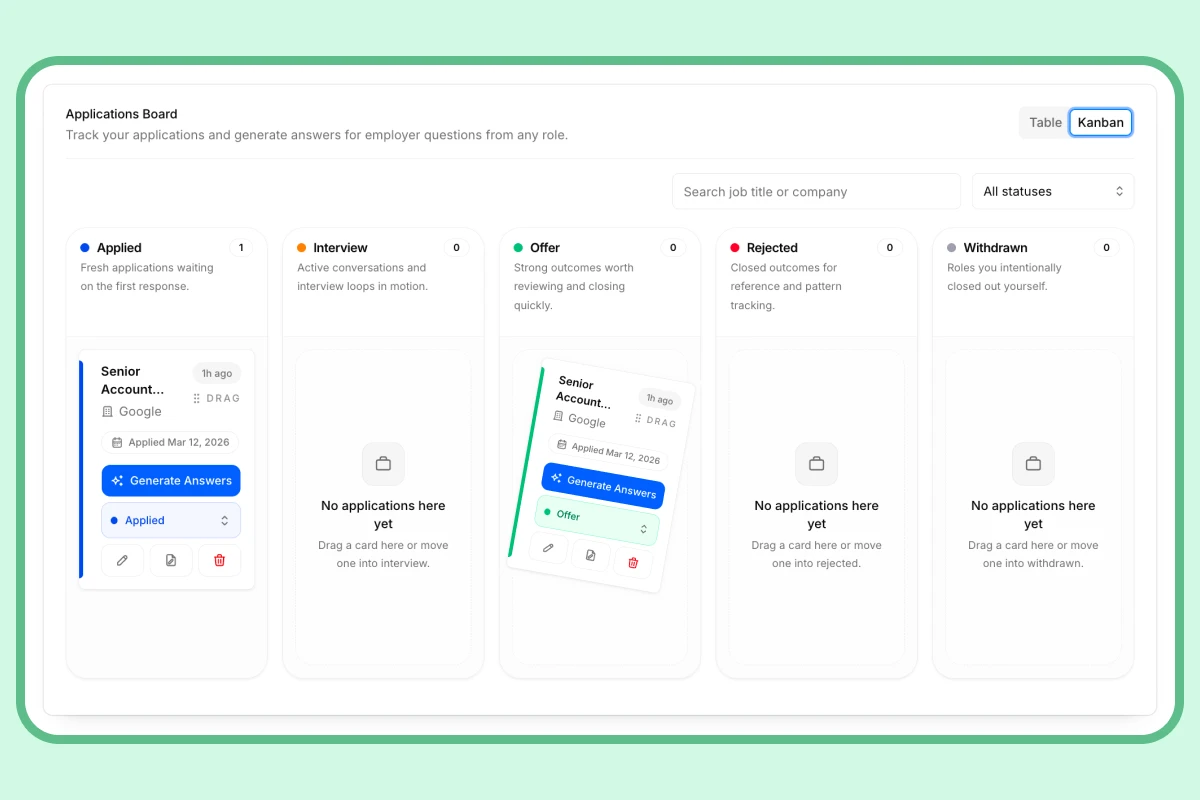
Application Tracker
Applying to 10+ jobs? You need a real system.
No more spreadsheets or lost threads. Track every role, stage, deadline, and follow-up in one dashboard — so you always know exactly where you stand.
What If the Employer Pushes for Salary History?
In some locations, employers are not allowed to ask about salary history. Even where they can, it is often better to redirect the conversation toward the value of the role.
Try:
"I prefer to focus on the market value of this position and the contribution I can make rather than past compensation."
This response is professional, concise, and future-focused.
What Are Common Mistakes to Avoid?
Avoid these common errors in a Salary Expectations Interview:
- Giving a number too early
- Sharing a wide range
- Quoting a figure without research
- Basing your answer only on your last salary
- Forgetting bonuses, equity, and benefits
- Sounding apologetic or uncertain
A clear, calm answer usually works better than an overly detailed explanation.
What If I’m Asked for a Salary Number Before I’m Ready?
If you’re caught off guard, pause and buy time. You can say:
"That’s a great question. I’d like to understand the role a bit better before giving a specific number. Could you share the salary range you’ve budgeted?"
If they insist, provide a researched range and emphasize flexibility based on the full package.
What Is the Best Strategy for 2025?
For 2025, the best strategy is simple:
- Prepare your salary range in advance
- Research current market data
- Tailor your response to the interviewer
- Keep your answer concise
- Focus on total compensation, not only base pay
- Stay aligned with pay transparency expectations
That approach helps you answer confidently while staying competitive.
Final Tips for the Salary Expectations Interview
Before your interview, remember:
- Know your target range
- Practice your response out loud
- Stay calm and professional
- Ask clarifying questions when needed
- Let the employer share the budget first when possible
The Salary Expectations Interview does not have to be stressful. With the right preparation and a few polished scripts, you can answer in a way that supports both your confidence and your compensation goals.
FAQ
What should I say when asked about salary expectations in an interview?
Try to learn more about the role first, then share a researched range if needed.
What are some salary expectations interview examples?
Examples include asking for the range, providing a narrow market-based range, or referencing the posted salary band.
What are the best salary expectations interview tips?
Research market data, keep your range narrow, and tailor your response to the interviewer.
How do I prepare for a salary expectations interview question?
Use job interview preparation steps like researching market pay, identifying your minimum, and practicing a short response.
Should I give my current salary if asked?
Usually no. It is often better to focus on the market value of the new role and your expected compensation.
Explore this category
Interview Prep
Browse the full interview prep category for more related playbooks, examples, and tactical guides.
Browse Interview Prep articles →One workflow. Resume to offer.
Build ATS-ready resumes, track every application, and practice interviews — all in one place. Free to start, no credit card needed.
✓ Free plan forever · ✓ No card needed
Related articles
The Complete Guide to Behavioral Interview Questions: How to Prepare and Answer with Confidence
Behavioral interview questions are a critical part of the hiring process, designed to predict your future performance based on past experiences. This guide breaks down the most common types, provides actionable strategies for crafting compelling answers, and helps you turn interview anxiety into confidence.
How Do You Answer Tell Me About Yourself in an Interview? A Practical Guide
Answer "Tell me about yourself" with confidence using a simple Present-Past-Future framework, 60-90 second timing, and role-specific examples that fit the job.
How Do You Sell Yourself During an Interview: A Pragmatic Playbook
Selling yourself in an interview isn't about boasting; it's a strategic process of aligning your proven skills with the employer's needs. This playbook provides the concrete frameworks, scripts, and preparation tactics you need to communicate your value with confidence and authenticity.