





Making a strong first impression is a core career skill. Whether you're answering a question in a job interview, meeting someone at a networking event, joining a virtual team call, or sending a professional email, your introduction sets the tone for the conversation.
For related next steps, use common interview questions guide and behavioral interview questions guide.
For a broader preparation benchmark, compare MIT's STAR method overview.
This guide gives you a simple framework, context-specific examples, and practical tips so you can introduce yourself professionally with confidence.
Answer-First Summary: A professional introduction is a short, clear statement that says who you are, what you do, and why you matter. A strong introduction usually includes a greeting, your name, your role or background, one relevant strength or achievement, and a closing line that invites conversation. The best version depends on the situation, but most professional introductions should take 30 seconds to 2 minutes.
Why Does a Professional Introduction Matter?
Your introduction is often the first part of your personal brand that other people hear. In an interview, it helps frame your experience. In networking, it helps people remember you. In email, it shows professionalism and purpose.
A good introduction can make you sound prepared, confident, and easy to talk to. A weak one can make you seem vague, overly formal, or hard to remember.
What Should a Professional Introduction Include?
A clear professional introduction usually has five parts:
- Greeting — Open politely and naturally.
- Name — Say your name clearly.
- Role or background — Share what you do or what experience you bring.
- Value point — Mention a strength, achievement, or focus area.
- Connection line — End with a question, interest, or next step.
A Simple Formula You Can Use
Use this structure as a starting point:
Present + Past + Future
- Present: What are you doing now?
- Past: What experience led you here?
- Future: What are you looking for or hoping to do next?
Example:
Hi, I'm Jordan Lee. I'm currently a Marketing Specialist at BrightPath, where I focus on content strategy and campaign performance. Before that, I worked in social media and email marketing, which helped me build a strong background in audience engagement. I'm excited to keep growing in data-driven marketing and to connect with teams that value measurable results.
This structure works because it is easy to follow and gives the listener enough context without overwhelming them.
How Do You Introduce Yourself Professionally in a Job Interview?
In a job interview, your introduction is usually one of the first things you say. It should sound polished, but not memorized.
What to Include in an Interview Introduction
- Your name
- Your current or most recent role
- Your most relevant experience
- One or two achievements
- Why you're interested in the role
Example of a Professional Interview Introduction
Good morning, and thank you for having me. I'm Maya Patel. I'm currently a Project Manager at Northstar Consulting, where I lead cross-functional teams and manage client deliverables from start to finish. Over the past few years, I've helped improve project turnaround time by 20% and built stronger systems for team communication. I'm excited about this opportunity because it combines leadership, organization, and client-facing work, which are areas where I do my best work.
Professional Introduction Tips for Interviews
- Keep it to about 60 to 90 seconds.
- Focus on the experience most relevant to the job.
- Use numbers when possible.
- Practice out loud until it sounds natural.
- Show enthusiasm for the role and company.
Common Interview Mistakes to Avoid
- Talking too long
- Listing your entire resume
- Sounding robotic
- Forgetting to connect your background to the job
- Using vague phrases like "I'm a hard worker" without proof
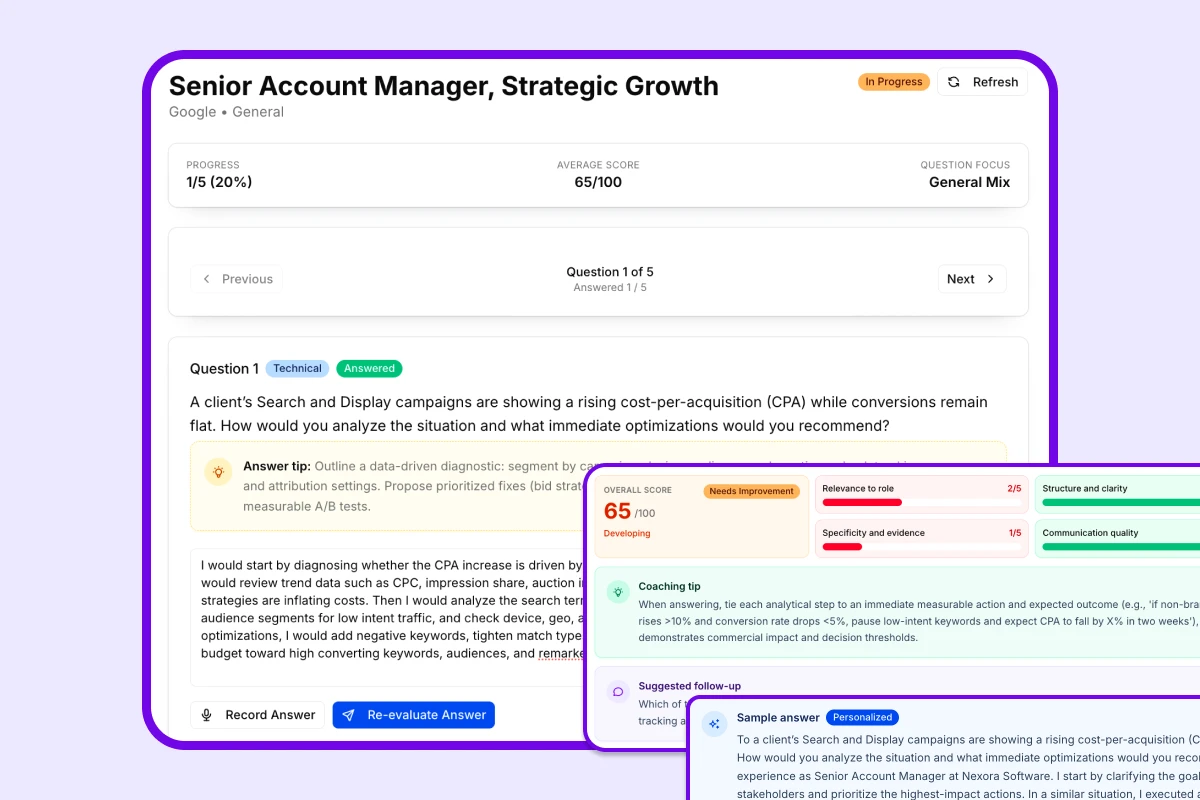
AI Interview Prep
Got the interview? Now make sure you're ready.
Practice the exact questions likely to come up for your target role. Get scored on clarity, structure, and relevance — so you walk in sharp, not winging it.
What Are Professional Introduction Examples for Networking?
Networking introductions should be short, clear, and easy to continue. The goal is not to give a full career history. The goal is to start a conversation.
Networking Introduction Example
Hi, I'm Kevin. I work in operations for a healthcare startup, and I focus on improving internal workflows and team coordination. I'm especially interested in how companies scale efficiently without losing clarity. What kind of work are you doing right now?
Another Networking Example
Hello, I'm Priya. I'm a UX designer with a background in research and product design. I enjoy helping teams build simple, user-friendly digital experiences. I'd love to hear more about what brought you to this event.
Tips for Networking Introductions
- Keep it conversational.
- Mention what you do in plain language.
- Include one point of interest.
- End with a question.
- Avoid sounding like you're reading a script.
How Do You Introduce Yourself Professionally in an Email?
A self-introduction email should be concise, respectful, and easy to scan. It should explain who you are, why you're reaching out, and what you want the recipient to do next.
What to Include in a Professional Introduction Email
| Part | What to Include |
|---|---|
| Subject line | Clear, specific, and relevant |
| Greeting | Professional and appropriate for the relationship |
| Opening | State your purpose right away |
| Body | Share who you are and why you're reaching out |
| Call to action | Ask for a meeting, response, or next step |
| Signature | Include your full contact details |
Professional Introduction Email Example
Subject: Introduction - Jamie Rivera
Dear Ms. Lopez,
My name is Jamie Rivera, and I was referred to you by Alex Chen at Beacon Tech. I work as a DevOps Engineer at CloudScale Inc., where I specialize in cloud infrastructure automation and system reliability.
I’ve been following your team’s work on sustainable cloud architecture and would love the chance to learn more about your approach. If you’re available, I’d appreciate the opportunity to connect for 15 minutes at your convenience.
Best regards, Jamie Rivera Senior DevOps Engineer, CloudScale Inc.
[Phone Number] | [Email Address] | [LinkedIn URL]
Tips for Writing a Professional Introduction Email
- Keep it short.
- Make the subject line specific.
- Mention any shared connection early.
- Focus on the recipient's time and priorities.
- End with a clear request.
How Do You Introduce Yourself Professionally in Virtual Meetings?
Virtual meetings require extra clarity because people may not know you well, and technical delays can make introductions feel awkward.
Virtual Meeting Introduction Example
Hi everyone, I'm Elena from the customer success team. I work on onboarding and client support, and I'll be helping with today's discussion around account setup.
Tips for Virtual Introductions
- Say your name clearly.
- Give context if people may not know you.
- Keep your camera, lighting, and audio professional.
- Use a friendly tone.
- Avoid interrupting if the meeting is already in progress.
What Body Language Tips Make a Professional Introduction Better?
Your words matter, but your body language shapes how those words land.
Body Language Tips for In-Person Introductions
- Stand or sit upright.
- Make steady eye contact.
- Smile naturally.
- Use a firm handshake only if appropriate.
- Keep gestures open and relaxed.
Body Language Tips for Virtual Introductions
- Look toward the camera when speaking.
- Sit at eye level with your webcam.
- Avoid distracting movements.
- Make sure your background is tidy and professional.
What Are Common Mistakes in Professional Introductions?
Here are some of the most common mistakes to avoid:
- Being too vague — "I work in business" does not say much.
- Rambling — Too much detail makes you harder to remember.
- Using jargon — Keep your language simple and clear.
- Sounding unprepared — A little practice makes a big difference.
- Forgetting the listener — A good introduction should create connection, not just describe you.
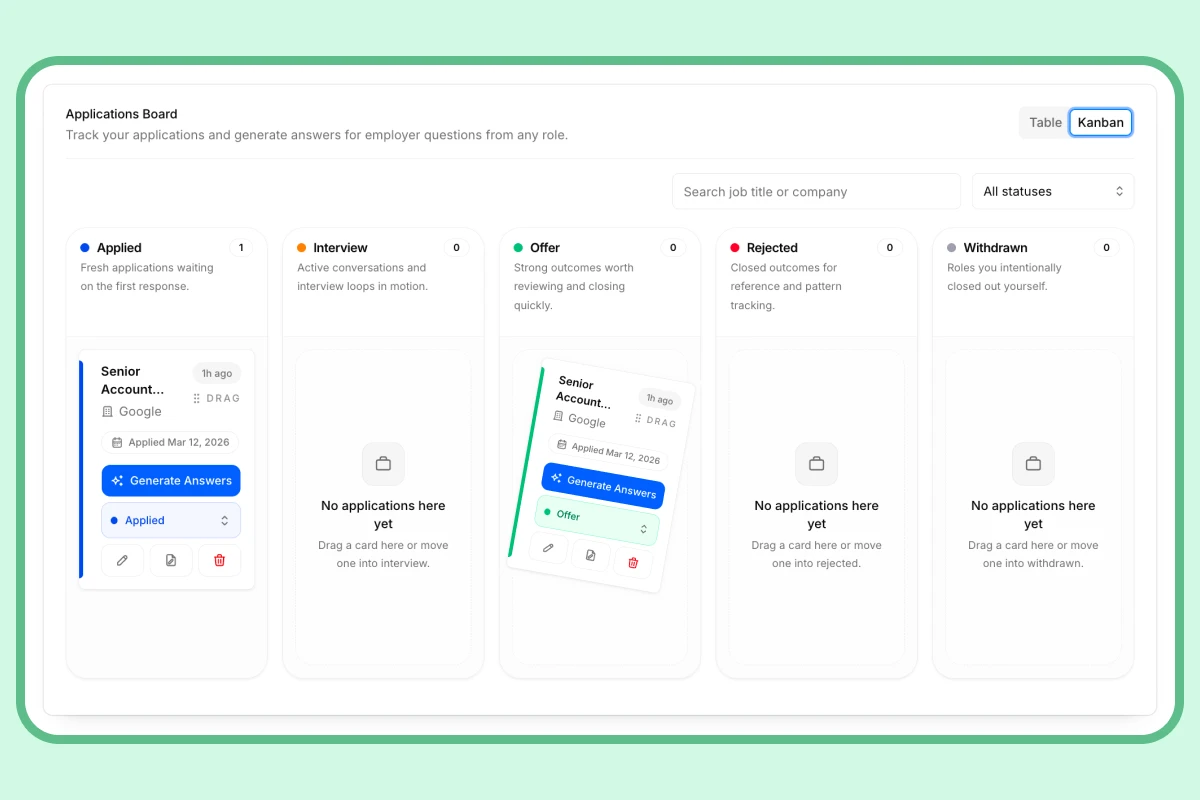
Application Tracker
Applying to 10+ jobs? You need a real system.
No more spreadsheets or lost threads. Track every role, stage, deadline, and follow-up in one dashboard — so you always know exactly where you stand.
How Long Should a Professional Introduction Be?
The right length depends on the situation.
- Interview introduction: about 60 to 90 seconds
- Networking introduction: about 20 to 45 seconds
- Email introduction: usually 3 to 6 short paragraphs or fewer
- Virtual meeting introduction: 10 to 30 seconds if you're just stating your role
Short is usually better, as long as your introduction still includes the most important details.
What Are the Best Professional Introduction Examples?
Here are a few quick examples you can adapt.
Entry-Level Example
Hi, I'm Marcus. I recently graduated with a degree in finance and completed an internship in corporate accounting. I'm interested in building a career in financial analysis and am excited to learn from experienced teams.
Career Change Example
Hello, I'm Nina. I've spent the last six years in retail management, where I built strong skills in team leadership, customer service, and operations. I'm now transitioning into HR because I enjoy working with people and helping teams succeed.
Mid-Career Example
I'm Carlos, and I work in supply chain management with a focus on inventory planning and vendor coordination. I’ve spent the last eight years improving efficiency across operations, and I'm always looking for ways to make processes smoother and more scalable.
What Is a Good Framework for Job Application Answers?
If you're answering a job application question about introducing yourself, use a short, direct response that highlights your role, experience, and goals.
Job Application Answer Template
I'm a [role] with [number] years of experience in [field]. I specialize in [skill or focus area], and my background includes [relevant experience or achievement]. I'm interested in opportunities where I can [value you bring or goal].
Example Job Application Answer
I'm a customer success specialist with five years of experience helping clients onboard successfully and stay engaged over time. I specialize in communication, problem-solving, and retention support. I'm looking for a role where I can use those skills to improve the customer experience and contribute to long-term growth.
This is especially useful for job application answers that ask you to summarize your background or introduce yourself in a professional way.
Final Checklist for a Professional Introduction
Before you use your introduction, ask yourself:
- Is it tailored to the situation?
- Does it say who I am and what I do?
- Does it include one strong detail or achievement?
- Is it concise and easy to understand?
- Does it end with a question or next step when needed?
- Have I practiced it out loud?
Final Thoughts
A strong professional introduction should feel clear, confident, and natural. You do not need to sound perfect. You just need to sound prepared, relevant, and easy to talk to.
If you learn the basic structure and adapt it to the setting, you can introduce yourself professionally in interviews, networking conversations, emails, and virtual meetings without sounding generic.
Explore this category
Interview Prep
Browse the full interview prep category for more related playbooks, examples, and tactical guides.
Browse Interview Prep articles →One workflow. Resume to offer.
Build ATS-ready resumes, track every application, and practice interviews — all in one place. Free to start, no credit card needed.
✓ Free plan forever · ✓ No card needed
Related articles
Elevator Pitch Template: 5-Step Framework, Examples, and Job Application Answers
Use this elevator pitch template to craft a clear, confident professional introduction for interviews, networking, LinkedIn, and outreach emails. Includes examples, a 5-step framework, and a quick checklist.
Fun Facts About Me: Examples and Tips for Interviews and Job Applications
Learn how to answer "Fun Facts About Me" with confidence in interviews, resumes, and job applications. This guide includes examples, tips for tailoring your response, and advice for sounding professional, authentic, and memorable.
How Do You Sell Yourself During an Interview: A Pragmatic Playbook
Selling yourself in an interview isn't about boasting; it's a strategic process of aligning your proven skills with the employer's needs. This playbook provides the concrete frameworks, scripts, and preparation tactics you need to communicate your value with confidence and authenticity.