





Starting your career journey can feel like a paradox: you need a resume to get a job, but you need a job to build a resume. This guide cuts through that frustration with a tactical, step-by-step approach to constructing a compelling resume that highlights your potential, not just your past job titles. We'll move from foundational principles to actionable formatting tips, ensuring your application gets noticed. For a neutral baseline on structure and formatting, CareerOneStop's resume guidance is a useful noncommercial reference.
Answer-First Summary: To create a resume with no job experience, focus on a functional or hybrid resume format that prioritizes transferable skills and relevant achievements from academic projects, volunteer work, extracurriculars, and coursework. Structure your resume with a strong professional summary, a detailed education section, a robust skills list, and dedicated sections for projects, certifications, and volunteer experience. Crucially, tailor every section with keywords from the job description to pass Applicant Tracking Systems (ATS) and demonstrate direct relevance to the role.
What is the Best Resume Format When You Have No Experience?
The chronological resume format, which lists work history in reverse order, is not your friend here. Instead, opt for a format that shifts the focus.
- Functional Resume: This format organizes your resume around skill categories (e.g., "Project Management," "Technical Analysis," "Customer Service") rather than job titles. Under each skill, you list achievements and evidence from class projects, club leadership, volunteer work, or independent projects. This can help career changers or new graduates highlight capability over chronology.
- Hybrid (Combination) Resume: This popular choice blends elements of functional and chronological formats. It typically starts with a professional summary and skills section, followed by a concise "Relevant Experience" section that can include academic projects, internships, or volunteer work, and then your education. It provides structure while allowing you to lead with your strongest assets.
When traditional experience is limited, a functional or hybrid approach is usually the strongest choice because it gives the reader concrete proof before they focus on job titles.
Free ATS Score
Your resume might be invisible to recruiters
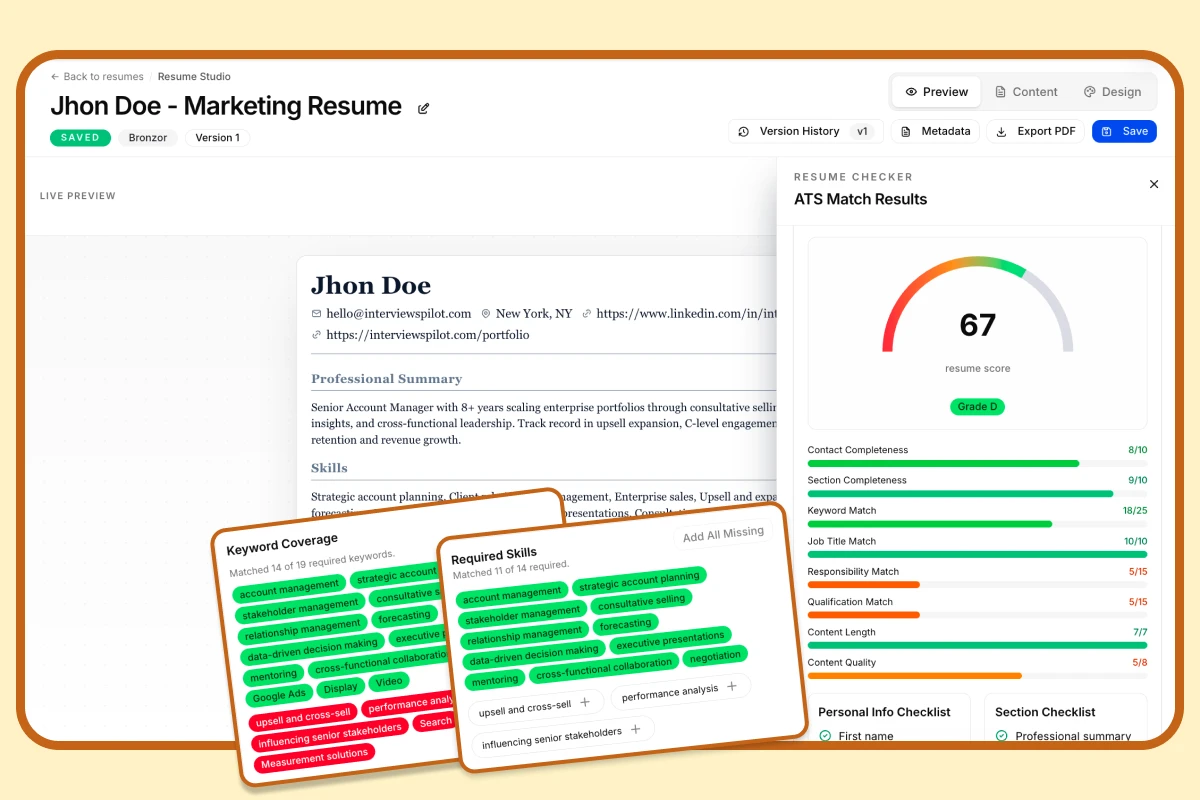
Most resumes are filtered out before a human ever sees them. Get your free ATS score and see exactly where your resume falls short — before you hit send.
What Sections Should You Include on a No-Experience Resume?
Your resume sections are the building blocks of your professional narrative. Include the following to create a complete picture:
- Contact Information: Name, phone, professional email, LinkedIn profile URL, and optionally, your city/state.
- Professional Summary (or Objective): A 2-3 sentence pitch at the top of your resume. A summary is preferable, focusing on your key skills, academic focus, and career goals. For example: "Motivated recent graduate with a B.A. in Communications, skilled in content creation, social media analytics, and collaborative project management. Seeking to apply a strong research background and detail-oriented approach to an entry-level marketing assistant role."
- Education: Place this section prominently. Include your degree, university, graduation date (or expected date), GPA (if 3.5+), and relevant coursework, honors, or academic projects.
- Skills: Create a dedicated section for both hard (technical) and soft (interpersonal) skills. Pull keywords directly from the job description.
- Projects: Detail significant academic, personal, or freelance projects. Describe the goal, your specific actions, and the quantifiable outcome.
- Certifications & Licenses: List any relevant certifications (e.g., Google Analytics, First Aid, software proficiency).
- Volunteer Experience & Leadership: Treat sustained volunteer work or club leadership like a job. Describe responsibilities and achievements.
- Awards & Honors: Academic awards, scholarships, or competition recognitions.
- Optional: Interests: Only include if they are genuinely relevant (e.g., "Active member of a coding hackathon community" for a developer role).
How Do You Identify and Highlight Transferable Skills?
Transferable skills are abilities you've gained in one context (school, hobbies, volunteering) that are valuable in a professional workplace. The key is to articulate them as achievements.
| Skill Category | Where It's From | How to Frame It on Your Resume |
|---|---|---|
| Communication | Group presentations, writing for school paper, tutoring peers | "Authored a 20-page research paper that received top marks in a 200-person class." "Explained complex calculus concepts to 3 peers, leading to a 15% average grade improvement on the final." |
| Project Management | Planning a campus event, leading a group project, organizing a fundraiser | "Orchestrated a 5-person team to deliver a semester-long marketing project two days ahead of schedule." "Managed a $500 budget for a charity bake sale, exceeding fundraising goal by 25%." |
| Technical Proficiency | Coursework in data analysis, personal website building, graphic design for a club | "Utilized Excel PivotTables and VLOOKUP to analyze a 1,000-row dataset for an economics research project." "Designed promotional graphics using Canva, increasing club event attendance by 40%." |
| Problem-Solving | Resolving team conflicts, debugging code, improving a process at a volunteer site | "Diagnosed and resolved recurring formatting issues in a collaborative Google Doc, improving team efficiency." |
As noted in career guides, quantifying these experiences—even with academic or small-scale metrics—makes them tangible and impressive to recruiters (InterviewsPilot, 2024).
What Are the Essential ATS-Friendly Tips for a No-Experience Resume?
Applicant Tracking Systems (ATS) are software used by most companies to filter resumes. To get past them:
- Keyword Tailoring is Non-Negotiable: Meticulously review the job description. Identify nouns (like "Python," "CRM," "SEO") and verbs (like "analyze," "coordinate," "develop") and integrate them naturally into your summary, skills, and project descriptions. A resume scanner that checks for keyword match can be invaluable here (InterviewsPilot, 2024).
- Use a Clean, Simple Format: Avoid headers, footers, tables, columns, and fancy graphics, as ATS can scramble them. Use standard section headings like "Education," "Skills," and "Experience."
- Submit the Correct File Type: Unless specified otherwise, a
.docxfile is often safest for ATS parsing, though.pdfis widely accepted if it's a text-based PDF (not a scanned image). - Use Standard Job Titles: When labeling your project or volunteer roles, use common terminology that aligns with the industry (e.g., "Project Coordinator" for a group project lead).
AI Resume Builder
Stop sending the same resume to every job
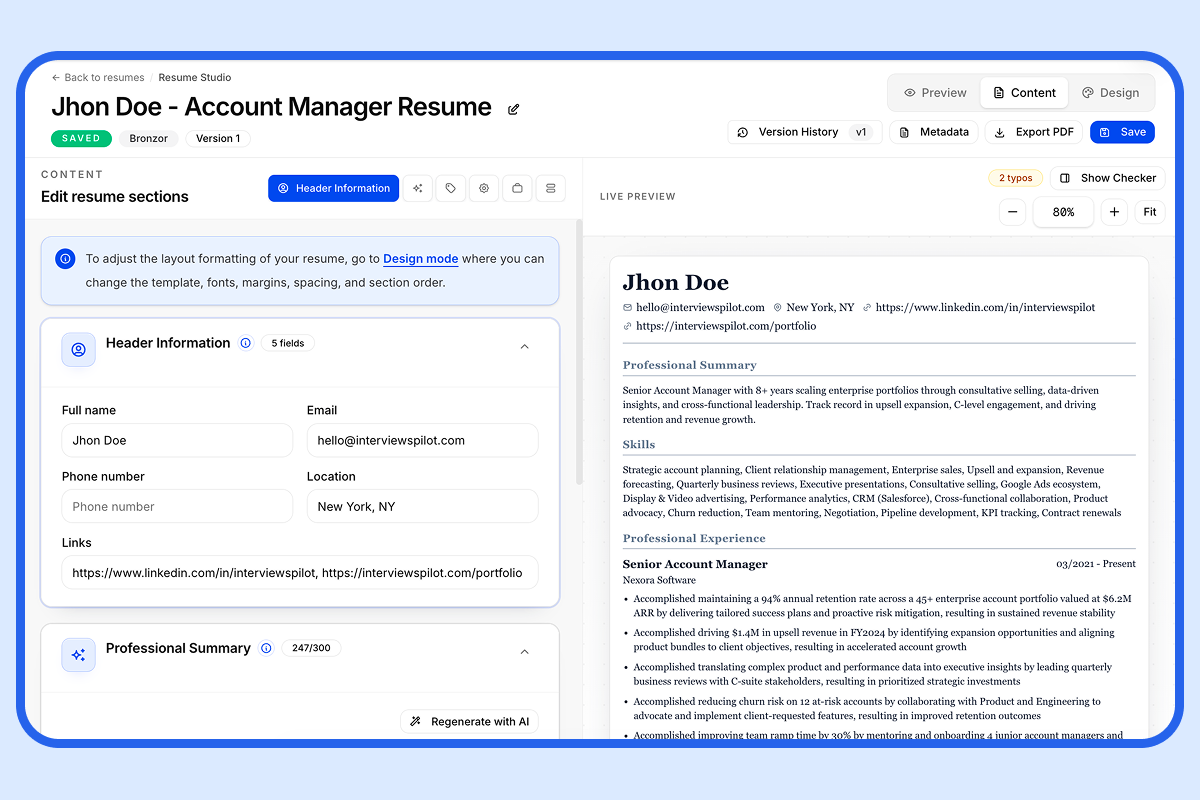
Paste any job description and InterviewsPilot rewrites your resume around it — keywords, bullets, and summary aligned to what recruiters are actually scanning for.
How Can You Make Your Education Section Stand Out?
Your education is a primary asset. Don't just list your degree and graduation date.
- List Relevant Coursework: Include 3-5 courses directly related to the target job.
- Detail Academic Projects: Treat a major thesis, capstone, or significant paper as a project. Use bullet points to describe the scope, tools used, and results/conclusions.
- Include Honors & Achievements: Dean's List, scholarships, academic societies.
- Add Study-Abroad or Relevant Programs: These demonstrate adaptability and initiative.
What Role Do Projects and Volunteering Play?
These sections are your opportunity to demonstrate applied skills and professional behaviors.
- For Projects: Use the STAR (Situation, Task, Action, Result) method as a mental model. What was the goal? What did you do? What tool or skill did you use? What was the outcome (e.g., grade, user feedback, efficiency gained)?
- For Volunteering: Frame it as professional experience. Instead of "Helped at food bank," write "Coordinated weekly inventory for a community food bank, streamlining the stocking process and reducing waste by 10%."
Well-articulated projects and volunteer work can provide concrete proof of your skills and work ethic, especially when they include outcomes, scope, tools, or people served.
Final Checklist Before You Hit "Submit"
Before sending your resume, run through this list:
- Tailored: Keywords from the specific job description are integrated throughout.
- Quantified: Achievements in projects, volunteering, or academics include numbers or metrics.
- Clean Format: Simple, professional font (e.g., Calibri, Arial); consistent spacing and bullet points; no spelling/grammar errors.
- Correct Focus: Uses a functional or hybrid format; education and skills are prominent.
- Complete Sections: Includes Summary, Education, Skills, Projects, and/or Volunteering.
- ATS-Friendly: Saved in a compatible file type; uses standard headings; no complex graphics.
Building a resume without experience is an exercise in strategic storytelling. It's about reframing your academic career, personal initiatives, and volunteer contributions as evidence of professional readiness. By focusing on transferable skills, choosing the right format, and meticulously optimizing for both human readers and ATS software, you create a powerful document that opens doors, not one that highlights closed ones. The goal is to show a hiring manager not where you've been, but what you can do.
Explore this category
Resume
Browse the full resume category for more related playbooks, examples, and tactical guides.
Browse Resume articles →One workflow. Resume to offer.
Build ATS-ready resumes, track every application, and practice interviews — all in one place. Free to start, no credit card needed.
✓ Free plan forever · ✓ No card needed
Related articles
The Biggest Resume Mistakes to Avoid: A 2026 Pragmatic Playbook
Your resume is your first interview. Avoid the common pitfalls—from missing contact details to vague duties—that get your application instantly rejected. This playbook details the biggest mistakes and provides clear, actionable solutions to craft a resume that gets noticed.
How Long Should a Resume Be? The Definitive, Data-Backed Guide for 2026
Forget rigid rules. The ideal resume length is determined by your experience, industry, and the ATS. This guide provides clear, evidence-based guidelines for entry-level to executive professionals.
How Many Bullet Points per Job on Resume? A Practical Guide
The usual rule is 3 to 5 bullet points per job on a resume. This guide shows when to use fewer or more, how to prioritize recent roles, and how to write bullets that are clear, results-driven, and ATS-friendly.