





Your resume format does more than organize your experience. It shapes how quickly a recruiter can understand your value and how accurately an applicant tracking system (ATS) can read your document. If you are searching for the best resume format to have, the answer for most job seekers is simple: reverse-chronological.
That does not mean it is the only format worth considering. Depending on your career stage, gaps in employment, or a major career change, a functional or combination resume format may serve you better. This guide explains the differences, shows when each format works best, and gives you the practical steps to create an ATS friendly resume format that gets noticed.
What Is the Best Resume Format to Have?
For most job seekers, the best resume format to have is the reverse-chronological resume format.
This format lists your most recent experience first, then works backward through your employment history. It is the most familiar structure for recruiters and the easiest for ATS software to parse. It also presents a clear story of career growth, which helps hiring managers quickly assess your resume structure.
Why reverse-chronological is the default choice
- It is widely recognized by employers and recruiters.
- It is easy for ATS tools to scan and rank.
- It highlights promotions, steady growth, and recent achievements.
- It works well for most industries and career levels.
If you want the safest all-purpose option, choose reverse-chronological.
What Are the Main Resume Format Types?
There are three main resume formats: chronological, functional, and combination.
1. Chronological resume format
The chronological resume format is the standard choice for most candidates. It lists work experience in reverse order, followed by education and skills.
Best for:
- Candidates with steady work history
- Recent graduates with relevant internships
- Job seekers in traditional industries
- Applicants who want an ATS-friendly resume format
Example of a chronological structure:
- Contact information
- Summary
- Work experience
- Education
- Skills
2. Functional resume format
The functional resume format focuses on skills instead of a detailed work timeline. It can work for people with major employment gaps, limited experience, or a significant career pivot.
Best for:
- Career changers
- People returning to the workforce
- Candidates with fragmented work histories
Important caution: Functional resumes can be harder for ATS systems to interpret and may raise concerns for recruiters if overused.
3. Combination resume format
The combination resume format blends the two approaches. It usually begins with a summary and skills section, then includes a reverse-chronological work history.
Best for:
- Career changers with strong transferable skills
- Candidates with specialized expertise
- Job seekers who want to lead with skills but still keep a timeline
Free ATS Score
Your resume might be invisible to recruiters
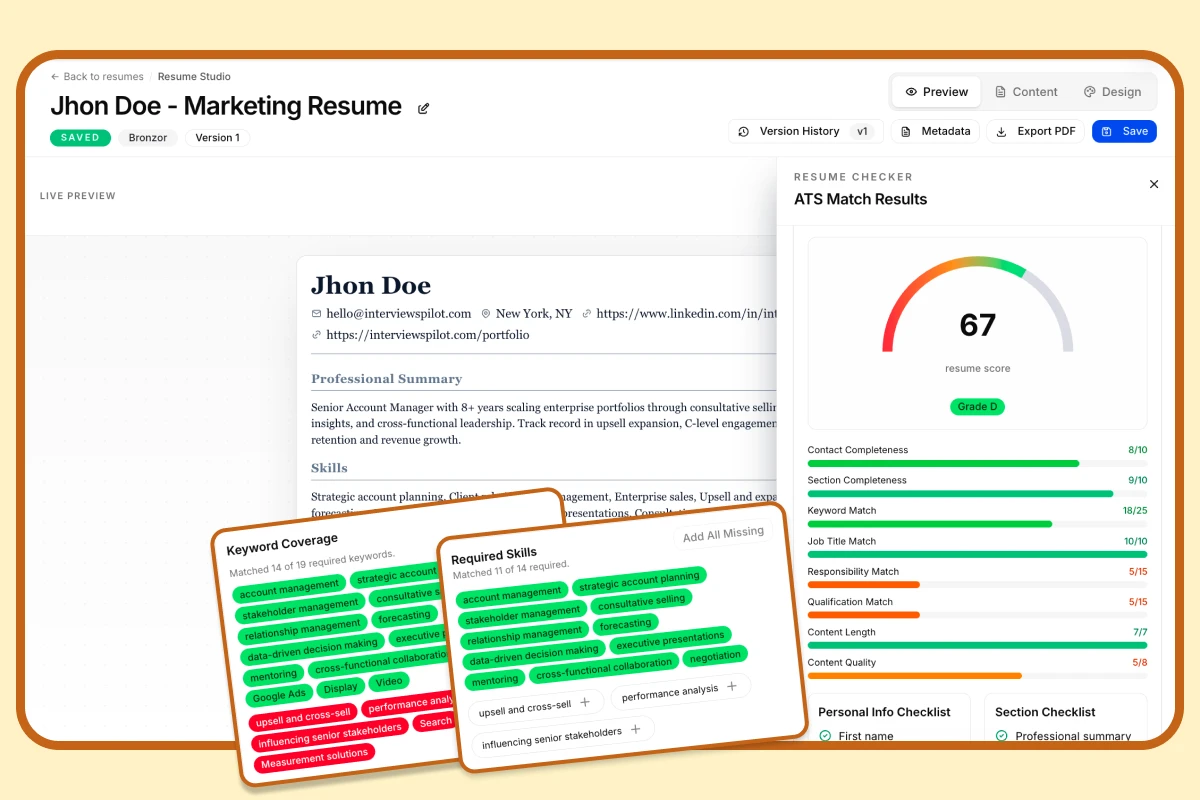
Most resumes are filtered out before a human ever sees them. Get your free ATS score and see exactly where your resume falls short — before you hit send.
When Should You Use Each Resume Format?
Here is a simple decision guide to help you choose.
| Situation | Best Resume Format | Why It Works |
|---|---|---|
| Consistent work history in one field | Chronological | Highlights growth and stability |
| Recent graduate or early-career candidate | Chronological | Shows education and internships clearly |
| Applying through ATS-heavy systems | Chronological | Maximizes readability and parsing accuracy |
| Major career change | Combination | Lets you emphasize transferable skills first |
| Employment gaps | Combination or functional | Can reduce focus on timeline, if used carefully |
| Creative or project-based work | Combination | Helps highlight projects and outcomes |
What Makes an ATS Friendly Resume Format?
An ATS friendly resume format is easy for software to read, categorize, and score. To improve your chances, keep the design simple and the content consistent.
ATS-friendly formatting rules
- Use a single-column layout.
- Avoid tables, text boxes, and graphics for core content.
- Use standard section headings like Work Experience, Education, and Skills.
- Choose a clean font such as Arial, Calibri, or Helvetica.
- Keep formatting consistent across the document.
- Save and submit in a file type the employer requests, usually DOCX or PDF.
ATS-friendly content rules
- Match keywords from the job description naturally.
- Use action verbs such as managed, developed, led, and implemented.
- Quantify results whenever possible.
- Keep job titles, dates, and section labels easy to scan.
Examples of the Best Resume Format to Have
If you are looking for the best resume format to have examples, the right choice depends on your background.
Example 1: Chronological resume format for steady career growth
A marketing manager with 8 years of experience should usually choose a chronological resume. It shows promotions, leadership progression, and recent accomplishments in a clear timeline.
Example 2: Combination resume format for a career change
A teacher moving into corporate training may benefit from a combination resume. The skills section can highlight communication, presentation, and curriculum design before the work history appears.
Example 3: Functional resume format for a return to work
Someone re-entering the workforce after a long pause may use a functional resume to emphasize transferable skills, certifications, and volunteer work. This should be done carefully, since many employers still prefer a timeline.
What Are the Pros and Cons of Each Resume Format?
Chronological resume format
Pros:
- Easy to read
- ATS-friendly
- Preferred by most recruiters
- Shows career progression clearly
Cons:
- Makes employment gaps more visible
- Less ideal for major career changes
Functional resume format
Pros:
- Highlights skills first
- Can minimize employment gaps
- Useful for nontraditional experience
Cons:
- Less ATS-friendly
- Can frustrate recruiters looking for a timeline
- Sometimes viewed as less transparent
Combination resume format
Pros:
- Balances skills and work history
- Useful for career changers
- Flexible for technical and project-based roles
Cons:
- Can become repetitive
- Slightly more complex to format well
- Still needs careful ATS optimization
AI Resume Builder
Stop sending the same resume to every job
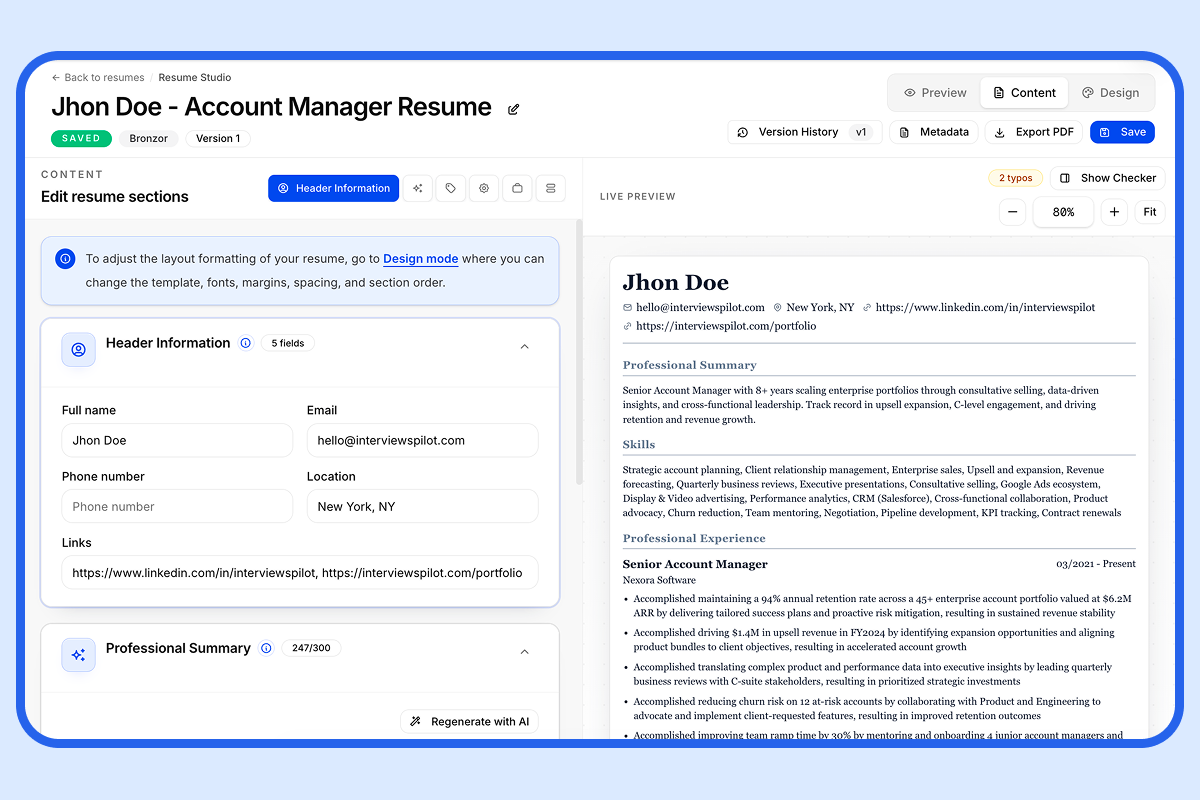
Paste any job description and InterviewsPilot rewrites your resume around it — keywords, bullets, and summary aligned to what recruiters are actually scanning for.
How Do You Choose the Best Resume Format for Your Situation?
Use this three-step approach:
- Review your work history. If your experience shows steady growth, reverse-chronological is probably the best choice.
- Match the format to the role. Conservative industries often expect traditional formatting, while some creative or technical fields allow more flexibility.
- Prioritize ATS compatibility. If your application will go through software first, keep the layout simple and standard.
What Should a Resume Format Look Like in 2026?
In 2026, the best resume format to have is still the one that balances clarity, keyword relevance, and recruiter readability. Trends may shift, but the core expectations remain the same:
- Keep the layout simple
- Make skills easy to find
- Show measurable results
- Use a structure ATS can read reliably
- Tailor the resume to each job description
Visual resumes, infographic layouts, and overly designed templates may look polished, but they are usually not the best choice for most job applications. A clean reverse-chronological resume still gives you the strongest combination of readability and ATS compatibility.
FAQ: The Best Resume Format to Have
What is the best resume format to have for most job seekers?
The best resume format to have for most job seekers is the reverse-chronological format.
Is a chronological resume format ATS friendly?
Yes. A chronological resume format is usually the most ATS friendly because it is standard, predictable, and easy to parse.
When should I use a functional resume format?
Use a functional resume format only when your skills matter more than your timeline, such as during a major career change or after a long employment gap.
Is a combination resume format a good compromise?
Yes. A combination resume format can be a strong choice if you want to emphasize skills while still keeping a clear work history.
What are the best resume format examples for job seekers with gaps?
For employment gaps, a combination resume is often the most practical choice, but a chronological resume may still work if your recent experience is strong.
Final Takeaway
If you want the best resume format to have, start with reverse-chronological. It is the most familiar, the most ATS friendly, and the most effective default for most job seekers.
Use a functional resume only when your work history would distract from your strengths, and use a combination resume when you need to lead with skills without losing the value of a timeline. The right format is the one that makes your qualifications easiest to understand quickly.
Explore this category
Resume
Browse the full resume category for more related playbooks, examples, and tactical guides.
Browse Resume articles →One workflow. Resume to offer.
Build ATS-ready resumes, track every application, and practice interviews — all in one place. Free to start, no credit card needed.
✓ Free plan forever · ✓ No card needed
Related articles
Chronological Resume: Structure, Examples, Tips, and ATS Optimization
A chronological resume presents your work history in reverse-chronological order, making it the standard choice for professionals with steady career growth. This guide explains the format, compares it with functional and hybrid resumes, and shows how to optimize every section for recruiters and ATS software.
How to Write a One-Page Resume: Examples, Tips, and ATS Optimization
A one-page resume works best when every line supports the job you want. This guide shows when to use a one-page resume, what sections to include, how to shorten a two-page resume, and how to make it ATS-friendly.
The Biggest Resume Mistakes to Avoid: A 2026 Pragmatic Playbook
Your resume is your first interview. Avoid the common pitfalls—from missing contact details to vague duties—that get your application instantly rejected. This playbook details the biggest mistakes and provides clear, actionable solutions to craft a resume that gets noticed.