





Answering "What are your greatest strengths?" is one of the most common interview tasks, but it is also one of the easiest to get wrong. A strong response is not a list of flattering adjectives. It is a focused, evidence-based answer that connects your best qualities to the role you want. For employability language around communication and teamwork, NACE's career readiness competencies provide a useful neutral benchmark.
This guide explains how to answer What are your greatest strengths clearly, confidently, and in a way that feels natural in an interview. You will learn how to identify your best strengths, choose the right ones for the job, and support them with examples that hiring managers remember.
Answer-First Summary
The best way to answer What are your greatest strengths is to name 2-3 strengths that match the job, explain why they matter, and give a short example that proves each one. A strong answer is specific, relevant, and easy to connect to the company’s needs.
Why Do Interviewers Ask About Your Strengths?
Interviewers ask this question to understand more than just your personality. They are looking for signs of job fit, self-awareness, and communication skills.
What are they trying to learn?
- Whether you match the role: Do your strengths align with the responsibilities in the job description?
- Whether you understand your value: Can you accurately describe what you do well?
- Whether you can support your claims: Do you have examples that show real results?
- Whether you can communicate clearly: Can you answer a common question in a structured way?
The question is also useful because it shows how you think about your own work. If you can explain your strengths in a way that is relevant to the job, you make it easier for the interviewer to picture you succeeding in the role.
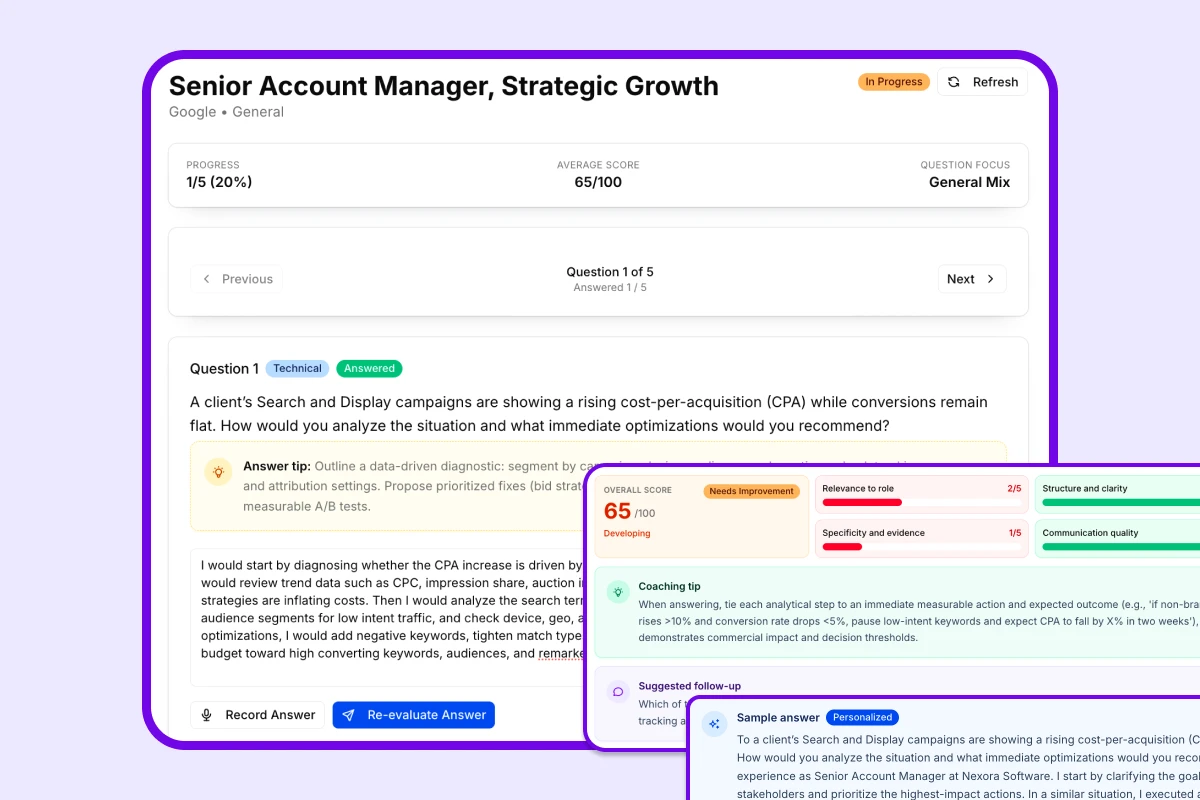
AI Interview Prep
Got the interview? Now make sure you're ready.
Practice the exact questions likely to come up for your target role. Get scored on clarity, structure, and relevance — so you walk in sharp, not winging it.
How to Answer What Are Your Greatest Strengths: A 5-Step Framework
Use this process to turn a vague idea into a polished interview response.
Step 1: Start with a broad self-inventory
Begin by listing strengths without worrying yet about which ones you will use. Think across several categories:
- Hard skills: data analysis, Python, financial modeling, CRM tools, graphic design
- Transferable skills: project management, research, budgeting, process improvement
- Interpersonal skills: collaboration, active listening, conflict resolution, mentoring
- Leadership skills: delegation, strategic thinking, decision-making, coaching
- Personal attributes: adaptability, resilience, attention to detail, curiosity, work ethic
If you are having trouble identifying your strengths, review performance feedback, think about what coworkers rely on you for, or look back at moments when you solved a problem quickly.
Step 2: Narrow your list to the most relevant strengths
Once you have a long list, choose the 2-3 strengths that best match the role. The goal is not to sound impressive. The goal is to sound like the right fit.
What should you look for?
- Relevance: Does the strength connect to the job description?
- Proof: Can you back it up with a real example?
- Differentiation: Does it help you stand out from other candidates?
- Balance: Do your strengths show a well-rounded profile?
For example, if you are applying for a project management role, strengths like organization, communication, and prioritization may be more useful than a generic trait like “I’m nice to work.”
Step 3: Prepare one short story for each strength
A strength becomes much more convincing when you can prove it. The easiest way to do that is with the STAR method:
- Situation: What was happening?
- Task: What needed to be done?
- Action: What did you do?
- Result: What changed because of your actions?
Example: Project management
- Situation: A website redesign project was already two weeks behind schedule.
- Task: I needed to help get the project back on track without lowering quality.
- Action: I re-prioritized tasks with stakeholders, introduced daily team check-ins, and created a shared progress dashboard.
- Result: We identified the critical path, launched on time, and improved communication across the team.
Keep your example short. In most interviews, a brief story is more effective than a long explanation.
Step 4: Tailor the answer to the role and company
A generic answer may be true, but it will not feel memorable. The strongest responses connect your strengths to what the employer actually needs.
How do you tailor it?
- Read the job description carefully
- Look for repeated skills and responsibilities
- Research the company’s values and current priorities
- Match your example to the work they are trying to do
Instead of saying, “I’m a strong leader,” you might say, “One of my strengths is mentoring junior team members, which I noticed would be especially useful for your growing analytics team.”
Step 5: Put everything into a concise final answer
A strong response usually fits into 60-90 seconds. Here is a simple structure you can adapt:
“One of my greatest strengths is [strength]. In my last role, I used that strength when [short example], which led to [result]. I also bring [second strength], which I believe is especially relevant because [connection to the job].”
This format works well because it gives the interviewer both personality and proof.
How to Choose the Best Strengths for an Interview
Not every strength is equally useful in every interview. The best choices are the ones that help the employer see you in the role.
Common categories of strong interview answers
| Category | Example strengths | Best for roles in |
|---|---|---|
| Analytical | data analysis, critical thinking, research, troubleshooting | finance, engineering, consulting, analytics |
| Communication | writing, public speaking, active listening, collaboration | sales, customer success, marketing, public relations |
| Leadership | delegation, coaching, strategic planning, decision-making | management, project leadership, operations |
| Execution | organization, time management, attention to detail, efficiency | administration, operations, logistics, planning |
| Creative | brainstorming, design thinking, adaptability, content creation | design, marketing, product, innovation roles |
If you are unsure which strengths to highlight, choose ones that meet these three tests:
- You have used them in real situations
- They are relevant to the job
- You can explain them in a simple, confident way
Examples of How to Answer What Are Your Greatest Strengths
Here are a few sample approaches you can adapt to your own background.
Example 1: Analytical and organized
“One of my greatest strengths is problem-solving. In my previous role, I noticed our reporting process was creating delays, so I streamlined the workflow and reduced turnaround time by two days. I’m also very organized, which helps me manage multiple priorities without losing track of details.”
Example 2: Collaborative and adaptable
“One of my strengths is collaboration. I work well with different teams and I’m good at keeping communication clear when a project involves a lot of moving parts. I’m also adaptable, so when priorities change, I can adjust quickly and stay focused on the goal.”
Example 3: Leadership and communication
“My greatest strength is mentoring others. I enjoy helping teammates build confidence and improve their skills, and I’ve used that strength to support newer employees during onboarding. I’d also say communication is a strength of mine because I can explain complex topics in a simple, practical way.”
Example 4: Detail-oriented and dependable
“One of my biggest strengths is attention to detail. In my last role, that helped me catch errors before they reached clients and improve the accuracy of our final deliverables. I’m also dependable, so people know they can count on me to follow through.”
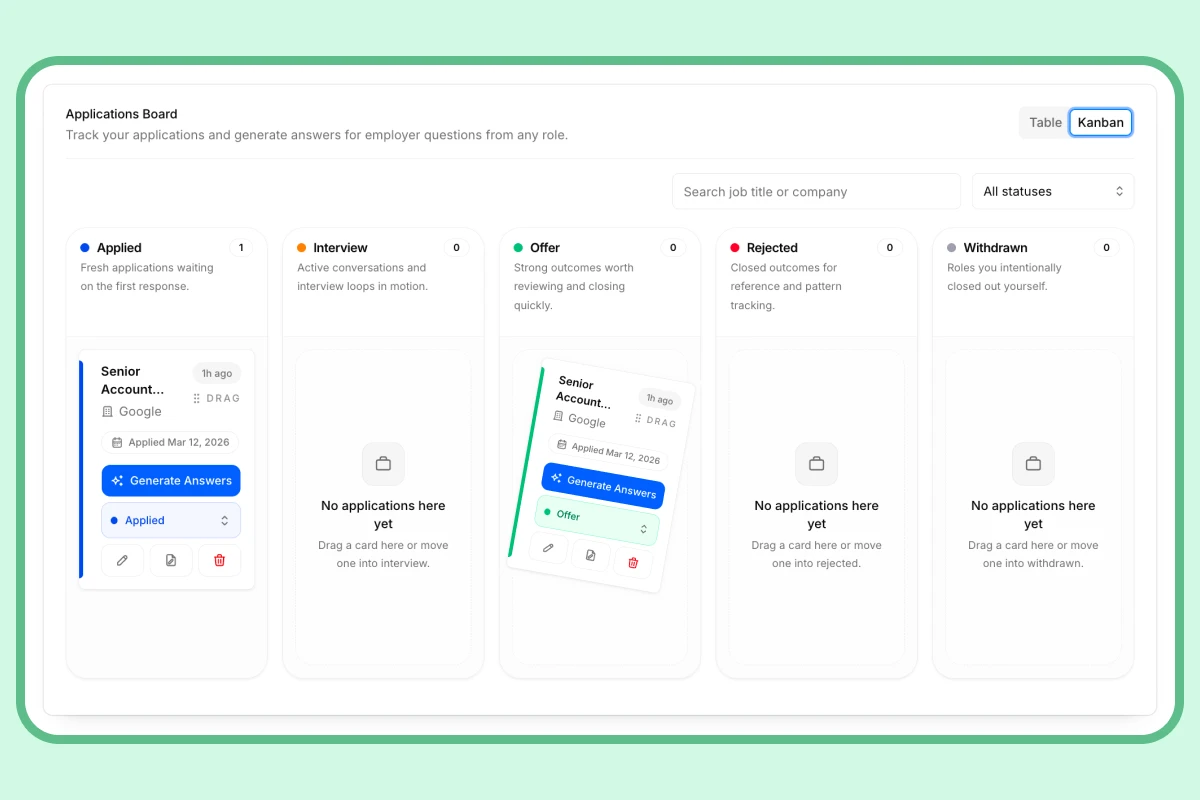
Application Tracker
Applying to 10+ jobs? You need a real system.
No more spreadsheets or lost threads. Track every role, stage, deadline, and follow-up in one dashboard — so you always know exactly where you stand.
What Are the Most Common Mistakes to Avoid?
Even good candidates weaken their answer by making it too broad or too generic.
Avoid these mistakes:
- Being vague: “I’m a hard worker” does not tell the interviewer much.
- Listing too many strengths: Too many traits make the answer feel unfocused.
- Skipping evidence: A strength without an example sounds like an opinion.
- Ignoring the job description: Your answer should relate to the role.
- Sounding rehearsed: Practice enough to be smooth, but not robotic.
- Rehashing your resume: The answer should add context, not repeat bullet points.
How to Prepare for the Related Weakness Question
Interviewers often ask about weaknesses after asking about strengths. The best way to handle both is to show self-awareness and growth.
If asked about a weakness, choose something real but not essential to the role, then explain how you are improving it.
A simple structure for weakness answers
- Name the weakness honestly
- Briefly explain why it has been a challenge
- Share what you are doing to improve
- End with progress, not perfection
This approach shows maturity and accountability.
Final Checklist Before Your Interview
- I have chosen 2-3 strengths that fit the job
- I can explain each strength in one clear sentence
- I have a short STAR method example for each one
- I have tailored my answer to the company and role
- I can deliver my response in 60-90 seconds
- I am ready to discuss a related weakness if asked
Final Thoughts
When you prepare well, How to Answer What Are Your Greatest Strengths becomes much easier. The strongest answers are not the flashiest ones. They are the ones that are honest, relevant, and backed by real examples.
If you choose your strengths carefully, support them with evidence, and connect them to the job, you give the interviewer a clear reason to believe you can do the work well.
Explore this category
Interview Prep
Browse the full interview prep category for more related playbooks, examples, and tactical guides.
Browse Interview Prep articles →One workflow. Resume to offer.
Build ATS-ready resumes, track every application, and practice interviews — all in one place. Free to start, no credit card needed.
✓ Free plan forever · ✓ No card needed
Related articles
How Do You Sell Yourself During an Interview: A Pragmatic Playbook
Selling yourself in an interview isn't about boasting; it's a strategic process of aligning your proven skills with the employer's needs. This playbook provides the concrete frameworks, scripts, and preparation tactics you need to communicate your value with confidence and authenticity.
Situational Interview Questions: Examples, Answers, and STAR Method Tips
Situational interview questions ask how you would handle hypothetical, job-related scenarios to evaluate problem-solving, judgment, and critical thinking. This guide explains what they are, how they differ from behavioral questions, and how to answer them with a simple framework and real examples.
How to Explain Being Fired in a Job Interview: Examples, Tips, and a Simple Framework
Being fired does not have to define your candidacy. Use this guide to explain a termination clearly, take responsibility, and pivot toward the value you can bring to your next role.