





How to Answer Teamwork Interview Questions effectively is a critical skill that can make or break your job application. While many candidates understand the importance of teamwork, few have a structured system to demonstrate their collaborative abilities under pressure. This guide provides a tactical, step-by-step playbook to move beyond generic answers and deliver compelling, evidence-based responses that resonate with interviewers. For employability language around communication and teamwork, NACE's career readiness competencies provide a useful neutral benchmark.
Why Teamwork Questions Are Asked and What They Assess
Employers ask teamwork interview questions to evaluate far more than your ability to get along with others. These questions probe collaborative intelligence: conflict resolution, communication style, leadership potential, adaptability, and contribution to shared goals. The underlying goal is to determine whether you will be a positive force within existing teams and someone who can drive projects forward through collaboration rather than individual effort alone.
The Foundational Framework: Mastering the STAR Method
The single most effective tool for answering behavioral questions, including those about teamwork, is the STAR method (Situation, Task, Action, Result). This structure forces you to provide a complete, concise narrative with a clear outcome.
- Situation: Set the scene briefly. Describe the context of the team project or challenge. (e.g., "In my previous role, our five-person marketing team was tasked with launching a new product within an aggressive two-month timeline.")
- Task: Explain your specific responsibility or the team's objective. (e.g., "My role was to manage the content calendar and coordinate with the design lead, but our shared task was to ensure all assets were aligned and delivered on schedule.")
- Action: Detail the steps you took. This is the most critical part—focus on your specific contributions and behaviors. Use "I" statements strategically alongside "we" statements. (e.g., "I noticed our weekly syncs were becoming unproductive. I proposed and facilitated a new stand-up format using a shared Kanban board to improve visibility. When a conflict arose between copy and design over priorities, I scheduled a one-on-one mediation session to clarify requirements and find a compromise.")
- Result: Quantify the outcome. What was the impact of your actions? Use numbers, percentages, or clear qualitative results. (e.g., "As a result, our team reduced missed deadlines by 40%, launched the campaign on time, and exceeded our initial engagement target by 15%. The new communication process was adopted by other teams in the department.")
Tailor your STAR method response to the role you are applying for. For a sales role, highlight teamwork in closing a deal; for an engineering role, focus on collaborative problem-solving during a sprint.
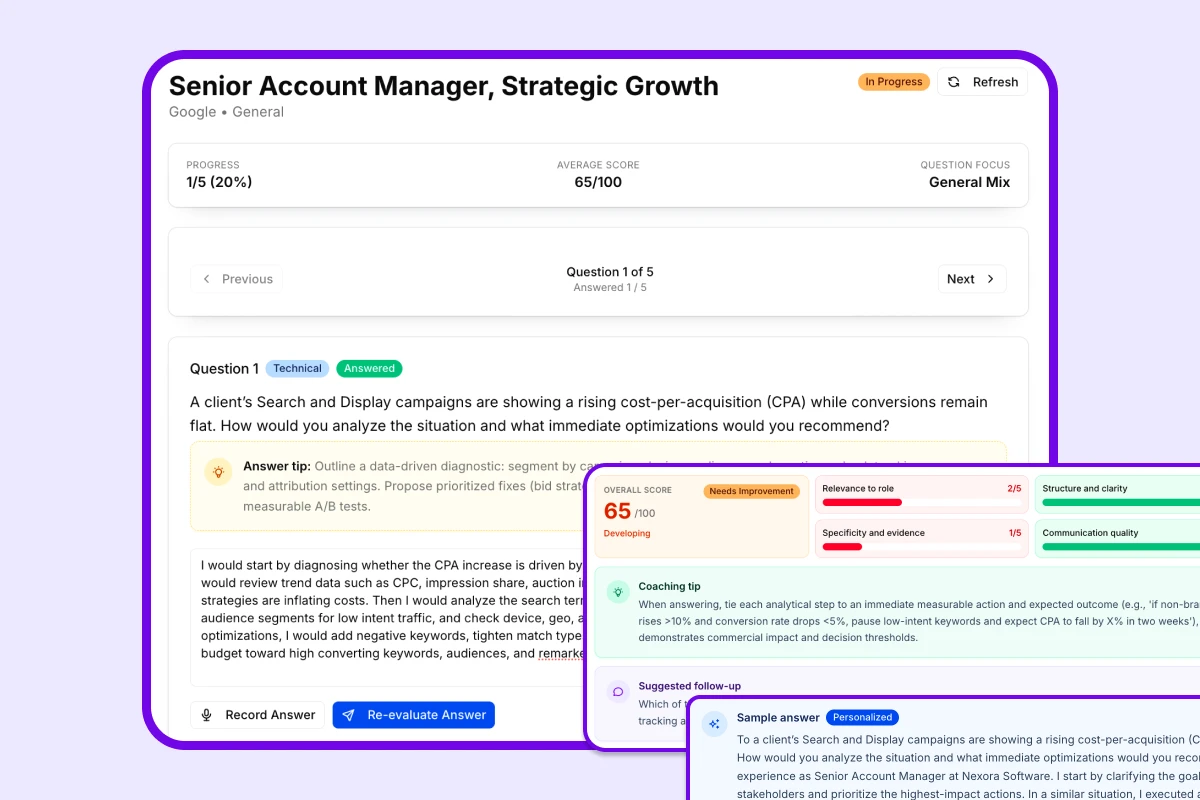
AI Interview Prep
Got the interview? Now make sure you're ready.
Practice the exact questions likely to come up for your target role. Get scored on clarity, structure, and relevance — so you walk in sharp, not winging it.
Step-by-Step Execution: From Preparation to Delivery
Step 1: Audit and Inventory Your Teamwork Examples
Before the interview, conduct a thorough audit of your past experiences. Don't wait for the question to jar your memory. Create a bank of 5-7 robust team-based stories that cover a spectrum of scenarios:
- A successful project you contributed to.
- A time you resolved a conflict or disagreement within a team.
- An instance where a team project failed or faced a major obstacle.
- A situation where you had to work with a difficult team member.
- A time you helped motivate a team or assumed informal leadership.
- An example of collaborating across departments or with remote colleagues.
For each story, draft a brief STAR outline. This preparation ensures you have a relevant example ready, regardless of the question's angle.
Step 2: Decode and Categorize the Question
Not all teamwork questions are the same. Learn to identify the type to select the best example.
- Behavioral (Past): "Tell me about a time..." "Describe a situation where..." → Use a full STAR narrative from your prepared bank.
- Situational (Hypothetical): "What would you do if..." → Structure your answer as a proposed action plan, still grounded in principles from your past experiences.
- Strength/Competency-Based: "What are your strengths as a team player?" "How do you handle conflicting priorities in a team?" → Pair a direct trait with a succinct example that proves it.
TargetJobs categorizes questions to help candidates understand what the interviewer is truly seeking, whether it's leadership, conflict management, or simply cooperation.
Step 3: Structure Your Response with Impact
Combine your prepared example with the STAR framework to build your answer.
- Direct Answer First: Start with a one-sentence summary that answers the question directly. (e.g., "I believe strong teamwork is about clear communication and shared accountability. For example...")
- Deliver the STAR Story: Narrate your chosen example clearly, ensuring the "Action" section highlights your personal initiative and soft skills.
- Connect Back to the Role: Explicitly link the lesson or skill from your story to the position you're interviewing for. (e.g., "This experience in navigating team dynamics to hit a deadline is directly relevant to the fast-paced, collaborative environment you've described here.")
Step 4: Practice and Refine Delivery
Practice aloud, not just in your head. Time your responses to ensure they are detailed but concise (60-90 seconds is a good target). Record yourself to check for clarity, filler words ("um," "like"), and confident tone. Practice with a friend or mentor who can give feedback and ask follow-up questions.
10 Common Teamwork Questions with Sample Answer Frameworks
Here is how to apply the playbook to specific, frequent questions. Use these frameworks to build your own authentic answers.
- "Tell me about a time you worked successfully in a team."
- Framework: Choose a clear success story. Focus on how collaboration, not just individual effort, led to the win. Highlight a specific collaborative action you took.
- "Describe a time a team project failed or faced a major setback. What was your role?"
- Framework: This tests accountability and learning. Briefly describe the failure, but spend most of your time on the actions taken to mitigate, learn, or recover. Emphasize the lesson, not the blame.
- "How do you handle working with a difficult team member?"
- Framework: Show empathy and proactive problem-solving. Example: describe attempting to understand their perspective through private conversation, focusing on shared goals, and escalating only as a last resort.
- "What do you do if you disagree with a manager or team lead's decision?"
- Framework: Demonstrate respect and professional communication. Outline steps: seek clarification privately, present data or an alternative perspective respectfully, and commit fully to the final decision once made.
- "Are you more productive working independently or on a team?"
- Framework: Avoid a binary choice. A strong answer is: "I am self-motivated and can drive projects independently, but I find collaboration essential for innovation and complex problem-solving. For instance, on project X, my independent research phase was crucial, but it was the team brainstorming that led to our breakthrough solution."
- "Tell me about a time you had to assume leadership on a team."
- Framework: This probes initiative. Describe a vacuum or need, the specific actions you took to organize or motivate the group (not just taking over), and the positive outcome that resulted from your initiative.
- "How do you ensure effective communication within a team?"
- Framework: Move beyond clichés. Give concrete tactics: advocating for regular stand-ups, using specific collaboration tools (Slack, Asana), documenting decisions, or implementing a "no surprises" rule for deadlines.
- "Describe your ideal team environment."
- Framework: Align your answer with the company's culture (which you should research). Focus on values like psychological safety, clear goals, mutual respect, and open feedback. This is a covert culture-fit question.
- "Give an example of how you've helped a teammate."
- Framework: Showcase empathy and a lack of siloed thinking. Pick an example where you assisted outside your strict responsibilities, which boosted overall team morale or productivity.
- "Why is teamwork important to you?"
- Framework: Connect teamwork to personal values and better outcomes. "Teamwork is important because it combines diverse strengths, leading to more robust solutions than any individual could create alone. I find the process of collaborating towards a shared goal highly motivating."
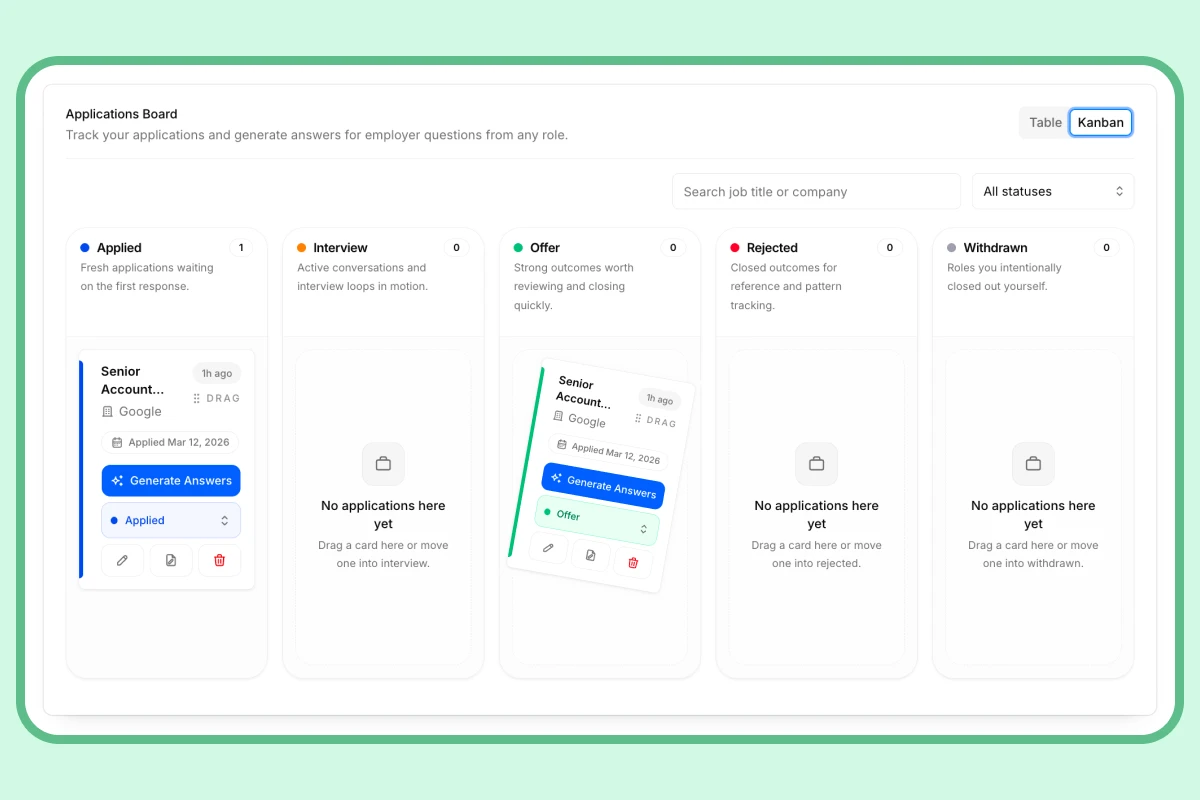
Application Tracker
Applying to 10+ jobs? You need a real system.
No more spreadsheets or lost threads. Track every role, stage, deadline, and follow-up in one dashboard — so you always know exactly where you stand.
Critical Mistakes to Avoid
- Using Vague, Generic Answers: Saying "I'm a great team player" is meaningless without proof. Always back claims with a specific story.
- Taking All the Credit or Blaming Others: Even when describing your action, acknowledge the team's role. Never throw a former colleague under the bus.
- Providing an Unstructured, Rambling Story: Without STAR, you risk missing key details or talking too long. Structure is your friend.
- Neglecting to Connect to the New Role: Your story must feel relevant to the interviewer. Make the connection explicit.
- Being Unprepared for Negative Scenarios: Having no example for failure or conflict signals a lack of experience or self-awareness. Prepare these stories thoughtfully.
Advanced Tactics: Handling Complex Scenarios
For senior roles, expect nuanced questions. Prepare for scenarios like:
- Building team trust remotely. (Action: Instituting weekly video coffee chats, creating a "virtual water cooler" channel, over-communicating on projects.)
- Merging two conflicting team cultures post-acquisition. (Action: Facilitating joint workshops to find common values, creating cross-team project pairs, leading by example in embracing new processes.)
- Motivating a team during a period of low morale or burnout. (Action: Advocating for and implementing "focus time" with no meetings, organizing team recognition events, having candid one-on-ones to redistribute workload.)
Post-Interview: The Follow-Up as a Teamwork Signal
Your collaboration skills can shine after the interview. In your thank-you note, reference a specific moment of connection or a shared idea from the panel. For example: "I really enjoyed our discussion on collaborative problem-solving, and it reinforced my excitement about contributing to your team's dynamic." This demonstrates active listening and relational skills.
Final Preparation Checklist
Before your next interview, ensure you have:
- A bank of 5-7 STAR-formatted teamwork examples covering success, failure, conflict, and leadership.
- Practiced answers to the 10 common questions above.
- Researched the company's culture and team structure to tailor your answers.
- Prepared 1-2 thoughtful questions to ask them about their team dynamics and collaboration.
- Conducted at least one mock interview focusing on behavioral questions.
By treating your interview preparation with the same systematic approach you'd apply to a team project, you transform anxiety into confidence. You're no longer hoping to recall a good story; you're strategically presenting documented evidence of your collaborative value. This shift from reactive answering to proactive demonstration is what ultimately lands the job.
Explore this category
Interview Prep
Browse the full interview prep category for more related playbooks, examples, and tactical guides.
Browse Interview Prep articles →One workflow. Resume to offer.
Build ATS-ready resumes, track every application, and practice interviews — all in one place. Free to start, no credit card needed.
✓ Free plan forever · ✓ No card needed
Related articles
Situational Interview Questions: Examples, Answers, and STAR Method Tips
Situational interview questions ask how you would handle hypothetical, job-related scenarios to evaluate problem-solving, judgment, and critical thinking. This guide explains what they are, how they differ from behavioral questions, and how to answer them with a simple framework and real examples.
What Are the Most Common Interview Questions and Answers?
Learn how to answer the most common interview questions with confidence. This guide covers the core questions employers ask, why they ask them, and how to build strong, authentic answers.
100 Words to Describe Yourself in an Interview: A Practical Playbook
The 'describe yourself' question is a pivotal interview moment. This guide provides a strategic toolkit of 100+ impactful words, categorized for clarity, demonstrates how to weave them into compelling, job-specific answers that showcase your unique value.