





If you’re asking how many jobs should I apply for, you’re asking the right question. A job search works best when it has a job search action plan: enough volume to create opportunities, enough selectivity to avoid burnout, and enough personalization to get noticed. For a noncommercial baseline on planning and tracking applications, CareerOneStop's job search guidance is a useful reference.
There is no single number that fits every job seeker. The right target depends on your timeline, your field, your experience level, and how much time you can realistically spend on the search. Still, most experts agree on a practical range: 10–15 high-quality applications per week for a standard search, with a total target of 100–200 applications across the whole process.
Answer First: How Many Jobs Should I Apply For?
A good starting point is:
- Standard search: 10–15 tailored applications per week
- Urgent search: 20–25+ applications per week
- Longer search: 5–10 highly selective applications per week
- Typical total range: 100–200 applications to land an offer.
That said, the best target is the one you can sustain without sacrificing relevance, networking, and follow-up.
How Many Jobs Should I Apply For Each Week?
Your weekly target should match your timeline and urgency.
| Job Search Timeline | Suggested Weekly Applications | Best Approach |
|---|---|---|
| 1 month or less | 20–25+ | Prioritize speed, consistency, and rapid tailoring |
| 3 months | 10–15 | Balance applications, networking, and interview prep |
| 6 months or more | 5–10 | Focus on fit, strategic targeting, and relationship-building |
If you have a hard deadline, your weekly number should be higher. If you have time to be selective, a lower volume can work better because it gives you more time to customize each application.
How Many Jobs Should I Apply For in Total?
Many job seekers do best with a total application range of 100–200. That number is not a guarantee; it is a planning benchmark.
A total goal helps you:
- stay consistent over time
- measure progress instead of guessing
- avoid stopping too early
- adjust your strategy if responses are low
If you are getting interviews from a smaller number of applications, your resume and targeting may already be strong. If you are sending dozens of applications with no response, the issue may be fit, keywords, formatting, or targeting.
Should I Prioritize Quality or Quantity?
For most people, the real answer is both, in the right balance.
Quantity matters because job searches are a numbers game to some extent. But quality matters more because generic applications are easier to ignore, harder to track, and less likely to lead to interviews.
What makes a high-quality application?
- A resume tailored to the role
- Clear alignment with the job description
- Relevant keywords without stuffing
- A cover letter or intro message when appropriate
- A strong reason for applying to that specific company
A simple rule: only apply when you meet most of the must-have qualifications, unless the role is clearly entry-level or designed for adjacent experience.
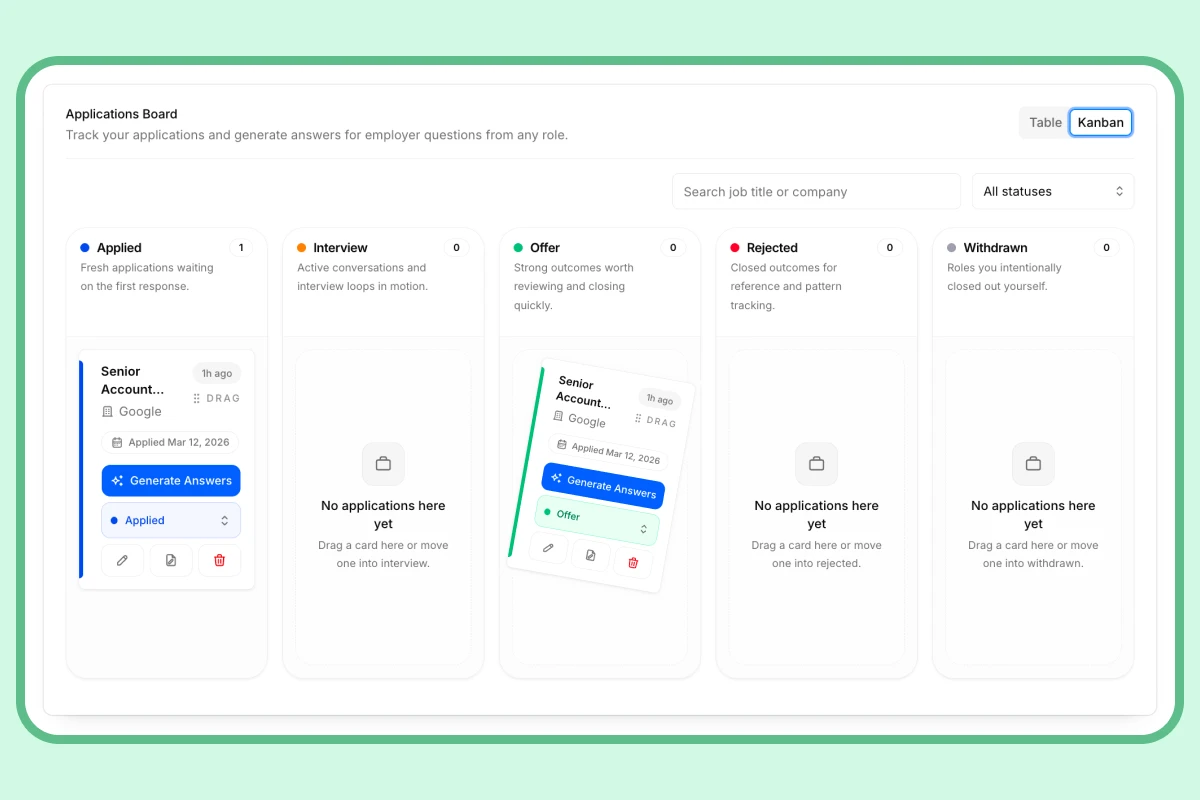
Application Tracker
Applying to 10+ jobs? You need a real system.
No more spreadsheets or lost threads. Track every role, stage, deadline, and follow-up in one dashboard — so you always know exactly where you stand.
How Does My Timeline Affect How Many Jobs I Should Apply For?
Your timeline should shape your pace.
1. If you need a job fast
If you are unemployed, nearing the end of a contract, or facing a firm deadline, your search should be more intense.
- Apply to more roles each week
- Use templates to speed up tailoring
- Keep networking active every day
- Track follow-ups carefully
In a fast search, the goal is not perfection. The goal is to maintain momentum while still submitting strong applications.
2. If you have a few months
A three-month search gives you room to be strategic.
- Apply to roles that are a strong fit
- Customize each resume and cover letter
- Spend time on networking and referrals
- Prepare for interviews while continuing to apply
This is the most balanced approach for many job seekers.
3. If you have six months or more
A longer search allows you to be more selective.
- Focus on high-value opportunities
- Research companies more deeply
- Build relationships before applying
- Improve your resume, portfolio, or skills as you go
This approach usually leads to better-fit roles and a stronger long-term outcome.
What Job Search Strategy Works Best?
A strong job search strategy usually combines four activities:
- Applying to targeted roles
- Networking with people in your field
- Following up on applications and referrals
- Improving your resume, LinkedIn profile, or portfolio
If you only apply online, you may miss out on hidden opportunities. If you only network and never apply, you may lose momentum. A better plan uses both.
How Much Time Should I Spend on Applications?
A useful way to think about job application help is by time, not just count.
For each application, you may spend:
- 10–15 minutes for a quick, already-matched role
- 20–30 minutes for a tailored application
- 30+ minutes for a competitive or high-priority role
If you are applying to 10–15 roles per week, that may take several focused work sessions. If you are applying to 20–25 roles weekly, efficiency becomes essential, so templates, saved resume versions, and tracking tools matter more.
Does Networking Matter More Than Applying?
Networking does not replace applications, but it can improve results.
A referral or warm introduction can help your application get reviewed faster or noticed sooner. That means one well-placed connection can sometimes matter more than five cold applications.
A balanced job search strategy often looks like this:
- 60% applying and tailoring
- 40% networking and follow-up
That split is flexible, but it helps keep your search active on both fronts.
How Many Jobs Should I Apply For by Career Level?
Your experience level also matters.
Entry-level candidates
Entry-level job seekers often need to apply to more roles because competition is high and hiring managers may be looking for broad potential rather than a perfect match.
- Expect a higher application volume
- Tailor your transferable skills
- Emphasize internships, projects, and coursework
Mid-career professionals
If you already have relevant experience, you may need fewer applications because your background can create stronger alignment.
- Focus on fit and impact
- Highlight measurable results
- Use networking to identify stronger matches
Senior and executive candidates
At senior levels, public job postings matter less than relationships, reputation, and recruiter outreach.
- Apply selectively
- Build direct connections
- Use your professional network aggressively
- Position your experience around business outcomes
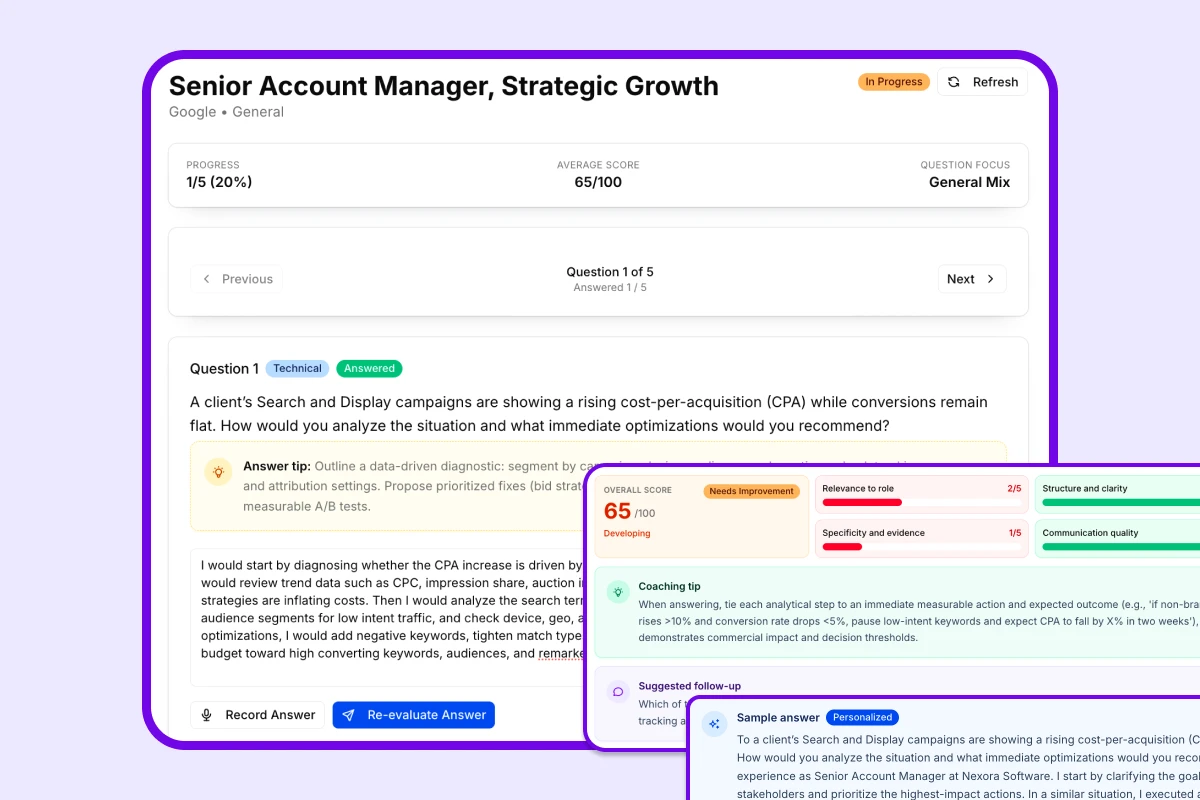
AI Interview Prep
Got the interview? Now make sure you're ready.
Practice the exact questions likely to come up for your target role. Get scored on clarity, structure, and relevance — so you walk in sharp, not winging it.
How Many Jobs Should I Apply For in Different Industries?
Industry norms vary a lot.
- Tech, media, and creative roles: More competition, so volume may need to be higher
- Specialized fields: Fewer openings, so targeted applications matter more
- Academic or research roles: Applications may be fewer, but each one is more detailed
- Skilled trades or high-demand roles: Local opportunities may create a faster response rate
If your field is competitive, make sure your resume, portfolio, and LinkedIn profile are strong before increasing volume.
What If I’m Applying a Lot but Not Getting Interviews?
If you are sending many applications with no response, your target may not be the problem.
Check these areas:
- Are you applying to roles that match your actual experience?
- Are you using the right keywords from the job description?
- Is your resume easy to scan?
- Are you submitting the same generic version every time?
- Are you following up when appropriate?
Sometimes the best next step is not applying to more jobs. It is improving the quality of the applications you are already sending.
How Should I Track My Job Applications?
Tracking turns a stressful search into a manageable system.
At minimum, track:
- company name
- role title
- date applied
- source of the listing
- recruiter or contact person
- follow-up date
- interview status
- notes on fit or feedback
A tracker helps you spot patterns. You may notice, for example, that referrals outperform cold applications or that certain job titles get better response rates.
What Is the Best Rule of Thumb?
If you want one simple answer to How Many Jobs Should I Apply For, start here:
- Apply to 10–15 well-matched jobs per week
- Aim for 100–200 total applications in a typical search
- Increase volume if your timeline is urgent
- Decrease volume if you need more customization or are targeting a niche role
- Use networking to improve the odds of each application
That is the most practical balance of speed, quality, and strategy for most job seekers.
Frequently Asked Questions
How many jobs should I apply for in a week?
For most job seekers, 10–15 applications per week is a strong baseline. If you need work quickly, you may need to apply to more.
How many jobs should I apply for total?
A common benchmark is 100–200 total applications, though the right number depends on your industry, experience, and job search timeline.
Should I apply to every job I see?
No. It is better to apply to jobs that are a real fit than to send out a large number of weak applications.
Is networking more important than applying?
Networking is not a replacement for applying, but it can significantly improve your odds and help you find roles you would not see otherwise.
What if I need job application help right away?
Start by tightening your resume, choosing fewer but better-matched jobs, and setting a weekly target you can actually maintain.
Final Takeaway
The best answer to How many jobs should I apply for is not a fixed number. It is a plan.
Start with a weekly target that fits your timeline, keep your applications relevant, and use networking to strengthen your search. If you stay consistent, track your results, and adjust based on response rate, you will make better decisions and improve your chances of landing the right role.
Explore this category
Job Applications
Browse the full job applications category for more related playbooks, examples, and tactical guides.
Browse Job Applications articles →One workflow. Resume to offer.
Build ATS-ready resumes, track every application, and practice interviews — all in one place. Free to start, no credit card needed.
✓ Free plan forever · ✓ No card needed
Related articles
Email Subject for Job Application: A Practical Guide
Your email subject line is the first thing a hiring manager sees. Learn how to write a clear, concise, professional subject for a job application that gets opened and makes your intent obvious.
How to Apply for Jobs: A Step-by-Step Job Search Strategy
Applying for jobs works best as a structured process, not a guessing game. This guide shows how to research roles, customize each application, track your progress, and follow up professionally to improve your results.
How to Create a Strategic Job Search Plan: A Step-by-Step Playbook
A strategic job search plan turns an overwhelming job hunt into a focused process. Use this step-by-step framework to define your targets, organize your search, tailor your applications, and stay on track.