





A strategic job search plan is not about sending hundreds of applications and hoping for the best. It is a focused process that helps you target the right roles, stay organized, and improve your odds of getting interviews. If you want practical How to Create a Strategic Job Search Plan tips, the best approach is to treat your search like a project with clear goals, tracked actions, and consistent follow-through.
Answer-First Summary
A strategic job search plan is a structured framework that replaces randomness with intention. The core pieces are.
- Self-assessment and target definition to clarify what roles fit your skills, values, and goals.
- Material optimization to tailor your resume, LinkedIn profile, and cover letter for both ATS and human readers.
- Systematic organization using a tracker to manage applications, contacts, and follow-ups.
- Proactive outreach and interview preparation to build relationships and convert opportunities.
The goal is simple: create a manageable, repeatable job search strategy that increases your chances of landing a role that fits.
Why Do You Need a Strategic Job Search Plan?
A job search without a plan often becomes reactive. You scroll job boards, apply to random openings, lose track of deadlines, and repeat the same work for every application. A strategy gives your search direction.
A strong plan helps you:
- Focus on roles that match your background
- Spend time where it matters most
- Avoid duplicate effort
- Track what is working and what is not
- Stay consistent during a long search
Instead of asking, “What should I apply to today?” you start asking, “What action will move me closer to the right job?”
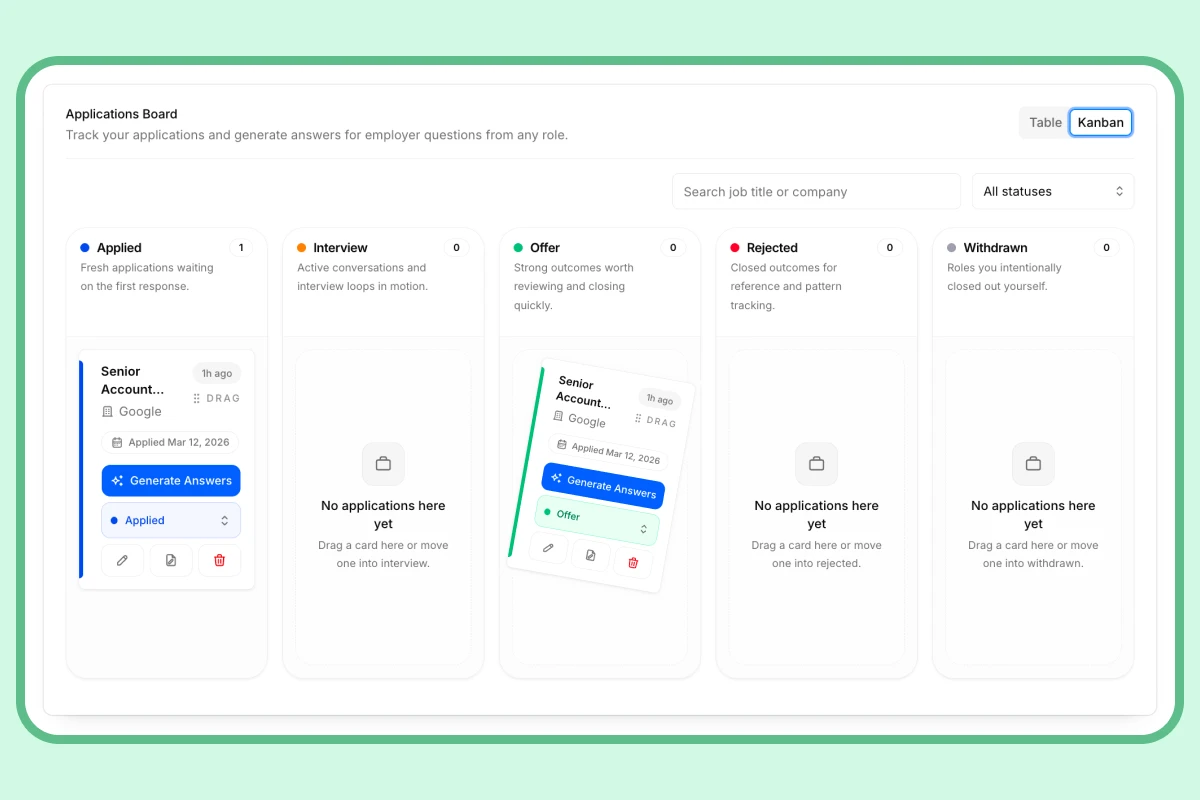
Application Tracker
Applying to 10+ jobs? You need a real system.
No more spreadsheets or lost threads. Track every role, stage, deadline, and follow-up in one dashboard — so you always know exactly where you stand.
What Should You Do Before You Start Applying?
The most important work happens before you submit a single application. This is the foundation of a strategic job search plan.
1. Conduct a self-assessment
Start by identifying what you want and what you bring to the table. A useful self-assessment should cover:
- Skills you use well
- Tasks you enjoy
- Work environments you prefer
- Values that matter to you
- Accomplishments you can prove
Helpful exercises include a skills inventory, an accomplishments list, and a values review. The goal is to understand the kind of work that fits you best, not just the job title you want.
2. Define your target role
Turn your self-assessment into a short list of target roles. Try to narrow it to 2 or 3 job titles. If your search is too broad, your materials and networking efforts become scattered.
For each role, write down:
- Core responsibilities
- Required skills
- Typical industries
- Common job titles
- Salary or level range, if relevant
3. Build a target company list
Once you know the roles you want, create a list of companies to pursue. Aim for 10 to 15 target employers.
Consider:
- Industry
- Company size
- Location or remote flexibility
- Growth trajectory
- Culture and mission
- Career advancement potential
This makes your job search strategy more focused and helps you avoid spending time on jobs that are not a good fit.
4. Set realistic goals and timelines
A job search can easily become overwhelming if you do not define the pace. Set weekly targets for the main parts of your process.
For example:
- Research 5 companies
- Submit 4 tailored applications
- Reach out to 3 new contacts
- Schedule 1 informational interview
- Update 2 resume versions
Treat your search like a part-time job, in an active search, a full-time project. Build a weekly rhythm so the process remains steady and measurable.
How Do You Organize a Strategic Job Search?
Organization is what turns good intentions into consistent action. The simplest and most effective tool is a job search tracker.
Use a job search tracker
Your tracker should act as a single source of truth for every application, contact, and follow-up.
Essential columns for your tracker
| Column | Purpose | Example |
|---|---|---|
| Company | Identifies the employer | Acme Corp |
| Role | Tracks the position | Senior Data Analyst |
| Date Applied | Helps with timing | 2026-04-10 |
| Status | Shows pipeline stage | Applied / Interviewing / Rejected |
| Job Description Link | Saves the source posting | JD URL |
| Resume Version | Tracks customization | Resume_Acme_DataAnalyst.pdf |
| Contact Name | Stores recruiter or referral info | Jane Doe |
| Follow-Up Date | Prevents missed outreach | 2026-04-17 |
| Notes | Captures interview details or reminders | Mentioned Python and dashboarding |
A tracker helps you avoid duplicate applications, remember where you are in the process, and follow up at the right time.
Create a weekly job search routine
A practical routine might look like this:
- Monday: Review targets and search for openings
- Tuesday: Tailor resume and cover letter
- Wednesday: Network and send outreach messages
- Thursday: Submit applications
- Friday: Review progress and prep for interviews
This structure makes your search easier to manage and helps you keep momentum.
How Can You Improve Your Resume and LinkedIn Profile?
Your application materials need to work in two ways: first with software, then with people. This is a major part of any effective job application help plan.
Tailor your resume for ATS
Most employers use applicant tracking systems to sort applications. To improve your chances:
- Review each job description carefully
- Identify required skills, tools, and keywords
- Match those terms naturally in your resume
- Keep formatting simple and readable
Do not keyword-stuff. Instead, make sure your language reflects the role you want.
Write stronger achievement bullets
Generic bullet points do not help you stand out. Use a simple structure like:
- Action + result + scope
- Problem + solution + impact
- Task + method + measurable outcome
Example:
- Improved reporting efficiency by 25%, saving 10 hours per week for the team.
Whenever possible, use numbers, percentages, and concrete outcomes.
Align your LinkedIn profile
Your LinkedIn profile should support your job search, not confuse it. Make sure your headline, About section, and experience entries reflect the roles you are targeting.
Focus on:
- Clear headline with target role keywords
- Complete and current experience section
- Skills aligned with your target positions
- Professional photo and clean profile presentation
A consistent online presence helps recruiters understand your background quickly.
How Do You Network Effectively During a Job Search?
Networking is not just asking people for jobs. It is a way to learn, build trust, and uncover opportunities earlier.
Start with your existing network
Look at:
- Former coworkers
- Alumni
- Friends and family
- Professional contacts
- LinkedIn connections
You may already know someone connected to your target company or industry.
Request informational interviews
An informational interview is a short conversation with someone in a role or company you are interested in. The goal is to learn, not to ask for a job.
Good questions include:
- What does a typical day look like?
- Which skills matter most in this role?
- What helped you break into the field?
- What advice would you give to someone applying here?
These conversations can help you better understand the market and may lead to referrals later.
Stay visible online
You do not need to post constantly, but you should show up professionally. Comment on industry posts, share relevant articles, and connect with people in your field. This can strengthen your visibility over time.
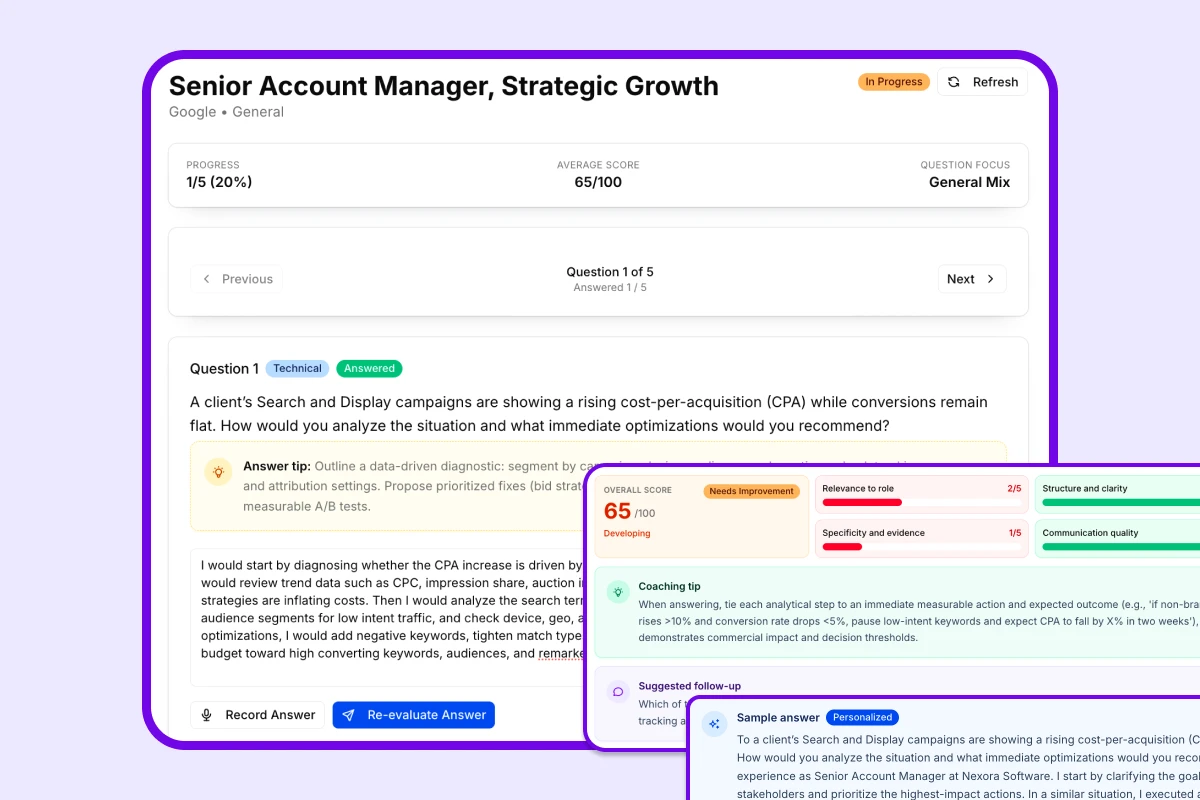
AI Interview Prep
Got the interview? Now make sure you're ready.
Practice the exact questions likely to come up for your target role. Get scored on clarity, structure, and relevance — so you walk in sharp, not winging it.
How Should You Prepare for Interviews and Follow-Up?
A strategic job search plan should continue after the application is submitted. That includes interview prep and follow-up.
Build a story bank
Instead of memorizing scripted answers, prepare 8 to 10 strong stories from your experience. Use the STAR method:
- Situation
- Task
- Action
- Result
Have examples ready for:
- Leadership
- Problem-solving
- Conflict resolution
- Teamwork
- Prioritization
- Adaptability
This helps you respond confidently to behavioral questions.
Research each company before the interview
Before every interview, review:
- The company website
- Recent news or announcements
- The job description
- The team or interviewer’s LinkedIn profile
Prepare 3 to 5 thoughtful questions that show interest and preparation.
Follow up professionally
After the interview, send a thank-you email within 24 hours. Keep it short, specific, and professional. Mention something memorable from the conversation and restate your interest.
If you do not hear back, use your tracker to schedule a polite follow-up at the right time.
How Do You Know If Your Job Search Strategy Is Working?
A strategic job search plan should be flexible. You need to monitor results and adjust when necessary.
Track basic metrics such as:
- Applications submitted
- Responses received
- Interviews scheduled
- Follow-ups completed
- Offers received
If your application-to-interview ratio is weak, your resume, targeting, or keywords may need revision. If you get interviews but no next steps, your interview storytelling may need work.
Use those signals to improve your process instead of repeating the same approach.
How Do You Stay Consistent Without Burning Out?
Job searching can be draining, especially over several weeks or months. Consistency matters, but so does energy management.
Try to:
- Block time for job search tasks
- Break large goals into small weekly steps
- Take regular breaks
- Ask for support from mentors or peers
- Keep up with exercise, sleep, and non-job-search routines
A sustainable process is more effective than an intense burst followed by burnout.
Final Thoughts
Learning how to create a strategic job search plan is really about creating structure, clarity, and momentum. When you know your target, organize your work, tailor your materials, and follow through consistently, the search becomes far more manageable.
The best job search plan is not the most complicated one. It is the one you can actually follow.
Explore this category
Job Applications
Browse the full job applications category for more related playbooks, examples, and tactical guides.
Browse Job Applications articles →One workflow. Resume to offer.
Build ATS-ready resumes, track every application, and practice interviews — all in one place. Free to start, no credit card needed.
✓ Free plan forever · ✓ No card needed
Related articles
How Many Jobs Should I Apply For? 2025 Job Search Strategy and Weekly Application Targets
Wondering how many jobs you should apply for? This guide breaks down weekly and total application targets, explains when to prioritize quality over quantity, and shows how to build a smarter job search plan for your timeline.
Organize Job Search: A Step-by-Step System for Tracking Applications, Follow-Ups, and Materials
Need a better way to manage your job hunt? This guide shows how to organize your job search with a practical tracking system for applications, documents, contacts, and follow-ups.
Email Subject for Job Application: A Practical Guide
Your email subject line is the first thing a hiring manager sees. Learn how to write a clear, concise, professional subject for a job application that gets opened and makes your intent obvious.