





Do you need a cover letter? Sometimes yes, sometimes no. If the job description or application portal asks for one, you should submit one. If it is optional, a cover letter can still help you explain a career gap, highlight a transition, show genuine interest, or add context that a resume cannot.
For related next steps, use job search checklist and strategic job search plan.
The short version: required means required; optional means strategic..
This guide breaks down when a cover letter matters, when you can skip it, and how to write one efficiently without turning each application into a major project.
Do You Need a Cover Letter in 2025?
In 2025, the answer is still yes when requested and sometimes when it is not. Recruiters and hiring managers often use cover letters to gauge communication, attention to detail, and motivation. At the same time, many employers treat them as optional unless they are specifically part of the application.
That means the right choice depends on three things:
- The job instructions
- How much context your resume provides
- How competitive or important the role is to you
When Is a Cover Letter Required?
A cover letter is not optional in these situations:
- The job posting explicitly requests one.
- The application portal has a required cover letter field.
- A recruiter or hiring manager asks you to send one directly.
If one of these applies, send it. Not doing so can look like you ignored instructions.
When Is a Cover Letter Helpful Even If It Is Optional?
A cover letter can give you an edge when it adds useful context. It is especially helpful if:
- You are changing careers or industries.
- You have a gap in your work history.
- Your background is non-linear or unusually broad.
- You were referred by someone at the company.
- You want to show specific interest in this role or employer.
- The role values communication, writing, or client-facing skills.
In these cases, the cover letter helps answer a question your resume cannot fully cover: why you, why this role, and why now?
When Can You Skip a Cover Letter?
You can usually skip the cover letter when:
- The posting says it is optional and you have nothing new to add.
- The application process does not provide a place to submit one.
- You are applying to a high-volume role where applications are screened quickly.
- You would only repeat what is already on your resume.
If your cover letter would be generic or rushed, a strong tailored resume is often the better move.
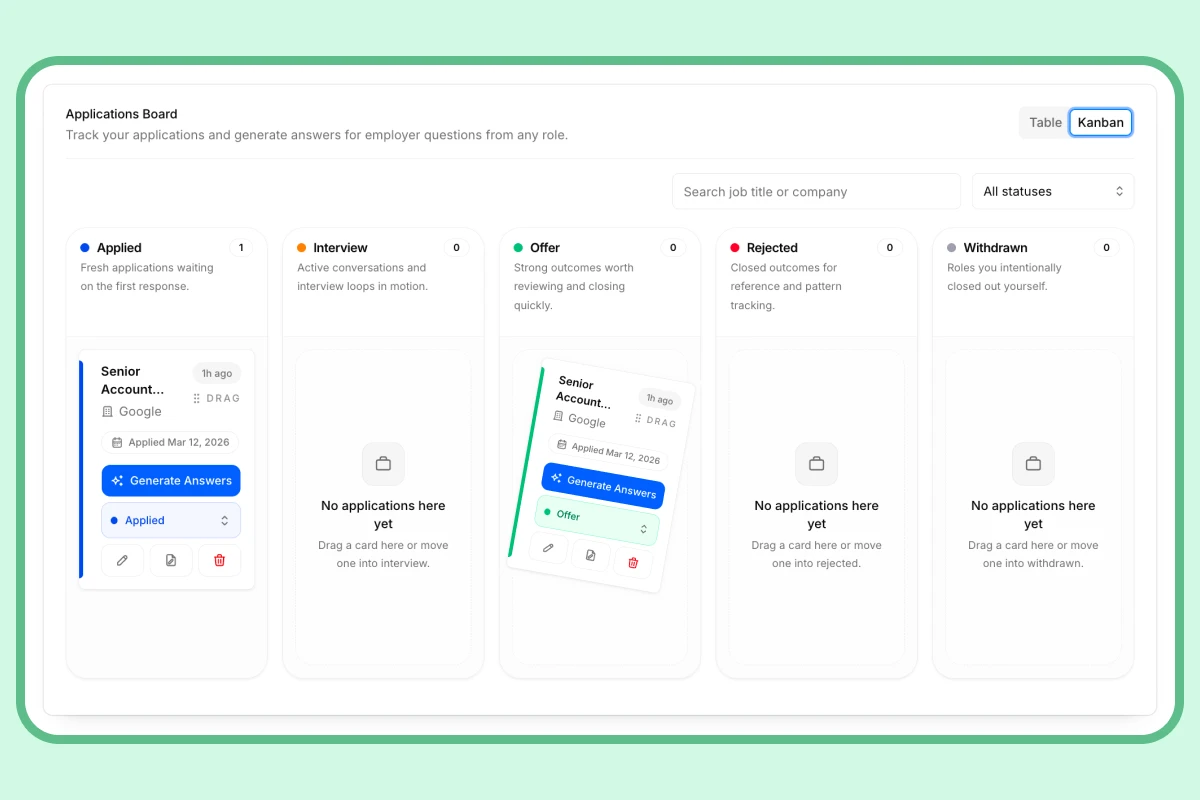
Application Tracker
Applying to 10+ jobs? You need a real system.
No more spreadsheets or lost threads. Track every role, stage, deadline, and follow-up in one dashboard — so you always know exactly where you stand.
Do Recruiters Read Cover Letters?
Yes, sometimes. Recruiters are more likely to read a cover letter when it is required, when the candidate stands out, or when they need clarification on experience.
They usually scan for:
- the correct company and role name
- a clear explanation of fit
- relevant achievements
- signs of carelessness, such as typos or generic wording
A good cover letter can help. A sloppy one can hurt.
What Should a Good Cover Letter Include?
A strong cover letter is short, specific, and easy to scan. Aim for these core parts:
1. Opening
State the role you are applying for and why you are interested.
2. Value paragraph
Connect your experience to the employer’s needs. Focus on 2 to 3 relevant achievements.
3. Proof of fit
Show why your background fits this specific job, company, or team.
4. Closing
Reaffirm interest and invite the next step.
Cover Letter Writing Tips
If you do write one, keep it efficient and targeted.
- Tailor the first paragraph to the company and role.
- Use the middle paragraph to highlight the most relevant achievements.
- Mirror a few keywords from the job description naturally.
- Keep the tone professional but direct.
- Use short paragraphs or bullets if it improves readability.
- Proofread carefully before sending.
Cover letter writing tip:
Think of the letter as a bridge between your resume and the employer’s needs, not as a summary of your entire career.
Do You Need a Cover Letter Examples
Here are a few situations where a cover letter is worth including:
- Career change example: You are moving from customer service into project coordination and need to explain transferable skills.
- Gap explanation example: You took time off for caregiving, travel, or study and want to frame that period positively.
- Referral example: A current employee recommended you and you want to mention that relationship early.
- High-interest role example: You are applying to a company you have followed for years and want to show genuine motivation.
These are the kinds of cases where a cover letter adds context rather than repeating your resume.
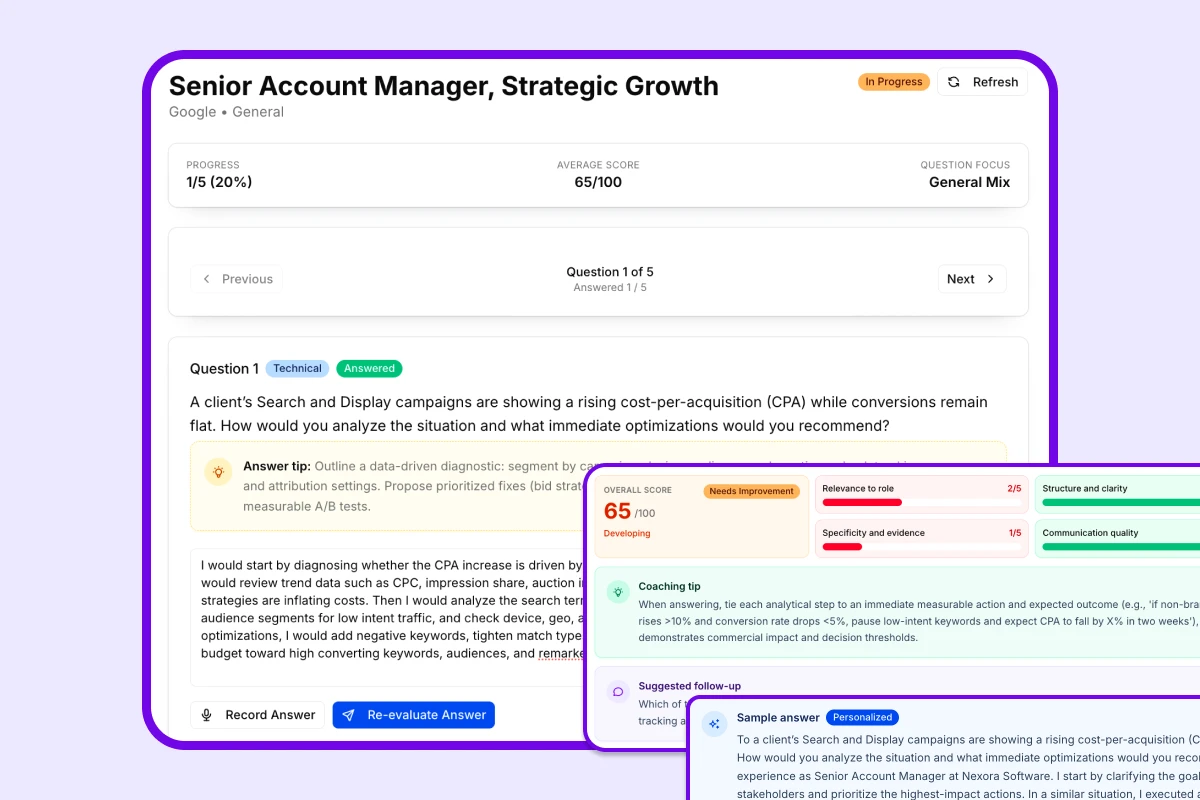
AI Interview Prep
Got the interview? Now make sure you're ready.
Practice the exact questions likely to come up for your target role. Get scored on clarity, structure, and relevance — so you walk in sharp, not winging it.
Common Cover Letter Mistakes to Avoid
A weak cover letter can do more harm than good. Avoid:
- Generic openings.
- Copying your resume line by line.
- Talking only about what you want.
- Using the wrong company name or role title.
- Writing too much.
- Skipping proofreading.
How to Write One Faster
You do not need to start from scratch every time.
- Build a reusable template.
- Save 2 to 3 achievement examples you can adapt.
- Customize the opening and closing for each application.
- Keep separate versions for different role types.
- Edit for relevance instead of rewriting everything.
This approach helps you move quickly while still sounding specific.
The Role of AI and Tools in Cover Letter Writing
Given the time investment required for a tailored letter, many job seekers now leverage technology to streamline the process. AI-powered tools can help you draft a solid first draft by analyzing the job description and your resume, suggesting relevant keywords and phrasing. However, it's crucial to personalize any AI-generated content. Always inject your unique voice, double-check for accuracy, and ensure the final letter authentically represents you. These tools are best used as a starting point to save time on structure, not as a replacement for thoughtful customization.
Industry-Specific Nuances
The necessity and format of a cover letter can vary by field. In creative industries like marketing or design, a cover letter might be expected to showcase your writing flair and personality. For technical roles in engineering or IT, recruiters may prioritize the resume but still value a concise letter that explains project relevance or problem-solving approach. In academia or research, a detailed cover letter outlining your research interests and fit with the department is often mandatory. Understanding these unwritten expectations can help you decide how much effort to invest.
The Data Behind the Decision
While expert opinions vary, data provides useful context. Surveys indicate that a significant percentage of hiring managers still read cover letters, especially for mid-to-senior level roles or when making a final decision between candidates. However, for high-volume, entry-level positions, the resume often gets the first and sometimes only glance. This reinforces the strategic approach: use a cover letter to provide necessary context or to stand out in a competitive pool, but don't assume it will be read in every scenario. Your energy is best spent on roles where the letter can clearly advance your candidacy.
Final Answer: Do You Need a Cover Letter?
Yes, if it is required. Probably, if it gives you a real advantage. No, if it is optional and would only repeat your resume.
The best rule is simple: use a cover letter when it helps you explain fit, show effort, or strengthen your candidacy. Skip it when it would not add meaningful value.
If you are applying for a role you care about, a tailored cover letter is often worth the extra time.
Explore this category
Job Applications
Browse the full job applications category for more related playbooks, examples, and tactical guides.
Browse Job Applications articles →One workflow. Resume to offer.
Build ATS-ready resumes, track every application, and practice interviews — all in one place. Free to start, no credit card needed.
✓ Free plan forever · ✓ No card needed
Related articles
How to Write a Cover Letter: The Ultimate Guide for 2026
Forget generic templates. This ultimate guide provides a clear framework for writing a cover letter that connects your skills directly to the job, highlights your achievements, and demonstrates genuine enthusiasm.
How to Write a Cover Letter with No Experience (With Examples)
No formal work experience? You can still write a strong cover letter. Use this guide to turn academic projects, volunteering, coursework, and personal initiatives into a persuasive application with examples you can adapt.
Short Cover Letter Examples: How to Write a Concise, Effective Cover Letter
Short cover letter examples can help you write a concise letter that introduces you, shows genuine interest in a role, and highlights the most relevant qualifications without repeating your resume. Use this guide to understand the structure, see sample phrasing, and tailor your letter for any job.