





A Job Search Pipeline is more than a to-do list; it's a strategic operating system for your career transition. By borrowing principles from sales and recruitment, this framework helps you move from a reactive, scattered approach to a proactive, organized campaign. It provides clarity on where you are, what's next, and how to systematically convert opportunities into offers. For a noncommercial baseline on planning and tracking applications, CareerOneStop's job search guidance is a useful reference.
What is a Job Search Pipeline and Why Do You Need One?
A job search pipeline is a structured process that breaks down the complex journey of finding a new role into distinct, manageable stages. The core value lies in its ability to bring order to chaos. Instead of randomly applying to jobs and hoping for the best, you manage a portfolio of opportunities, each progressing through a defined funnel. This allows you to track progress, identify bottlenecks (e.g., getting interviews but no offers), and allocate your time and effort strategically.
Beyond basic organization, a pipeline instills a crucial mindset shift: you are managing a business-of-one, where you are both the product and the sales lead. This perspective encourages treating each interaction with professionalism and strategic intent, moving beyond emotional reactions to rejections. It transforms the search from a passive waiting game into an active, metrics-driven project where you have control over inputs and can analyze outputs to improve performance.
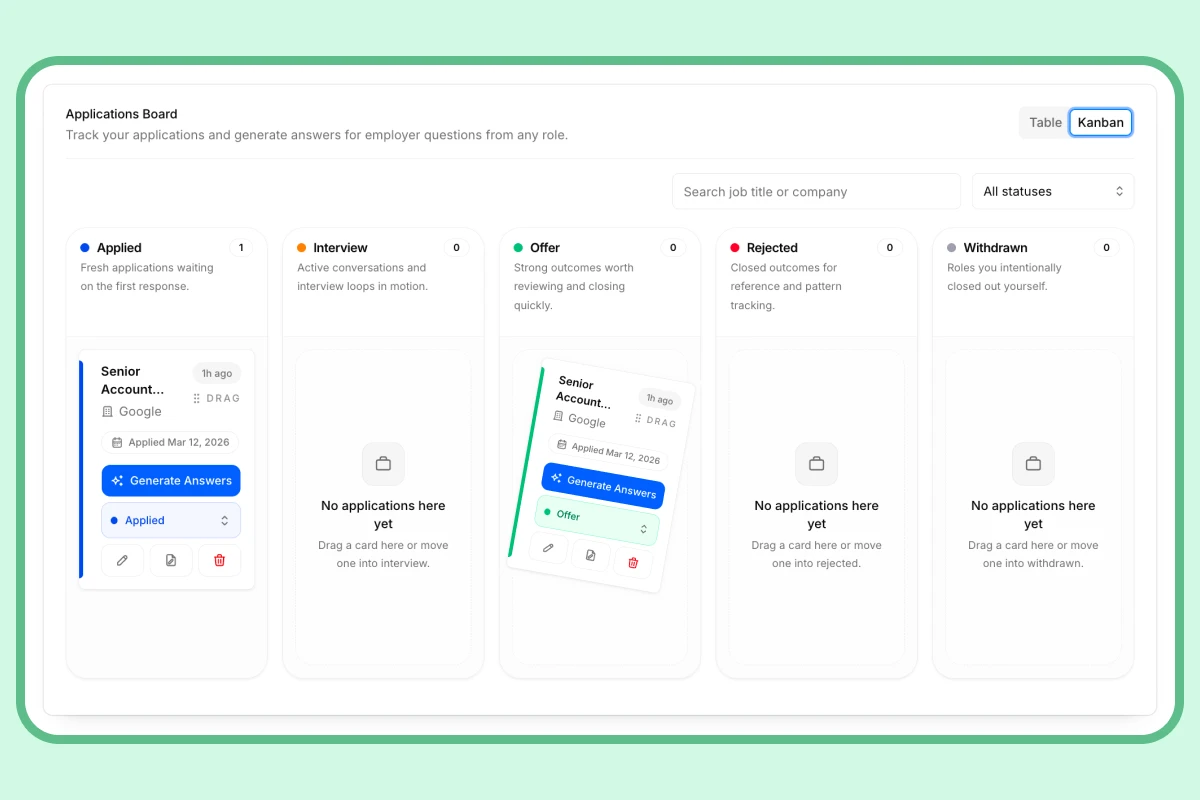
Application Tracker
Applying to 10+ jobs? You need a real system.
No more spreadsheets or lost threads. Track every role, stage, deadline, and follow-up in one dashboard — so you always know exactly where you stand.
How Do You Structure the Stages of Your Pipeline?
The most effective pipelines are modeled after proven business processes. A common and highly effective structure mirrors a sales pipeline, consisting of six key stages.
- Prospecting: This is the research phase. Your goal is to identify potential opportunities through job boards, company career pages, LinkedIn, and your network. Quantity matters here—aim to build a robust list of potential targets. Effective prospecting also involves identifying "hidden" jobs not yet posted by researching companies you admire and understanding their growth trajectories.
- Qualification: Not every job is worth pursuing. In this stage, you evaluate each prospect against your criteria (role fit, company culture, compensation range, location, growth potential). This prevents wasted effort on long-shot applications and ensures you invest energy in opportunities with a higher probability of success and personal satisfaction. A qualification checklist can be invaluable here.
- Outreach: This is the application and networking phase. You submit tailored applications, send personalized connection requests, and initiate conversations with recruiters or hiring managers. The key is moving beyond the 'Apply' button; strategic outreach includes engaging with team members on LinkedIn or commenting thoughtfully on a company's content to get on their radar before you even apply.
- Nurturing: After outreach, you must maintain engagement. This includes following up on applications, sharing relevant content with new connections, and staying on the radar of target companies through periodic, value-added communication. Nurturing turns a cold application into a warm lead and is often the differentiator in a crowded applicant pool. Automated reminders in your tracker are essential for consistency.
- Presentation: You've secured interviews. This stage involves all interactions from the phone screen to the final panel interview. Your focus is on effectively presenting your skills, experience, and cultural fit through prepared narratives, thoughtful questions, and professional demeanor. Each interview is a presentation of your value proposition.
- Negotiation & Closing: You have an offer. This final stage involves evaluating the offer comprehensively (salary, benefits, equity, work flexibility), negotiating terms professionally, and formally accepting the position to successfully close the pipeline for that opportunity. It also includes a graceful closure for other pipelines you may have running.
This stage-gated approach, as highlighted in strategies that map sales principles to job searching, creates a clear roadmap and turns abstract goals into concrete actions. It allows you to visualize your entire search landscape at a glance, understanding how many opportunities are in each stage and where you need to focus your daily efforts.
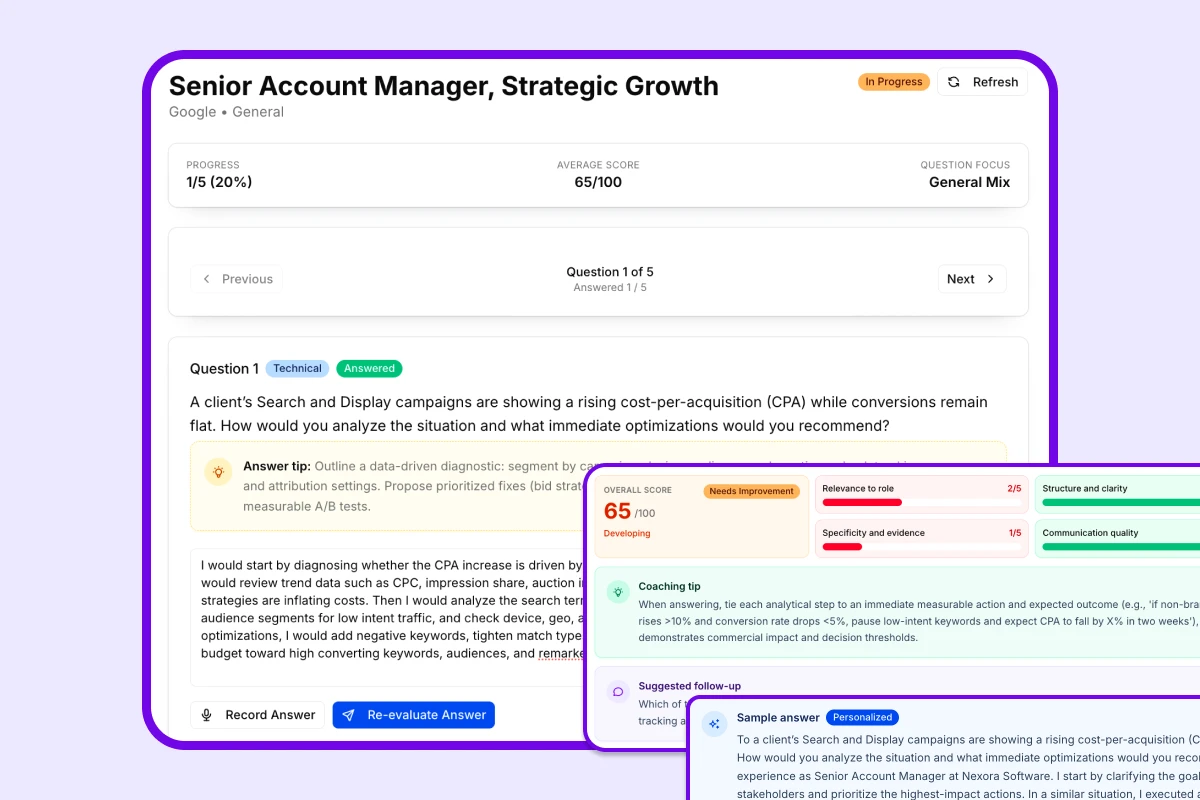
AI Interview Prep
Got the interview? Now make sure you're ready.
Practice the exact questions likely to come up for your target role. Get scored on clarity, structure, and relevance — so you walk in sharp, not winging it.
What Tools and Tactics Power an Effective Pipeline?
A framework is only as good as the tools you use to execute it. Your primary tool should be a dedicated Job Application Tracker. This acts as your Customer Relationship Management (CRM) system, centralizing all details for every opportunity: company name, role, date applied, job description link, contact persons, notes from conversations, follow-up dates, and current stage. A simple spreadsheet can work, but dedicated apps often provide better visualization of your pipeline's health through dashboards and kanban boards. The tracker is your single source of truth.
Your second critical tool is a dynamic, master resume and profile. Before you apply to a single job, create a comprehensive document containing all your achievements, skills, and experiences. From this master file, you can then swiftly create tailored resumes for each qualified opportunity by highlighting the most relevant 10% of your experience, a tactic emphasized in professional job search guidance. Similarly, ensure your LinkedIn profile is optimized as a persistent, public-facing version of your master resume.
Key Tactics for Each Stage:
- Prospecting: Set daily or weekly targets for new opportunities identified. Use advanced search operators on job boards and set up alerts. Dedicate time to expand your network with individuals in target companies or roles.
- Qualification: Use a scoring system (e.g., 1-5 on role fit, company growth, compensation) to prioritize. Create a list of non-negotiable and nice-to-have criteria to filter prospects quickly.
- Outreach: Customize every cover letter and resume with keywords from the job description. For networking outreach, craft personalized messages that reference specific details about the person's work or the company.
- Nurturing: Schedule calendar reminders for all follow-ups 5-7 days after an application or interview. Nurturing can also involve engaging with a company's social media posts or sending a relevant article to a contact.
- Presentation: Prepare structured stories (using the STAR method: Situation, Task, Action, Result) for common interview questions. Conduct mock interviews and research every interviewer on LinkedIn to tailor your conversation.
- Closing: Research compensation using employer-posted ranges, public labor-market data, and CareerOneStop's salary finder before negotiation. Prepare a negotiation script, know your walk-away point (BATNA), and practice the conversation.
How Can You Measure Progress and Optimize Your Pipeline?
You manage what you measure. Tracking key metrics transforms your pipeline from a static list into a source of actionable insights. Focus on these core conversion rates and leading indicators:
| Pipeline Stage | Key Metric to Track | What It Tells You |
|---|---|---|
| Prospecting to Qualification | Qualification Rate | How well your initial criteria match the market; helps refine your target role/company profile. |
| Qualification to Outreach | Application Rate | How selective and decisive you are in pursuing qualified opportunities. |
| Outreach to Presentation | Interview Invitation Rate | The effectiveness of your resumes, cover letters, and initial outreach. A low rate signals a need for better tailoring or stronger personal branding. |
| Presentation to Closing | Offer Rate | How well you interview, present your value, and navigate the final stages. |
| Overall | Pipeline Velocity | The average time an opportunity takes to move from Prospecting to Closing. Helps forecast your search timeline. |
For example, if your Interview Invitation Rate is low (e.g., 5%), the bottleneck is likely in your resume or application strategy. You might need better keyword optimization or a more impactful professional summary. If your Offer Rate is low despite many interviews, you need to improve your interview skills, storytelling, or negotiation posture. This data-driven mirroring of recruitment pipeline analytics, where success is tracked through stage conversions, allows for precise optimization. Regularly review these metrics weekly to adjust your tactics.
What Are Common Pitfalls and How Do You Avoid Them?
Even with a great pipeline, job seekers stumble on predictable obstacles. Recognizing and planning for these is half the battle.
- Pitfall 1: The "Spray and Pray" Application Approach. Applying to hundreds of jobs without qualification leads to burnout, low-quality applications, and a demoralizing lack of responses.
- Solution: Enforce a strict qualification stage. Be ruthless in prioritizing only the roles that are a strong fit for your skills and career goals. Quality over quantity always wins in a strategic search.
- Pitfall 2: The "Black Hole" of Follow-Up. Sending an application and then doing nothing is passive and leaves your fate entirely to others.
- Solution: Systematize nurturing. Your tracker should have a clear "Next Follow-Up Date" for every active opportunity. A polite, concise email to a recruiter or hiring manager 7-10 days after applying can significantly increase visibility and demonstrate proactive interest.
- Pitfall 3: Neglecting the Pipeline During Busy Times. When you get deep into interviews for one promising role, it's tempting to stop prospecting and nurturing others.
- Solution: Treat pipeline maintenance as a non-negotiable weekly task. Dedicate a few hours even during intensive interview periods to keep other opportunities moving. This ensures you have leverage and options, preventing desperation and giving you confidence during negotiations.
- Pitfall 4: No Post-Close Analysis. Whether you get an offer or a rejection, failing to learn from the experience is a missed opportunity for growth.
- Solution: After each closed opportunity (win or lose), conduct a brief retrospective. Note what worked (e.g., a specific resume format, a particular interview answer) and what didn't. Did you lack a key skill? Was your salary expectation misaligned? Use these insights to refine your process, update your materials, and better qualify future prospects.
- Pitfall 5: Ignoring the Human Element (Networking). Over-reliance on online applications without building relationships.
- Solution: Integrate networking as a core activity in the Prospecting, Qualification, and Nurturing stages. Aim for a mix of applications and warm introductions. A referral can dramatically increase your interview conversion rate and often provides valuable internal context about the role and team.
By viewing your job search as a pipeline, you shift from being a hopeful applicant to becoming the CEO of your own career campaign. It provides the structure to be proactive, the metrics to be analytical, and the clarity to navigate the market with confidence. Implement this system, track your progress diligently, and continuously refine your approach based on data and reflection. The result is not just a new job, but a repeatable, professional skill set for managing career transitions throughout your professional life, making you resilient in any market condition.
Explore this category
Job Applications
Browse the full job applications category for more related playbooks, examples, and tactical guides.
Browse Job Applications articles →One workflow. Resume to offer.
Build ATS-ready resumes, track every application, and practice interviews — all in one place. Free to start, no credit card needed.
✓ Free plan forever · ✓ No card needed
Related articles
How Many Jobs Should I Apply For? 2025 Job Search Strategy and Weekly Application Targets
Wondering how many jobs you should apply for? This guide breaks down weekly and total application targets, explains when to prioritize quality over quantity, and shows how to build a smarter job search plan for your timeline.
How to Create a Strategic Job Search Plan: A Step-by-Step Playbook
A strategic job search plan turns an overwhelming job hunt into a focused process. Use this step-by-step framework to define your targets, organize your search, tailor your applications, and stay on track.