





Crafting the right elevator pitch can feel intimidating. You may have only 30 to 60 seconds to introduce yourself, explain your value, and make a memorable impression—whether you're answering a job interview question, meeting someone at a networking event, or writing a LinkedIn message.
The good news: you do not need a script that sounds rehearsed. You need a flexible elevator pitch template you can adapt to different career situations. This guide gives you that template, plus examples, common mistakes to avoid, and ways to use it in interviews, applications, networking, and outreach.
Answer-First Summary
An elevator pitch is a short, compelling professional introduction. For job seekers, it is especially useful for interviews, networking, LinkedIn, and outreach emails because it helps you explain who you are, what you do, and what you want next.
The simplest effective structure is:
- Who you are
- What you do well
- What result you have delivered
- What you are looking for next
- A call to action or question.
This article provides a fill-in-the-blank Elevator Pitch Template, real-world examples, and tips to tailor your answer for job applications and professional conversations.
What Is an Elevator Pitch and Why Does It Matter for Job Applications?
An elevator pitch is more than a quick self-introduction. It is a strategic way to communicate your professional identity in a concise format.
In job searching, it helps you:
- answer “Tell me about yourself” in interviews
- introduce yourself at networking events
- write a stronger LinkedIn About section
- create concise outreach messages
- make your job application story feel consistent across resume, cover letter, and interview answers
A strong pitch gives you confidence and clarity. It also makes it easier for other people to remember what you do and why you are a fit for the roles you want.
How Do You Structure an Elevator Pitch Template?
Here is a practical 5-step framework you can use as a fill-in-the-blank template.
1. How Do I Start My Elevator Pitch?
Begin with your name, current role, and area of expertise.
Template:
I’m [Name], a [Job Title] with [X] years of experience in [Industry or Function].
Example:
I’m Jordan, a Data Analyst with five years of experience in healthcare analytics.
2. How Do I Explain What I Do Best?
Share your main strengths, specialties, or unique value.
Template:
I specialize in [Skill 1], [Skill 2], and [Skill 3], and I’m known for [unique strength or approach].
Example:
I specialize in SQL, Python, and dashboard reporting, and I’m known for turning complex data into clear decisions.
3. How Do I Add Proof to My Pitch?
Use a recent achievement or measurable result.
Template:
Recently, I [describe achievement], which led to [measurable outcome].
Example:
Recently, I helped redesign our reporting process, which cut weekly analysis time by 30%.
4. How Do I Say What I’m Looking For?
State your next step clearly so the listener understands your goals.
Template:
I’m currently looking for a [Target Role] where I can [type of contribution].
Example:
I’m currently looking for a Senior Data Analyst role where I can support faster, more strategic decision-making.
5. How Do I End with a Strong Call to Action?
Close with a question or invite further conversation.
Template:
I’d love to hear more about [topic]. Would you be open to a quick conversation?
Example:
I’d love to hear how your team uses analytics to drive product decisions. Would you be open to a brief chat?
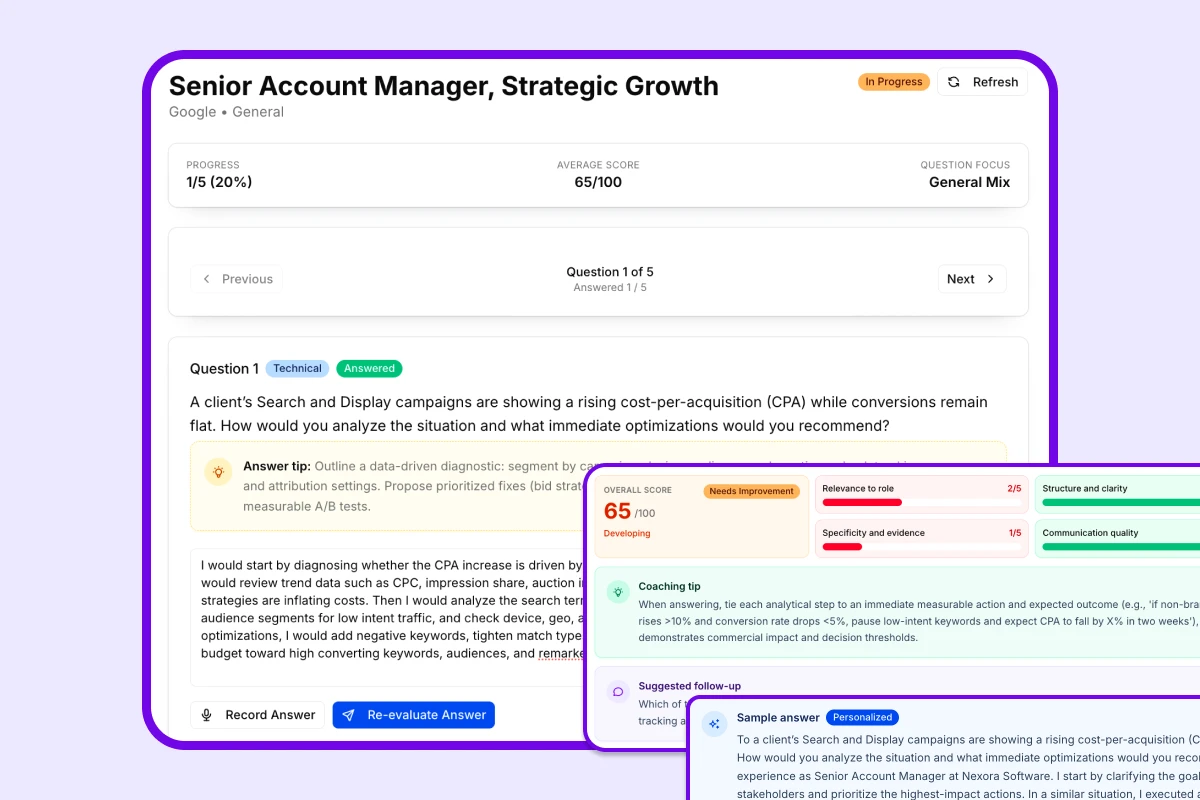
AI Interview Prep
Got the interview? Now make sure you're ready.
Practice the exact questions likely to come up for your target role. Get scored on clarity, structure, and relevance — so you walk in sharp, not winging it.
What Does a Finished Elevator Pitch Look Like?
Here are two complete elevator pitch examples you can adapt.
Example 1: Job Interview Answer
I’m Sam, a Marketing Manager with seven years of experience in B2B SaaS. I specialize in demand generation, campaign strategy, and messaging, and I’m known for turning product features into clear customer value. Recently, I led a content initiative that generated a $2.5M pipeline in one quarter. I’m currently seeking a Senior Marketing Manager role where I can help scale growth for a product-led team. I’d love to share how my background could support your goals.
Example 2: Networking Introduction
Hi, I’m Jordan, a Data Analyst focused on healthcare. I use Python and SQL to turn patient and operations data into actionable insights for clinical teams. I’m exploring new opportunities in health tech, especially with companies improving efficiency and patient outcomes. I’d be interested to hear about your experience in this space.
These examples show the difference between a longer interview answer and a shorter networking introduction. The structure stays the same, but the delivery changes based on context.
How Do I Use an Elevator Pitch in Interviews?
The most common interview use case is the “Tell me about yourself” question.
To answer well:
- keep your focus on professional background, not personal history
- highlight one or two strengths that match the role
- include one achievement with a number if possible
- end by connecting your goals to the job or company
For skill framing, NACE's career readiness competencies are a useful reference because they translate broad strengths into workplace behaviors.
A good interview answer template sounds natural, not memorized. You want to sound prepared and confident, not robotic.
Job Application Answer Template
Use this shorter structure when you need a concise answer in an application or interview setting:
I’m [Name], a [role] with experience in [field]. I specialize in [skills] and have helped [type of team or company] achieve [result]. I’m looking for a role where I can [goal].
How Can I Adapt My Elevator Pitch for LinkedIn and Outreach Emails?
Your elevator pitch can also become the foundation of written introductions.
LinkedIn About Section
For LinkedIn, use the same structure but expand slightly:
- who you are
- what you do well
- one or two career highlights
- what opportunities you are open to
Keep the tone professional and conversational.
Outreach Email or Connection Request
For a short email or message, trim the pitch down to the essentials:
Hi [Name], I came across your work on [topic] and found it insightful. I’m a [role] with experience in [skill or field], and I’m currently exploring opportunities in [target area]. I’d appreciate the chance to learn from your perspective. Would you be open to a brief chat?
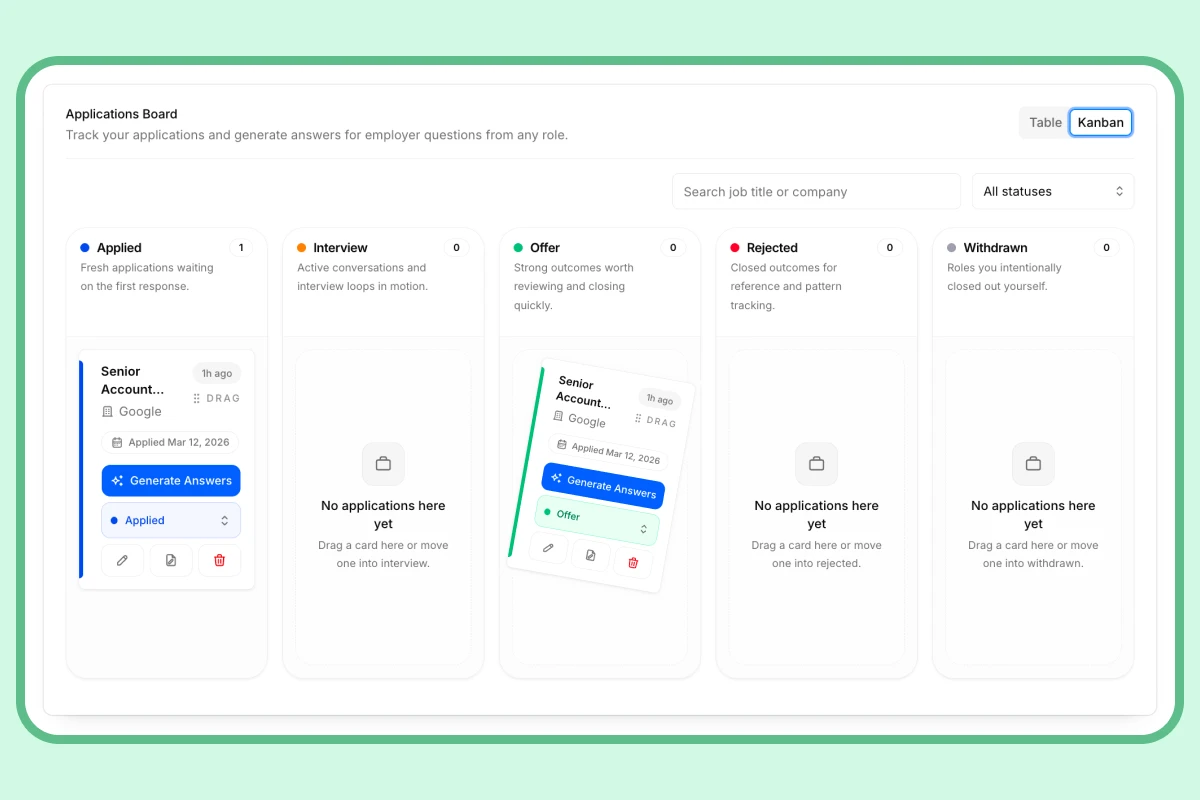
Application Tracker
Applying to 10+ jobs? You need a real system.
No more spreadsheets or lost threads. Track every role, stage, deadline, and follow-up in one dashboard — so you always know exactly where you stand.
What Are the Most Common Elevator Pitch Mistakes?
Even a strong template can fall flat if the delivery is unclear. Watch out for these common issues.
| Mistake | Why It Hurts | Better Approach |
|---|---|---|
| Being too vague | It does not tell people what you actually do | Use clear role titles, skills, and outcomes |
| Making it too long | People lose interest | Keep it under 60 seconds for spoken use |
| Focusing only on yourself | It can feel self-centered | Connect your experience to the listener’s needs |
| Sounding memorized | It feels stiff and unnatural | Practice speaking it conversationally |
| Ending without direction | The conversation stalls | End with a question or next step |
How Does an Elevator Pitch Connect to My Resume and Cover Letter?
Your elevator pitch should match the story told by your resume and cover letter.
- Resume summary: A written version of your core pitch
- Cover letter opening: A tailored version of your pitch for one specific role
- Interview story: A broader version of the same message, expanded with examples
Consistency matters. When your pitch, resume, and cover letter reinforce the same strengths, your candidacy feels clearer and more credible.
What Is the Best Way to Practice an Elevator Pitch?
To make your pitch sound natural:
- write out a first draft
- shorten it to the essential points
- read it aloud
- time yourself
- practice with different audiences and settings
- refine it until it sounds like you
A polished pitch should feel confident, conversational, and easy to adjust.
Final Checklist: Is Your Elevator Pitch Ready?
Before you use your pitch, check whether it:
- fits within 30 to 60 seconds when spoken
- explains who you are clearly
- includes specific skills or strengths
- features at least one measurable result
- states what role or opportunity you want
- ends with a question or call to action
- sounds natural and authentic
- works for interviews, networking, or LinkedIn with minor edits
Conclusion
A strong Elevator Pitch Template helps you present yourself with clarity in interviews, networking conversations, and job application answers. When you know how to explain who you are, what you do well, and what you want next, you make it much easier for other people to understand your value.
Use the framework in this guide to build your own version, then adjust it for each situation. With a little practice, your elevator pitch can become one of the most useful tools in your job search.
Explore this category
Interview Prep
Browse the full interview prep category for more related playbooks, examples, and tactical guides.
Browse Interview Prep articles →One workflow. Resume to offer.
Build ATS-ready resumes, track every application, and practice interviews — all in one place. Free to start, no credit card needed.
✓ Free plan forever · ✓ No card needed
Related articles
How to Introduce Yourself Professionally: Examples, Tips, and Templates for Interviews, Networking, and Emails
Use this guide to build a professional introduction that feels natural, confident, and tailored to the situation. Includes examples, templates, and tips for interviews, networking, emails, and remote meetings.
100 Words to Describe Yourself in an Interview: A Practical Playbook
The 'describe yourself' question is a pivotal interview moment. This guide provides a strategic toolkit of 100+ impactful words, categorized for clarity, demonstrates how to weave them into compelling, job-specific answers that showcase your unique value.
Fun Facts About Me: Examples and Tips for Interviews and Job Applications
Learn how to answer "Fun Facts About Me" with confidence in interviews, resumes, and job applications. This guide includes examples, tips for tailoring your response, and advice for sounding professional, authentic, and memorable.