





Navigating the "Describe yourself" or "Tell me about yourself" interview question is less about memorizing a script and more about strategically showcasing your professional identity. This guide provides a pragmatic playbook: a categorized list of 100+ powerful words and a framework for weaving them into answers that resonate with hiring managers. For a neutral preparation baseline, CareerOneStop's interview tips reinforce the same focus on examples, practice, and clear communication.
For related next steps, use common interview questions guide, behavioral interview questions guide, situational interview questions guide, and tell me about yourself guide.
Why Your Word Choice Matters in an Interview
Your choice of descriptors acts as a verbal business card. Generic terms like "hardworking" blend into the background, while precise, vivid language paints a memorable picture of your capabilities and potential. According to career resources, selecting words aligned with the job's core requirements can significantly strengthen your candidacy by demonstrating role-specific understanding. This precision helps you stand out in a competitive field where interviewers may screen dozens of candidates, making your personal brand instantly clearer and more compelling.
How to Structure Your "Describe Yourself" Answer
Before diving into the word list, understand the proven structure for your answer. A compelling response typically follows this arc.
- Present: Start with your current role and a key professional strength relevant to the job.
- Past: Briefly highlight 1-2 achievements that prove that strength.
- Future: Connect your skills and passions directly to the role you're interviewing for.
This framework ensures your answer is concise, relevant, and forward-looking. It transforms a potentially open-ended question into a targeted pitch, guiding the conversation toward your suitability for the position. Experts recommend keeping this narrative to 60-90 seconds to maintain engagement and clarity.
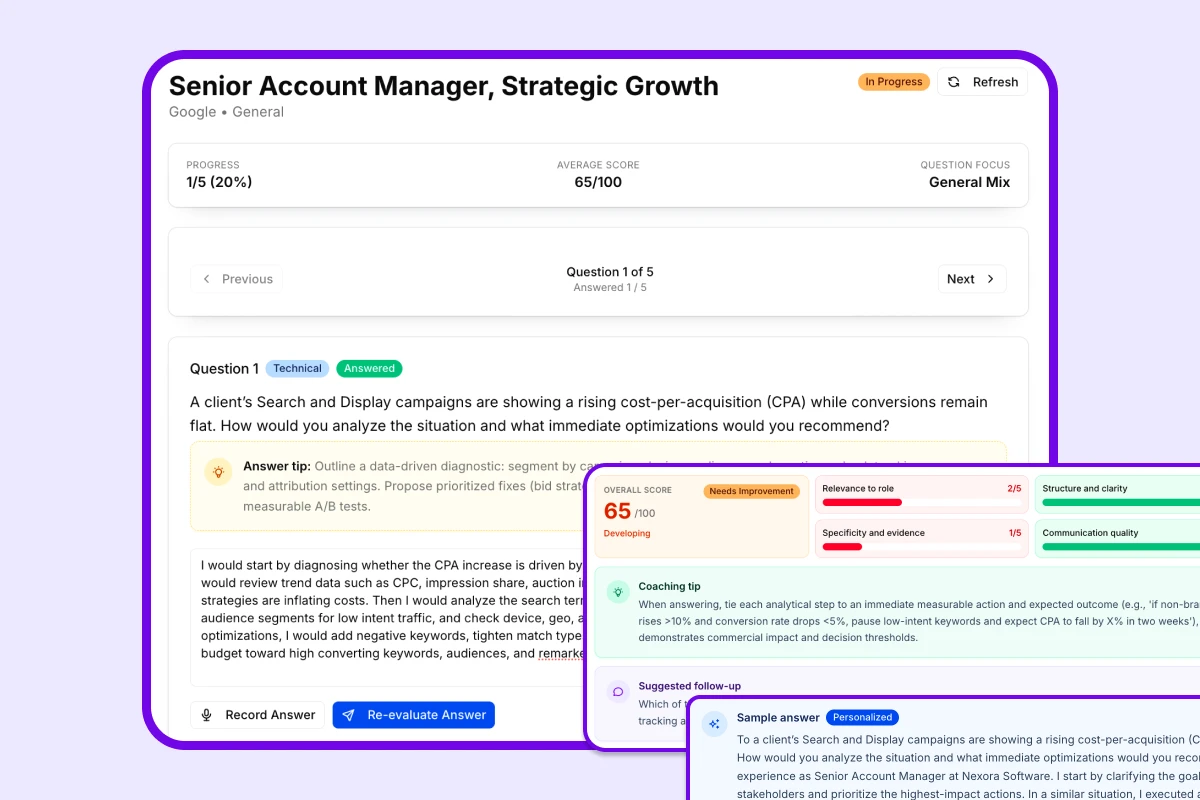
AI Interview Prep
Got the interview? Now make sure you're ready.
Practice the exact questions likely to come up for your target role. Get scored on clarity, structure, and relevance — so you walk in sharp, not winging it.
The Interview Word Bank: 100+ Words Categorized for Impact
Use this categorized list as a toolkit. Select words that authentically reflect you and align with the job description. Mixing words from different categories can create a well-rounded professional portrait.
1. Leadership & Initiative
These words demonstrate your capacity to guide, own outcomes, and drive progress.
- Accountable, Decisive, Diplomatic, Empowering, Influential, Motivational, Strategic, Visionary
- Example in context: "I'm a decisive and accountable leader. In my last project, I empowered my team to implement a new workflow, which we owned from start to finish, increasing departmental efficiency by 15%."
2. Problem-Solving & Analytical Thinking
Showcase your logical approach to challenges and data-driven decision-making.
- Analytical, Detail-Oriented, Diagnostic, Inquisitive, Logical, Methodical, Perceptive, Resourceful
- Example in context: "I am inherently inquisitive and analytical. When sales dipped, I diagnosed the root cause through customer data and resourcefully tested a new outreach strategy that recovered 95% of at-risk accounts."
3. Collaboration & Interpersonal Skills
Highlight your ability to build relationships and work effectively within teams.
- Cooperative, Diplomatic, Empathetic, Harmonious, Personable, Receptive, Synergistic, Team-Oriented
- Example in context: "I'm a team-oriented and empathetic collaborator. I believe in synergistic work; for instance, I facilitated a harmonious cross-departmental workshop that resolved a long-standing communication bottleneck."
4. Drive & Work Ethic
Communicate reliability, passion, and a commitment to excellence.
- Diligent, Disciplined, Earnest, Meticulous, Passionate, Persistent, Reliable, Tenacious
- Example in context: "My approach is disciplined and tenacious. I persistently refined our quality assurance protocol over six months, resulting in a 40% reduction in customer-reported issues."
5. Creativity & Innovation
Illustrate your ability to think differently and improve processes or products.
- Creative, Curious, Imaginative, Ingenious, Innovative, Inventive, Original, Visionary
- Example in context: "I am an innovative and curious thinker. I invented a simple automation script for a repetitive task, an ingenious solution that saved the team over 10 hours per week."
6. Adaptability & Growth
Prove you can thrive in change and are committed to continuous learning.
- Adaptable, Agile, Dynamic, Flexible, Progressive, Resilient, Versatile
- Example in context: "I am adaptable and resilient. When our company underwent a major software migration, I agilely learned the new platform and created training materials for my versatile team, ensuring a smooth transition."
7. Communication & Influence
Essential for roles requiring clear articulation, persuasion, or stakeholder management.
- Articulate, Clear, Convincing, Eloquent, Persuasive, Tactful, Transparent
- Example in context: "I am an articulate and persuasive communicator. I transparently presented a complex data analysis to non-technical stakeholders, using clear visuals to convincingly secure budget approval for a new initiative."
8. Results & Achievement Orientation
Focus on outcomes, goal attainment, and delivering measurable value.
- Ambitious, Driven, Goal-Oriented, High-Achieving, Productive, Results-Driven, Successful
- Example in context: "I am results-driven and ambitious. As a goal-oriented project manager, I consistently delivered projects 10% under budget, directly contributing to the team's high-achieving quarterly targets."
Crafting Your Answer: From Words to a Winning Narrative
A list of words is only powerful when integrated into a coherent story. Follow this process:
- Audit the Job Description: Identify 3-5 key competencies or traits the role demands. Look for repeated verbs and nouns.
- Self-Match: From the categories above, select 2-4 words that both describe you authentically and match those key competencies. Prioritize words that you can back with evidence.
- Build Your ARC: Using the Present-Past-Future structure, craft a 60-90 second answer. Weave in your chosen words and support each with a specific, quantifiable achievement where possible.
Sample Answer Framework (for a Marketing Manager role):
"Currently, I'm a strategic and data-driven Marketing Manager focused on growth. In the past, my analytical approach helped me diagnose an underperforming campaign channel. I resourcefully reallocated the budget to a more innovative social strategy, which increased lead generation by 25% last quarter. I'm excited by this role because it would allow me to apply my versatile experience in both analytics and creative brand building to scale your market presence."
Sample Answer Framework (for a Software Developer role):
"I am a meticulous and solution-oriented software developer. I'm passionate about writing clean, efficient code. For example, when faced with a persistent performance bottleneck in a previous role, I took a diagnostic and logical approach to refactor a key module, which improved application response time by 300ms. I'm eager to bring this detail-oriented and persistent problem-solving to your team to help build robust, scalable features."
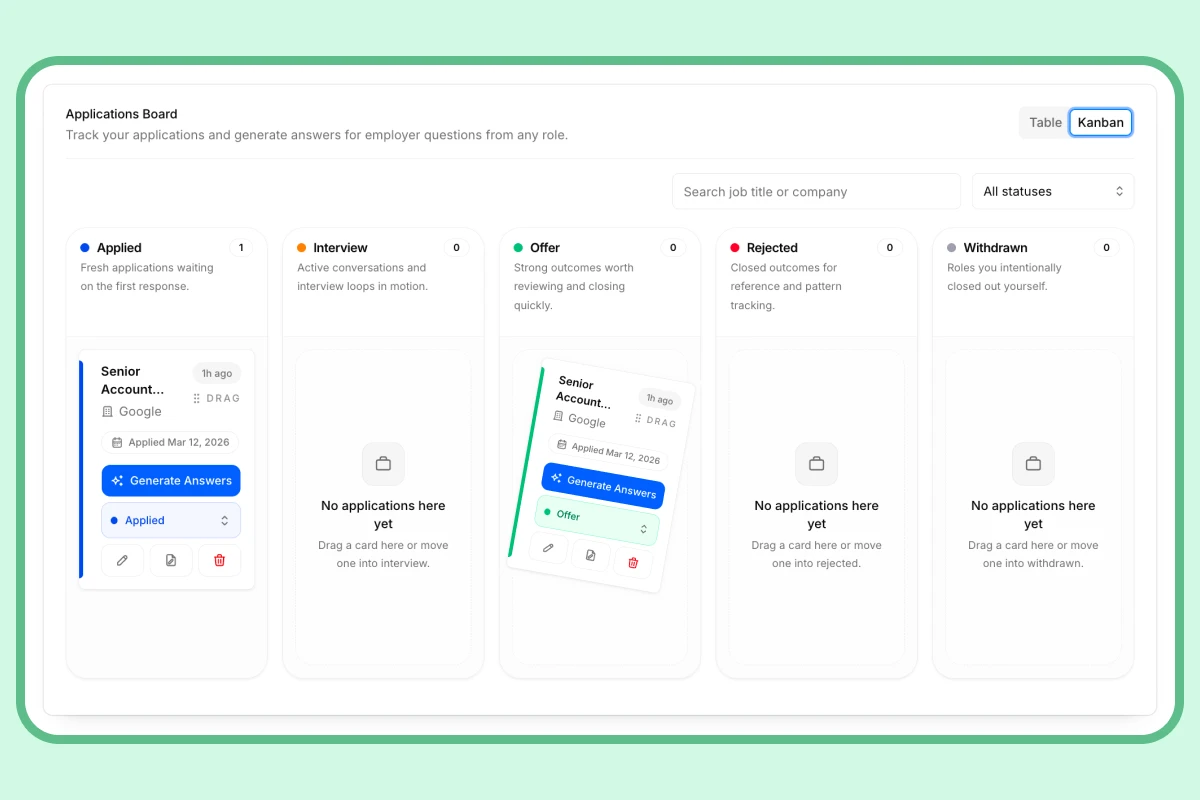
Application Tracker
Applying to 10+ jobs? You need a real system.
No more spreadsheets or lost threads. Track every role, stage, deadline, and follow-up in one dashboard — so you always know exactly where you stand.
Common Pitfalls to Avoid
- Using Empty Clichés: Avoid overused words like "hardworking" or "team player" without concrete proof. They lack differentiation.
- Being Too Generic: Your answer must be tailored to this job at this company. Research the company culture to inform your word choice (e.g., "innovative" for a startup, "reliable" for a regulated industry).
- Listing Without Story: Don't just recite adjectives. Embed them in the narrative of your achievements. The story makes the trait believable.
- Misrepresenting Yourself: Choose words that are true to your experience. Authenticity is key, as inconsistencies can be probed in follow-up questions.
- Overcomplicating: Using overly complex or jargon-heavy words can seem inauthentic. Clarity and confidence trump vocabulary showmanship.
Advanced Tip: Leverage Modern Tools for Precision
While crafting your answer manually is essential, modern career tools can provide an edge. AI-powered platforms can help you identify the most impactful keywords from a job description and suggest ways to integrate them seamlessly into your interview narratives and resume bullet points. This ensures your language is not only powerful but also optimized for the specific opportunity. For instance, tools with resume scanners can highlight gaps between your materials and the job's keywords, allowing you to adjust your verbal pitch accordingly.
Applying Words Beyond the Interview Question
Your selected descriptive words shouldn't be siloed. Integrate them throughout the interview:
- In Behavioral Answers: When answering "Tell me about a time when..." questions, lead with the trait. "That situation required me to be adaptable..."
- In Your Questions: Frame your questions to reflect your traits. "As someone who is strategic, I'm curious about the company's roadmap for..."
- In Your Thank-You Note: Reinforce 1-2 key words you used, linking them back to the discussion. "I was particularly excited to discuss how my innovative approach could apply to your challenge..."
Final Checklist Before Your Interview
- I have identified 3-5 core requirements from the job description.
- I have selected 2-4 descriptive words that match both the job and my authentic experience.
- I have crafted a 60-90 second answer using the Present-Past-Future structure.
- I have included a specific, quantifiable example for each key trait I mention.
- I have practiced my answer aloud until it sounds natural and confident.
- I have considered how to weave these keywords into other potential interview answers.
By moving beyond a simple list to a strategic narrative, you transform the "describe yourself" question from a hurdle into a highlight, clearly communicating why you are the right candidate for the job. This playbook equips you not just with words, but with the methodology to deploy them effectively, turning a common interview prompt into a powerful personal branding opportunity.
Explore this category
Interview Prep
Browse the full interview prep category for more related playbooks, examples, and tactical guides.
Browse Interview Prep articles →One workflow. Resume to offer.
Build ATS-ready resumes, track every application, and practice interviews — all in one place. Free to start, no credit card needed.
✓ Free plan forever · ✓ No card needed
Related articles
Fun Facts About Me: Examples and Tips for Interviews and Job Applications
Learn how to answer "Fun Facts About Me" with confidence in interviews, resumes, and job applications. This guide includes examples, tips for tailoring your response, and advice for sounding professional, authentic, and memorable.
How Do You Sell Yourself During an Interview: A Pragmatic Playbook
Selling yourself in an interview isn't about boasting; it's a strategic process of aligning your proven skills with the employer's needs. This playbook provides the concrete frameworks, scripts, and preparation tactics you need to communicate your value with confidence and authenticity.
Interview Question: Why Should We Hire You for This Position? Answer Guide
Use this guide to build a strong answer to "Why should we hire you for this position?" with a simple framework, practical examples, and tips for tailoring your response to the role and company.