





Selling yourself in a job interview is the critical act of translating your experience and potential into undeniable value for the hiring manager. It's not about empty promotion; it's a structured, evidence-based conversation designed to prove you are the solution to their problem. For a neutral preparation baseline, CareerOneStop's interview tips reinforce the same focus on preparation, examples, and clear communication.
Answer-First Summary
To sell yourself effectively in an interview, you must systematically: 1) Decode the Job Description to identify core needs, 2) Develop a Compelling Value Narrative using frameworks like a tailored elevator pitch and the STAR method, 3) Master the Dialogue by asking strategic questions and actively listening, and 4) Project Confidence through prepared stories, thoughtful questions, and professional presence. Success hinges on preparation—transforming your resume bullets into relevant, quantifiable stories that directly address the company's challenges.
What Does 'Selling Yourself' in an Interview Actually Mean?
Contrary to popular belief, selling yourself isn't about being the loudest or most self-assured candidate in the room. It's the process of strategically aligning your documented skills and achievements with the specific problems and goals of the role and company. Strong answers prove fit through prepared examples and thoughtful dialogue, not generic claims about your qualifications. Think of yourself as a consultant presenting a case for why you are the best investment.
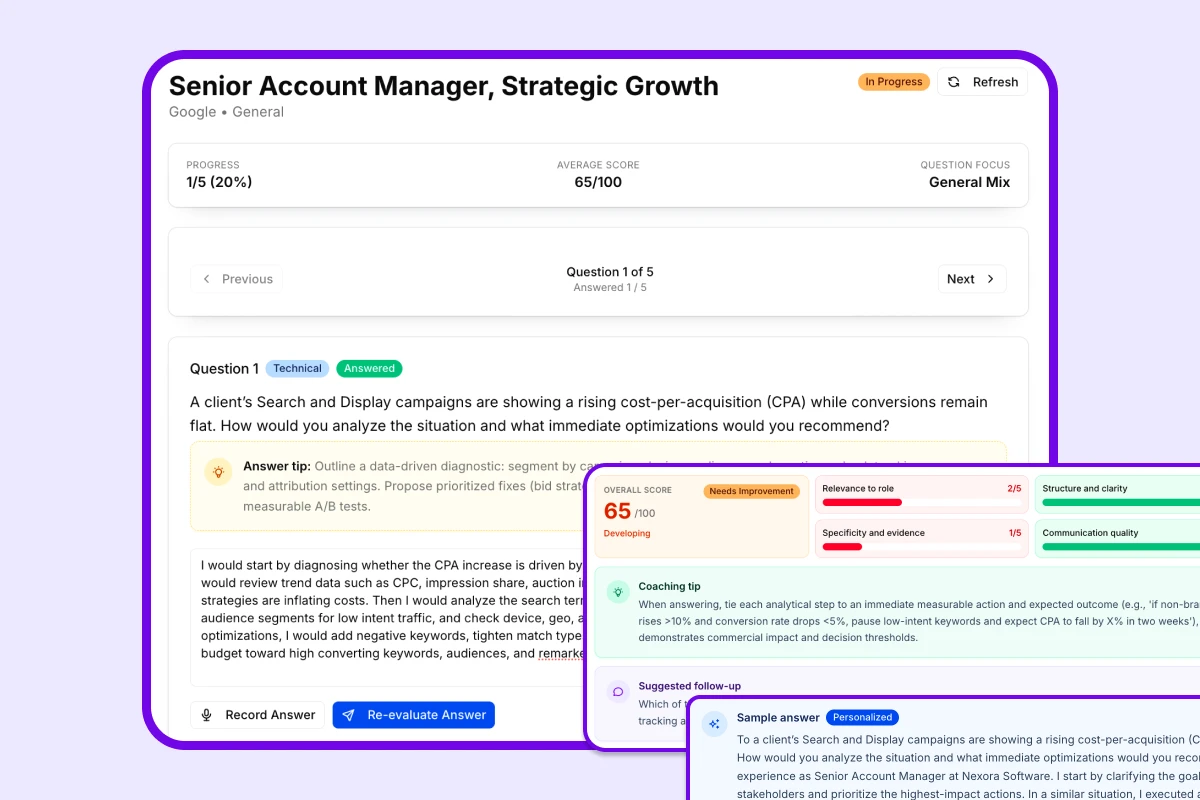
AI Interview Prep
Got the interview? Now make sure you're ready.
Practice the exact questions likely to come up for your target role. Get scored on clarity, structure, and relevance — so you walk in sharp, not winging it.
How Do You Prepare Your Core Value Proposition Before the Interview?
Preparation is the non-negotiable foundation. Walking in without a prepared value proposition leaves your pitch to chance.
1. Decode the Job Description
Analyze the posting to identify the 3-5 core problems the hire must solve. Look for repeated keywords, required outcomes, and implied challenges. This becomes your target list.
2. Audit Your Experience
Map your past achievements to each core problem. Use the following table to structure your audit:
| Core Need from Job Description | My Relevant Skill/Experience | Quantifiable Achievement (Use the STAR Method) |
|---|---|---|
| E.g., Improve team process efficiency | Project Management & Agile Methodology | Situation: Team missed deadlines. Task: Implement new sprint planning. Action: Led workshops, introduced Jira. Result: Reduced sprint overruns by 40% in 6 months. |
| E.g., Grow social media engagement | Content Strategy & Analytics | Situation: Static social media presence. Task: Increase engagement and followers. Action: Developed content calendar, used targeted hashtags. Result: Grew follower base by 150% and engagement rate by 300% YoY. |
3. Craft Your Tailored Elevator Pitch
Your answer to "Tell me about yourself" is your opening sales pitch. Structure it as: Present (your current role/core expertise) + Past (2-3 key achievements relevant to this job) + Future (why you're excited about this role/company). Keep it concise—60-90 seconds.
Example: "I'm a marketing manager with over seven years of experience specializing in data-driven growth campaigns. In my current role, I led a strategy that increased our qualified lead volume by 35% year-over-year. I've been following
What Are the Best Frameworks for Answering Behavioral Questions?
When asked about your experience, structured storytelling is key. The STAR method (Situation, Task, Action, Result) is the clearest way to provide evidence of your skills. The critical element often forgotten is the "R" for Result: quantify your impact with metrics such as percentages, time saved, revenue increased, or costs reduced.
Weak Answer: "I improved our customer service system."
Strong STAR method Answer: "Situation: Our customer service team was handling over 200 tickets daily with a 48-hour average resolution time. Task: I was tasked with streamlining the process to improve efficiency and satisfaction. Action: I researched and implemented a new ticketing software with automated categorization, created a knowledge base for common issues, and trained the team on new protocols. Result: Within three months, we reduced the average resolution time by 60% to under 19 hours and saw customer satisfaction scores increase from 78% to 92%."
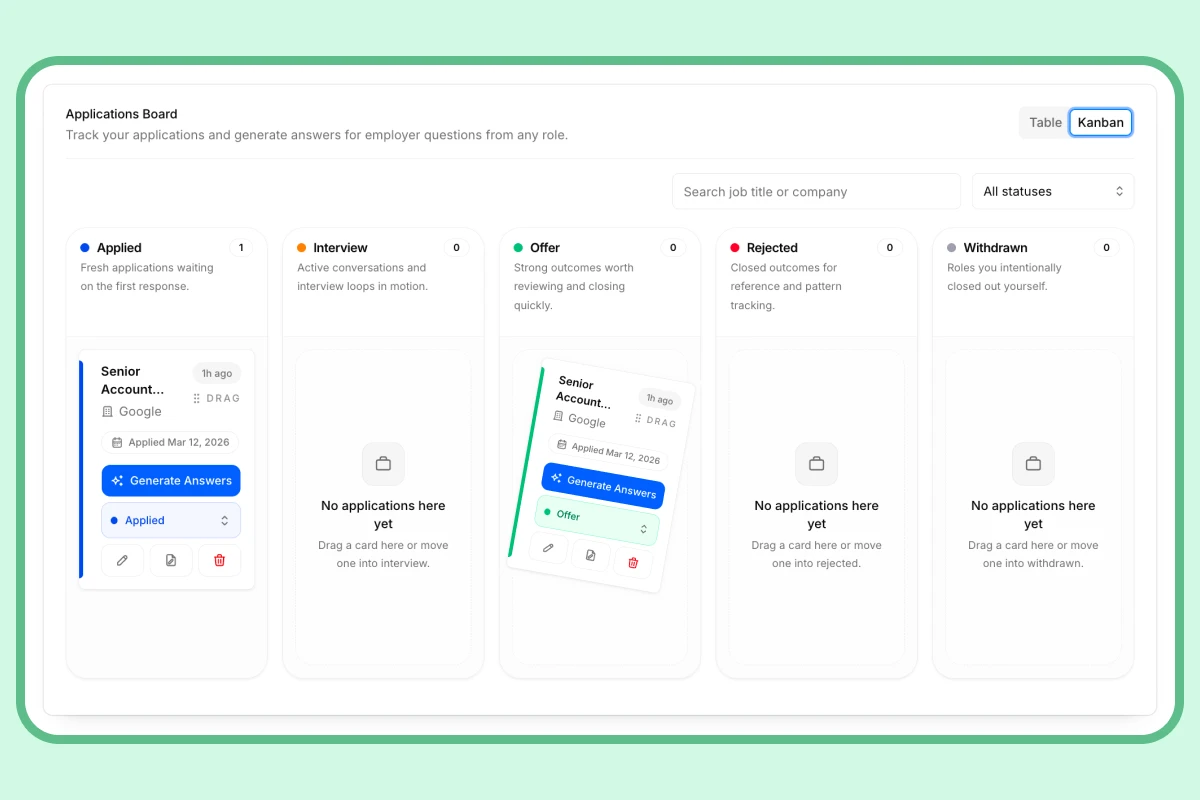
Application Tracker
Applying to 10+ jobs? You need a real system.
No more spreadsheets or lost threads. Track every role, stage, deadline, and follow-up in one dashboard — so you always know exactly where you stand.
How Can You Demonstrate Value Without Sounding Arrogant?
The line between confidence and arrogance is drawn by humility, authenticity, and focus on collective success. Frame your achievements to highlight teamwork and learning.
- Use "We" and "The Team": "Through a collaborative team effort, we were able to..."
- Acknowledge Context: "Given the market conditions at the time, the key was to..."
- Focus on Problem-Solving: Instead of "I'm the best salesperson," say, "I enjoy the challenge of understanding a client's unique pain points, which led to me exceeding our quarterly target by 20%."
- Show Growth: Share what you learned from a setback. This demonstrates self-awareness and resilience without pretending your path has been perfect.
What Strategies Make You Stand Out in a Competitive Interview?
- Ask Insightful Questions: Move beyond basics. Ask about challenges: "What's the biggest challenge the team has faced in the last quarter?" Ask about success: "What would outstanding performance in this role look like in the first six months?" This shows strategic thinking.
- Connect to Company Vision: Reference recent company news, a mission statement, or a product launch. Say, "I saw your announcement about X initiative; how does this role contribute to that?"
- Present a Prepared Idea (Tactfully): Based on your research, you might say, "Considering the company's goal to expand into Y market, one idea I had was... I'd be eager to explore that further."
- Master Non-Verbal Communication: Confidence is communicated through engaged eye contact, attentive posture, clear speech, and thoughtful pauses.
How Do You Relate Your Experience to the Company's Specific Needs?
This is the crux of selling yourself. Use bridging phrases to connect your story to their need after providing your STAR example.
- "That experience in [your past achievement] is why I'm confident I can help with [company's stated challenge]."
- "The skill I developed in [specific area] directly aligns with your team's need for [requirement from job description]."
- "Understanding that this role requires [key skill], my approach would be similar to when I [briefly reference past example]."
How Should You Follow Up to Reinforce Your "Sale"?
Your sell isn't over when the interview ends. Within 24 hours, send a personalized thank-you email to each interviewer. Re-sell yourself by:
- Thanking them for their time.
- Reiterating one key point of connection: "I was particularly excited to discuss how my experience in [specific area] could contribute to [specific project/challenge we discussed]."
- Briefly addressing any unanswered question or adding a concise thought related to the conversation.
- Restating your enthusiasm for the role.
This final touchpoint reinforces your value, professionalism, and genuine interest.
Key Takeaway: Selling yourself is a prepared performance of relevance. By meticulously researching the role, framing your achievements within structures like STAR, connecting every answer back to the employer's needs, and engaging as a problem-solver, you transform from a candidate listing qualifications into the obvious solution. It's not about being a different person; it's about preparing to be the most relevant version of yourself.
Explore this category
Interview Prep
Browse the full interview prep category for more related playbooks, examples, and tactical guides.
Browse Interview Prep articles →One workflow. Resume to offer.
Build ATS-ready resumes, track every application, and practice interviews — all in one place. Free to start, no credit card needed.
✓ Free plan forever · ✓ No card needed
Related articles
How to Answer What Are Your Greatest Strengths in an Interview
Learn how to answer "What are your greatest strengths?" with a concise, tailored response that highlights relevant skills, proves them with examples, and shows fit for the job.
Situational Interview Questions: Examples, Answers, and STAR Method Tips
Situational interview questions ask how you would handle hypothetical, job-related scenarios to evaluate problem-solving, judgment, and critical thinking. This guide explains what they are, how they differ from behavioral questions, and how to answer them with a simple framework and real examples.
100 Words to Describe Yourself in an Interview: A Practical Playbook
The 'describe yourself' question is a pivotal interview moment. This guide provides a strategic toolkit of 100+ impactful words, categorized for clarity, demonstrates how to weave them into compelling, job-specific answers that showcase your unique value.