





Quantifying your resume is one of the fastest ways to turn a list of responsibilities into proof of impact. Instead of saying what you did, you show what changed because of your work. That matters for recruiters, hiring managers, and Applicant Tracking Systems (ATS), which all respond better to specific results than vague claims. For a neutral baseline on structure and formatting, CareerOneStop's resume guidance is a useful noncommercial reference.
For related next steps, use resume skills section guide and resume summary examples.
Answer-First Summary: To quantify your resume, convert each bullet into a measurable achievement using the How Many? How Much? How Often? How Long? framework. If you do not have exact numbers, use scale, frequency, time saved, team size, budget, process improvements, or estimated ranges. The goal is to connect your action to a clear outcome so your resume accomplishments and resume bullet points read as evidence, not just experience.
What Does It Mean to Quantify Your Resume?
To quantify your resume means to add numbers, scale, or measurable outcomes to your bullet points. A quantified bullet shows the size of your work, the scope of your responsibility, or the result of your contribution.
For example, compare these two bullet styles:
- Before: Managed social media accounts.
- After: Managed 5 social media accounts with a combined audience of 100K+ followers, increasing monthly engagement by 22%.
The second version is stronger because it answers three questions at once: what you handled, how much you handled, and what changed.
Why Does Quantifying Your Resume Matter?
Quantified bullets make your resume more persuasive for two reasons:
- They build credibility. Numbers make accomplishments easier to verify and harder to ignore.
- They improve scannability. Recruiters can quickly see scale, ownership, and results.
They also support ATS resume optimization because measurable outcomes often include role-relevant keywords in context. A phrase like “managed a $500K budget” is more specific than “responsible for budget management,” and that specificity helps your experience stand out.
What Are the Best Examples of Quantified Resume Bullet Points?
The best examples are tied to the core function of the role. Avoid random metrics that do not support the story you want to tell.
Quantify Your Resume Examples by Role
- Marketing: Led an email campaign that generated $500K in pipeline revenue and improved conversion rates by 25%.
- Human Resources: Reduced onboarding time by 30% by launching a digital training workflow, improving new-hire satisfaction by 40%.
- Software Engineering: Optimized database performance, reducing page load time from 4.0 seconds to 1.2 seconds for 50K+ users.
- Project Management: Led a cross-functional team of 12 to deliver a product launch 2 weeks early and 15% under a $200K budget.
- Customer Service: Improved first-contact resolution from 70% to 85% within 6 months by creating a new knowledge base.
- Operations: Streamlined monthly reporting, saving 8 hours per week and reducing manual errors by 35%.
- Sales: Closed 118% of quota for 3 consecutive quarters and added $1.2M in annual recurring revenue.
Free ATS Score
Your resume might be invisible to recruiters
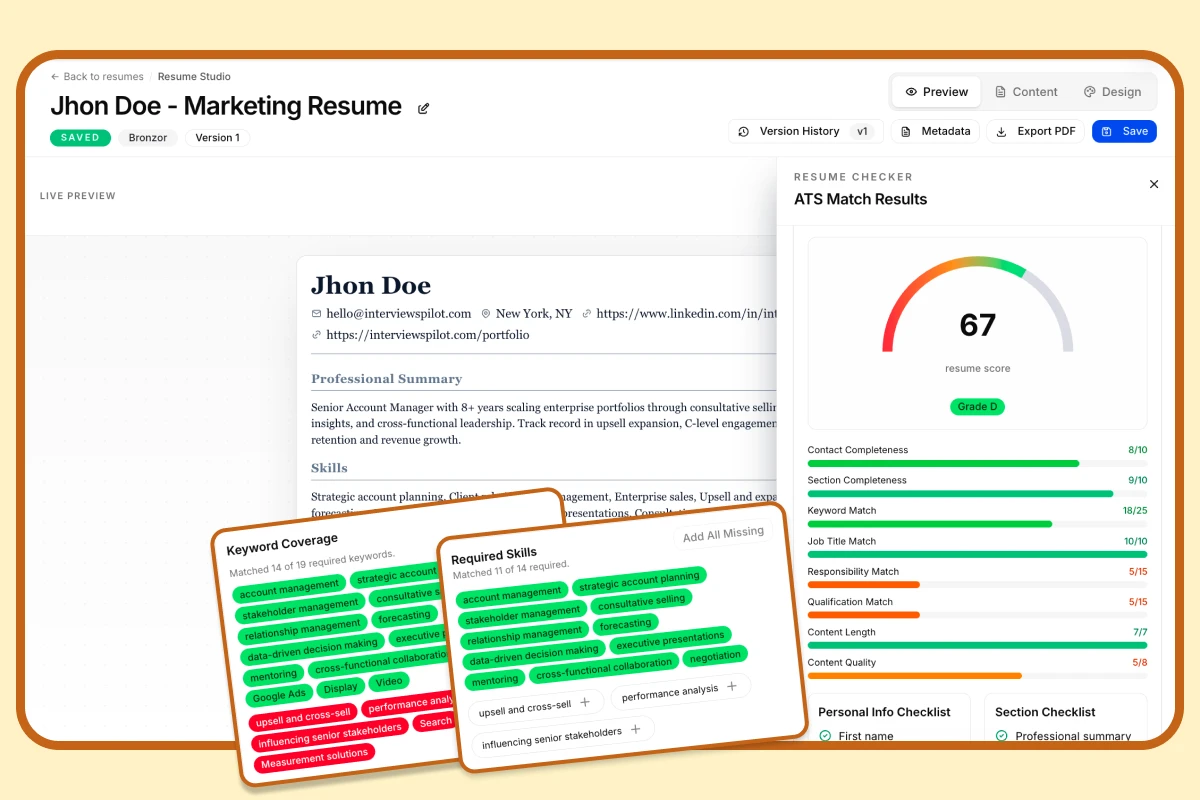
Most resumes are filtered out before a human ever sees them. Get your free ATS score and see exactly where your resume falls short — before you hit send.
How Do You Quantify Your Resume If You Don’t Have Exact Numbers?
This is the most common challenge. You do not need perfect data to write strong bullets. In many cases, proxy metrics are enough.
Use one of these approaches:
1. Quantify by Scale
Show the size of what you handled.
- Managed a portfolio of 7 client accounts.
- Supported a team of 14 employees.
- Oversaw a budget of approximately $80K.
2. Quantify by Frequency or Volume
Show how often or how much work you completed.
- Reviewed an average of 45 contracts per month.
- Processed 120+ customer requests weekly.
- Produced 3 executive reports each quarter.
3. Quantify by Time Saved
Show efficiency gains.
- Reduced report preparation time by 6 hours per week.
- Cut onboarding steps from 10 days to 4 days.
- Automated a recurring task that saved the team 20 hours monthly.
4. Quantify by Outcome or Improvement
Show what got better.
- Increased customer satisfaction scores by 18%.
- Decreased errors by 27%.
- Improved team adoption of a new process from 50% to 92%.
5. Use Estimates or Ranges
When exact figures are unavailable, use reasonable estimates.
- Approximately 20%
- More than 50 clients
- An estimated $10K in savings
Be careful to stay honest. If the number is approximate, make that clear.
What Frameworks Help You Quantify Accomplishments?
A repeatable framework makes it easier to turn weak bullets into strong ones.
The 4-Question Framework
Ask yourself:
- How many?
- How much?
- How often?
- How long?
If you cannot answer one question, try another. One strong metric is often enough.
The CAR Method
Use Challenge-Action-Result to build a complete bullet point.
- Challenge: What problem needed solving?
- Action: What did you do?
- Result: What changed, and by how much?
Example:
Improved a slow client onboarding process by designing a standardized intake form, reducing average onboarding time from 10 days to 4 days and increasing satisfaction scores by 30%.
The Scope + Action + Result Formula
This formula works well when you want the bullet to feel natural and readable.
- Scope: team size, budget, volume, audience, location, or scale
- Action: what you did
- Result: measurable impact
Example:
Managed a 9-person support team and introduced a new ticket-routing process that cut response time by 40%.
What Metrics Can You Use for Non-Sales Roles?
You do not need revenue metrics to quantify your resume. Many jobs can be measured through time, quality, volume, adoption, satisfaction, or efficiency.
| Role Type | Useful Metrics | Example |
|---|---|---|
| HR / People Ops | time-to-hire, retention, training completion, satisfaction | Reduced time-to-hire by 20% by improving interview scheduling and candidate follow-up. |
| Design / Creative | adoption, engagement, production volume, turnaround time | Designed a new onboarding flow adopted by 90% of users in the first month. |
| Admin / Support | requests handled, errors reduced, turnaround time, coordination scope | Coordinated logistics for 12 board meetings and delivered all materials on time. |
| Operations | cycle time, cost savings, throughput, efficiency | Improved fulfillment workflow, increasing daily output by 18% while lowering errors by 22%. |
| Management | team size, promotions, growth, project delivery | Led a 6-person team that completed 4 major releases on schedule over 12 months. |
How Do You Quantify Soft Skills on a Resume?
Soft skills should be proven through outcomes, not listed as adjectives.
Communication
- Presented quarterly results to 10 senior stakeholders, helping secure a 15% budget increase.
Problem-Solving
- Resolved recurring system outages, eliminating 40+ hours of monthly downtime.
Collaboration
- Partnered with sales and product teams on 3 launches that contributed to a 25% increase in quarterly revenue.
Leadership
- Mentored 5 junior analysts, 3 of whom were promoted within 18 months.
AI Resume Builder
Stop sending the same resume to every job
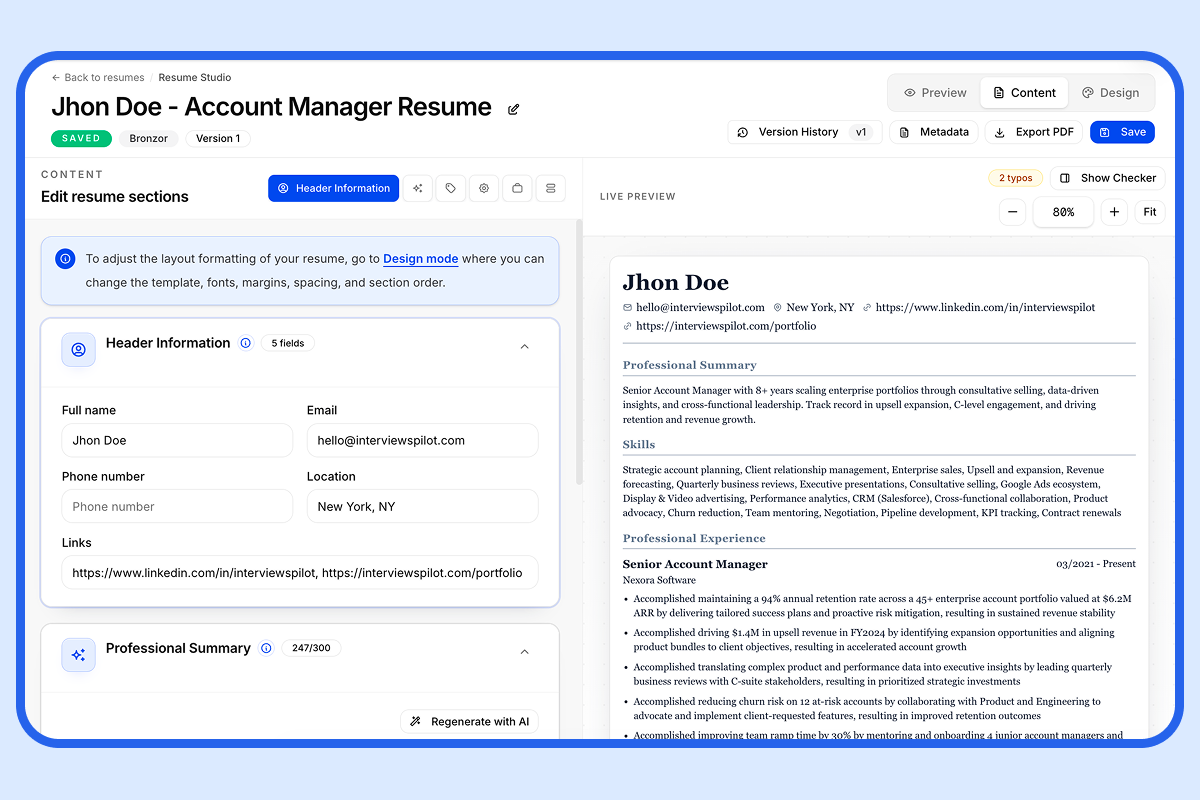
Paste any job description and InterviewsPilot rewrites your resume around it — keywords, bullets, and summary aligned to what recruiters are actually scanning for.
How Does Quantifying Your Resume Improve ATS Resume Optimization?
ATS tools are not only looking for keywords. They also analyze whether your experience matches the role in a meaningful way.
Quantified bullets help because they:
- place keywords in a stronger context
- show scope and seniority
- reinforce role-specific relevance
- make your experience easier to rank against the job description
For example, “budget management” is weaker than “managed a $250K annual budget.” The second version includes the same idea, but it gives the ATS and recruiter more useful context.
What Are Common Mistakes When You Quantify Your Resume?
Here are a few mistakes to avoid:
- Using numbers without context: “Improved revenue by 12%” is better when paired with the actual amount.
- Choosing vanity metrics: Pick numbers that match the job, not just the biggest number you can find.
- Overstuffing every bullet: Not every line needs two or three metrics.
- Guessing too aggressively: Estimates are fine, but keep them realistic.
- Repeating the same metric: Vary your bullets so your resume sounds well-rounded.
How Can You Quickly Find Numbers for Your Resume?
If you are stuck, review:
- performance reviews
- project dashboards
- client reports
- budget documents
- email threads with results
- task trackers
- team meeting notes
- before-and-after comparisons
If exact data is unavailable, ask yourself what changed in speed, quality, size, cost, or adoption.
Quantify Your Resume Checklist
Before you finalize a bullet point, check whether it answers at least one of these:
- What was the scale of the work?
- How much did I improve it?
- How many people, users, or items were involved?
- How often did it happen?
- How much time or money did I save?
- What changed because of my work?
If a bullet does not answer any of these questions, it probably needs more detail.
Final Thoughts
If you want to quantify your resume well, focus on impact, not just numbers. The strongest bullets combine action, scope, and result in a way that is easy to scan and hard to overlook. Whether you are writing for HR, design, operations, engineering, or management, the same rule applies: show what you did, show how much you did, and show what improved because of it.
That is how you turn experience into evidence.
Explore this category
Resume
Browse the full resume category for more related playbooks, examples, and tactical guides.
Browse Resume articles →One workflow. Resume to offer.
Build ATS-ready resumes, track every application, and practice interviews — all in one place. Free to start, no credit card needed.
✓ Free plan forever · ✓ No card needed
Related articles
The Biggest Resume Mistakes to Avoid: A 2026 Pragmatic Playbook
Your resume is your first interview. Avoid the common pitfalls—from missing contact details to vague duties—that get your application instantly rejected. This playbook details the biggest mistakes and provides clear, actionable solutions to craft a resume that gets noticed.
How Long Should a Resume Be? The Definitive, Data-Backed Guide for 2026
Forget rigid rules. The ideal resume length is determined by your experience, industry, and the ATS. This guide provides clear, evidence-based guidelines for entry-level to executive professionals.
How Many Bullet Points per Job on Resume? A Practical Guide
The usual rule is 3 to 5 bullet points per job on a resume. This guide shows when to use fewer or more, how to prioritize recent roles, and how to write bullets that are clear, results-driven, and ATS-friendly.