





Your resume summary is the first substantive thing a recruiter or hiring manager reads. In a competitive job market, a strong 2-4 sentence summary can help you quickly show relevance, confidence, and fit. This guide gives you resume summary examples, a simple writing formula, ATS-friendly resume summary tips, and common mistakes to avoid.
For related next steps, use ATS optimization checklist.
Answer-First Summary: A resume summary is a concise statement at the top of your resume that highlights your most relevant skills, experience, and achievements for a specific job. It acts like a professional elevator pitch, showing an employer why you are a strong fit before they reach your work history. Unlike a resume objective, which focuses on what you want, a summary focuses on what you bring.
What Is a Resume Summary and How Is It Different from a Resume Objective?
A resume summary, sometimes called a professional summary or qualifications summary, is a targeted introduction that gives employers a fast snapshot of your value. It is most useful when you already have relevant experience and want to show the strongest, most job-related parts of your background.
A resume objective, by contrast, explains your career goals. It can still be useful for recent graduates, career changers, or applicants with limited experience, but for most job seekers a summary is the better choice because it emphasizes proven results.
When Should You Use a Resume Summary?
Use a resume summary when you want to.
- Target your application to a specific job description
- Condense a long career into the most relevant highlights
- Show transferable skills during a career change
- Put your most important qualifications in front of the recruiter right away
If you are early in your career, you can still use a summary. Focus on coursework, internships, volunteer work, certifications, and transferable strengths that match the role.
How Do You Write a Strong Resume Summary?
Use this simple framework to write a professional summary that is clear and specific.
- Start with your professional title. Lead with your role or identity, such as "Marketing Manager" or "Registered Nurse."
- Add your years of experience. Include your experience level or specialization when it helps position you clearly.
- Highlight 2-3 job-relevant skills. Choose the hard and soft skills that best match the job description.
- Include a measurable achievement. Show impact with a metric, result, or outcome whenever possible.
- Tie it to the role. End with the value you bring or the type of work you are ready to do.
Resume Summary Tips That Improve Results
- Use keywords from the job description naturally.
- Keep the summary short and focused.
- Write in third person style without using "I" or "my."
- Prioritize proof over buzzwords.
- Tailor the summary for each application.
Free ATS Score
Your resume might be invisible to recruiters
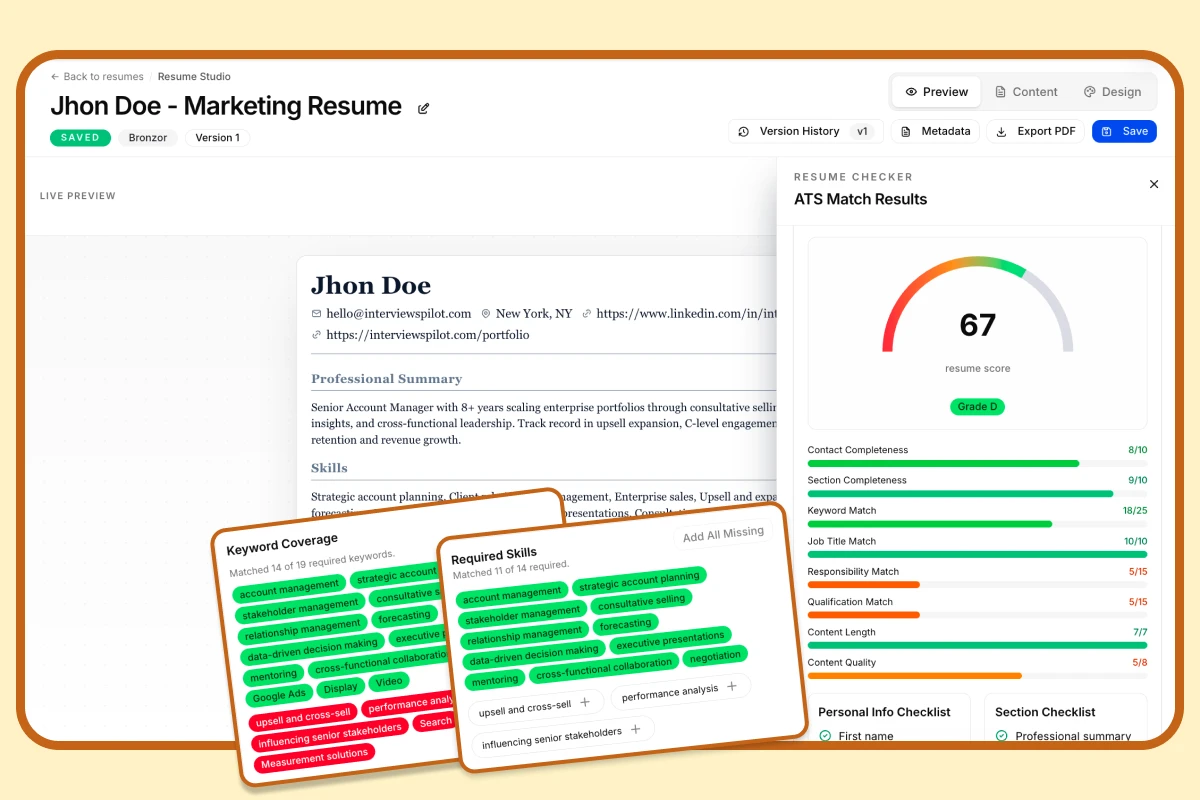
Most resumes are filtered out before a human ever sees them. Get your free ATS score and see exactly where your resume falls short — before you hit send.
Resume Summary Examples for Different Career Levels
Entry-Level Resume Summary Example
Detail-oriented recent business graduate with internship experience in project coordination and client communication. Skilled in data analysis, research, and presentation design, with a record of supporting team projects and improving reporting accuracy. Eager to apply strong organization and problem-solving skills in an entry-level operations role.
Why it works: This example emphasizes transferable skills, relevant experience, and clear direction without overclaiming.
Career Changer Resume Summary Example
Customer-focused hospitality professional transitioning into digital marketing. Brings 6 years of experience in team leadership, customer engagement, and process improvement, plus hands-on experience with social media content and campaign support. Known for adapting quickly, building trust with clients, and improving satisfaction metrics by 30%.
Why it works: It explains the transition, connects old experience to new goals, and includes a measurable result.
Mid-Career Professional Resume Summary Example
Strategic Project Manager with 7 years of experience in financial technology. Expert in Agile workflows, cross-functional team leadership, stakeholder communication, and budget management. Led a project portfolio valued at $2M, delivered initiatives on time and 15% under budget, and improved operational efficiency by 25% through process optimization.
Why it works: This summary is specific, metric-driven, and full of keywords that align with many project management roles.
Senior-Level Resume Summary Example
Visionary Chief Technology Officer with 15+ years of experience scaling engineering teams in high-growth startups. Deep expertise in cloud infrastructure, product strategy, team development, and systems architecture. Led a platform overhaul that reduced latency by 60% and supported growth from 500K to 5M+ monthly active users.
Why it works: It signals leadership, scale, and strategic impact while keeping the focus on measurable business results.
What Are Professional Summary Examples by Industry?
If you are looking for professional summary examples, the best approach is to match the language of your field. Here are a few quick examples.
Professional Summary Example for Marketing
Results-driven Marketing Specialist with 5 years of experience in content strategy, email campaigns, and lead generation. Increased qualified leads by 40% through targeted messaging and conversion-focused campaign optimization.
Professional Summary Example for Healthcare
Compassionate Registered Nurse with 8 years of experience in patient care, clinical documentation, and care coordination. Recognized for improving patient satisfaction scores and maintaining accurate, compliant records in fast-paced hospital settings.
Professional Summary Example for Finance
Detail-oriented Financial Analyst with strong experience in reporting, forecasting, and budget analysis. Identified cost-saving opportunities that reduced monthly expenses by 12% and improved decision-making through clearer financial dashboards.
Professional Summary Example for IT
Solutions-focused IT Support Specialist with experience in help desk operations, troubleshooting, and network maintenance. Resolved 95% of tickets within SLA and improved end-user satisfaction through faster response times and clear communication.
How Can You Make a Resume Summary ATS-Friendly?
Applicant Tracking Systems scan for keywords and role alignment, so your summary should be readable by both software and people. To improve ATS performance:
| Do | Don't |
|---|---|
| Use standard job titles and common synonyms. | Use unusual internal job titles only. |
| Include hard skills and software terms from the job post. | Rely only on vague traits like "team player." |
| Write complete sentences with natural keyword placement. | Stuff keywords into a list with no context. |
| Keep the format simple and easy to parse. | Use graphics or styling that may confuse ATS software. |
A well-written summary should reflect the language of the job posting without sounding copied or robotic.
AI Resume Builder
Stop sending the same resume to every job
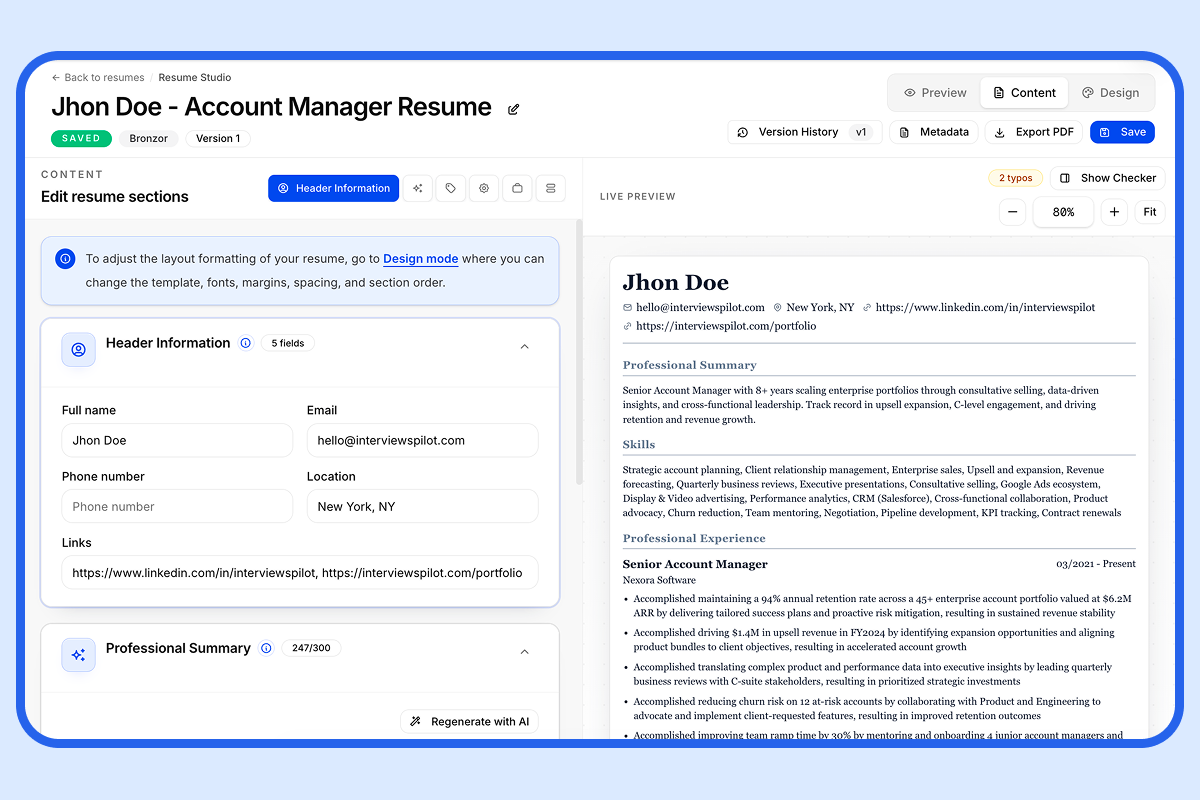
Paste any job description and InterviewsPilot rewrites your resume around it — keywords, bullets, and summary aligned to what recruiters are actually scanning for.
What Are Common Resume Summary Mistakes to Avoid?
- Being too vague. Phrases like "results-oriented professional" do not say much without proof.
- Making it too long. A summary should be short enough to scan quickly.
- Using first person. Skip "I," "me," and "my."
- Writing one version for every job. Tailor it to the role and company.
- Repeating your work history. Summarize patterns, strengths, and measurable impact instead of listing job titles.
- Including irrelevant details. Leave out information that does not support the job you want.
How Do You Choose the Best Keywords for a Resume Summary?
The best keywords come from the job description itself. Look for repeated terms related to:
- Job title
- Core responsibilities
- Technical tools or platforms
- Certifications or credentials
- Industry-specific terms
Then work those terms into a natural summary that still sounds human. For example, if a job description emphasizes "stakeholder management," "budget oversight," and "cross-functional collaboration," those phrases should appear in your summary if they accurately reflect your experience.
Resume Summary Tips for Career Changers and Non-Traditional Paths
If you are changing careers or returning to work after a gap, your summary should focus on transferable value.
- Lead with the role you want, not the role you left.
- Translate past experience into skills the new employer cares about.
- Use metrics from any relevant work, volunteer, freelance, or project-based experience.
- Highlight certifications, coursework, or training that support the transition.
For example, a former teacher moving into corporate training could emphasize presentation skills, curriculum design, stakeholder communication, and measurable learning outcomes.
Final Checklist for a Strong Resume Summary
Before you submit your resume, check that your summary:
- Is 2-4 sentences long
- Starts with a strong professional title or descriptor
- Includes relevant years of experience when helpful
- Uses 2-3 job-specific keywords naturally
- Includes at least one measurable result
- Matches the target role and industry
- Avoids vague filler and first-person language
- Is proofread for grammar and clarity
A resume summary should do one thing well: make it obvious why you are a strong fit. When you keep it specific, concise, and tailored, it becomes a powerful introduction that helps both ATS systems and hiring managers see your value faster.
Frequently Asked Questions
What is a resume summary and how does it differ from a resume objective?
A resume summary focuses on your experience, strengths, and measurable value. A resume objective focuses on your career goals. Most experienced job seekers benefit more from a summary.
When should you include a resume summary on your resume?
Include a summary when you want to target a role, highlight relevant achievements, or quickly communicate your fit. It is especially useful for mid-career and senior candidates, but early-career candidates can use one too.
How do you write a strong resume summary step-by-step?
Start with your title, add years of experience, include 2-3 relevant skills, add a measurable accomplishment, and end with the value you bring to the role.
What are examples of resume summaries for entry-level, mid-career, and senior professionals?
Entry-level summaries should emphasize transferable skills and training. Mid-career summaries should highlight expertise and results. Senior summaries should show leadership, scale, and strategic impact.
How can a resume summary be optimized for ATS systems?
Use common job titles, include keywords from the job description, and keep the format clean and readable. Avoid keyword stuffing and complex design elements.
What are common mistakes to avoid in resume summaries?
Avoid vague language, long paragraphs, first-person writing, generic claims, and summaries that are not tailored to the role.
How do professional summary examples help you write faster?
Professional summary examples show the structure, tone, and level of detail employers expect. They can help you adapt your own summary more quickly while still keeping it original and relevant.
Explore this category
Resume
Browse the full resume category for more related playbooks, examples, and tactical guides.
Browse Resume articles →One workflow. Resume to offer.
Build ATS-ready resumes, track every application, and practice interviews — all in one place. Free to start, no credit card needed.
✓ Free plan forever · ✓ No card needed
Related articles
How Long Should a Resume Be? The Definitive, Data-Backed Guide for 2026
Forget rigid rules. The ideal resume length is determined by your experience, industry, and the ATS. This guide provides clear, evidence-based guidelines for entry-level to executive professionals.
How to Read a Job Description: Tips, Examples, and ATS Resume Optimization
Learn how to read a job description like a recruiter. This guide explains the key sections of a posting, how to judge whether you qualify, and how to use job description keywords to improve ATS resume optimization with real examples tips.
Resume Accomplishments: The Definitive Guide to Quantifying Your Impact
A resume filled with duties is forgettable; one filled with accomplishments is compelling. This guide breaks down how to identify, quantify, and structure your professional achievements to create a resume that gets noticed by both hiring managers and ATS software.