





Writing your first cover letter can feel intimidating when you do not have a long work history to draw from. The good news is that employers do not only value job titles. They also look for communication, initiative, problem-solving, and the ability to learn quickly. For baseline formatting and message structure, Purdue OWL's job search letter guidance is a useful noncommercial reference.
This guide shows you how to write a cover letter with no experience by turning academic work, volunteer roles, extracurriculars, and personal projects into proof that you can contribute right away.
Answer-First Summary
If you are writing a cover letter with no experience, focus on what you can prove.
- Research the job description and company.
- Use a professional cover letter format.
- Highlight transferable skills from school, volunteering, or projects.
- Show enthusiasm and a clear reason for applying.
- Include specific examples instead of general claims.
The best no-experience cover letters are short, tailored, and evidence-based.
What should you focus on in a cover letter with no experience?
The goal is not to apologize for lacking experience. The goal is to show relevance.
Instead of saying, "I have no experience," shift your thinking to: "Here is the experience I do have that matches this role."
Good sources of evidence include:
- Academic projects and group assignments
- Volunteer work
- Student leadership roles
- Part-time or informal responsibilities
- Personal projects, portfolios, or side projects
- Coursework, certifications, or workshops
A strong cover letter connects those experiences to the employer’s needs.
How do you structure a cover letter with no professional history?
Use a standard business letter structure. A familiar format helps you sound polished and credible.
1. Header
Include your name, phone number, email address, LinkedIn profile if relevant, and location.
2. Date
Add the date you are sending the letter.
3. Employer information
If possible, include the hiring manager’s name, job title, company name, and address.
4. Greeting
Use a specific greeting when you can, such as:
- Dear Ms. Lopez,
- Dear Hiring Manager,
- Dear Marketing Team,
5. Body paragraphs
Most cover letters have 3 paragraphs:
- Paragraph 1: State the role and express interest.
- Paragraph 2: Show how your background matches the job.
- Paragraph 3: Reiterate your fit and request an interview.
6. Closing
End with a professional sign-off such as:
- Sincerely,
- Best regards,
- Thank you,
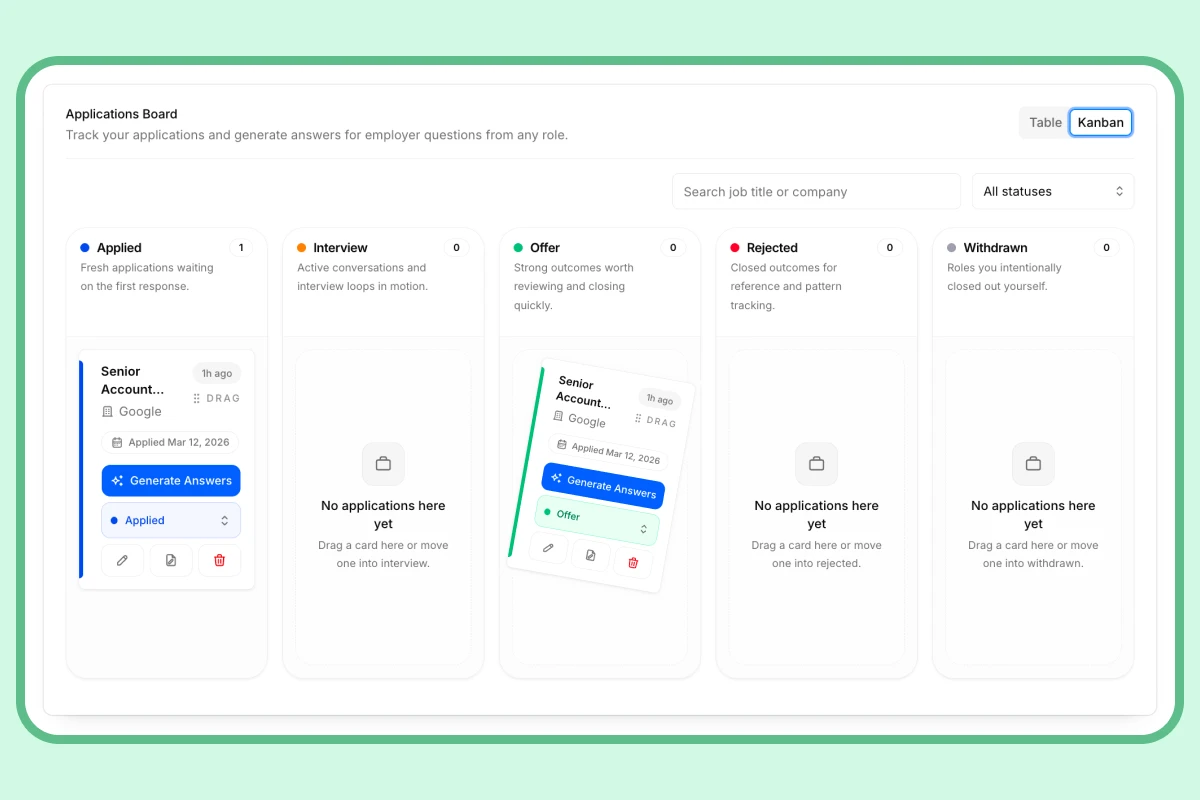
Application Tracker
Applying to 10+ jobs? You need a real system.
No more spreadsheets or lost threads. Track every role, stage, deadline, and follow-up in one dashboard — so you always know exactly where you stand.
How do you write a strong opening for a no-experience cover letter?
A strong opening does three things:
- Names the job you want
- Shows genuine interest
- Gives a quick reason why you are a fit
Weak opening
"I am writing to apply for the position. I do not have much experience, but I am a hard worker."
Strong opening
"I am excited to apply for the Junior Marketing Assistant role at BrightPath Media. Through my coursework in digital marketing and my leadership role in the campus business club, I have developed strong writing, organization, and social media skills that align well with this position."
The second version works better because it is specific, confident, and relevant.
What transferable skills should you highlight?
When you do not have formal work experience, transferable skills become the center of your cover letter.
| Skill | Where to show it |
|---|---|
| Communication | Presentations, essays, tutoring, club newsletters |
| Teamwork | Group projects, sports, volunteer events |
| Problem-solving | Research projects, technical troubleshooting, improving a process |
| Initiative | Independent learning, personal projects, organizing events |
| Time management | Balancing school, activities, and deadlines |
| Attention to detail | Editing work, data entry for clubs, lab work |
Example transformation
- Vague: "I am a quick learner and a good communicator."
- Specific: "As a peer tutor, I explained complex class material to first-year students and adapted my approach based on each student’s questions, which strengthened my communication and problem-solving skills."
Specific examples are much more convincing than general traits.
How do you write the body of a cover letter with no experience?
Use each paragraph to match one requirement in the job description.
Paragraph 1: Show interest
State the role and why it caught your attention.
Paragraph 2: Connect your background to the role
Choose one or two experiences that prove you can do the work.
Paragraph 3: Close with confidence
Restate your enthusiasm and ask for the opportunity to interview.
Example body paragraph
"In my final-year communications course, I worked on a campaign project that required audience research, writing, and group coordination. I helped develop messaging for a student organization event, drafted social posts, and presented our strategy to the class. That experience taught me how to stay organized, respond to feedback, and create clear content for a target audience. I would bring that same effort and attention to detail to the Marketing Assistant role at your company."
This approach works because it turns school experience into job-relevant proof.
How can you use examples from school, volunteering, or personal projects?
Think of your cover letter as a translation exercise.
You are not trying to make student work sound like corporate experience. You are showing how the underlying skills transfer.
Example 1: Academic project for a data role
"For my capstone project, I analyzed a dataset of customer survey responses to identify recurring themes and patterns. I used Excel to organize the information and created charts that made the findings easier to understand. This experience helped me build analytical thinking, accuracy, and the ability to present data clearly."
Example 2: Volunteer role for an operations or coordinator role
"While volunteering with a local food bank, I helped manage donation intake and organize supplies for weekly distributions. I worked with a team of volunteers to keep the process efficient and ensure items were sorted correctly. This strengthened my teamwork, organization, and attention to detail."
Example 3: Personal project for a creative role
"Outside of school, I built and maintained a personal portfolio website to showcase writing samples and class projects. I planned the layout, wrote the content, and updated the site regularly based on user feedback. That project improved my digital communication skills and taught me how to manage a project independently."
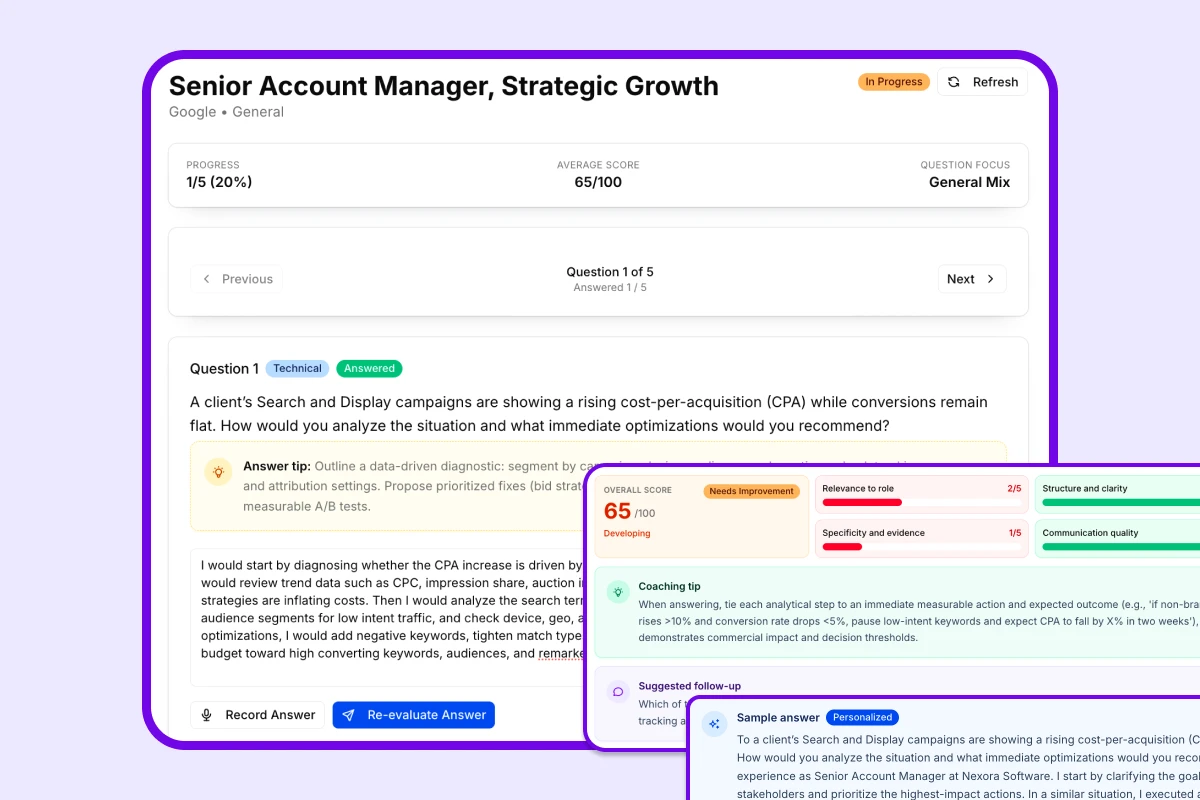
AI Interview Prep
Got the interview? Now make sure you're ready.
Practice the exact questions likely to come up for your target role. Get scored on clarity, structure, and relevance — so you walk in sharp, not winging it.
What is the best way to end a cover letter with no experience?
Your ending should be confident, polite, and action-oriented.
Weak closing
"Thank you for your time. I hope to hear back."
Strong closing
"I would welcome the chance to discuss how my coursework in public relations, my volunteer experience, and my enthusiasm for content creation can contribute to your team. Thank you for your time and consideration. I look forward to the opportunity to speak with you."
A good closing does not overstate your experience. It reinforces your interest and invites the next step.
Example cover letter for a candidate with no experience
Here is a simple example you can adapt:
Dear Hiring Manager,
I am excited to apply for the Administrative Assistant role at Horizon Group. Although I am early in my career, I have developed strong organization, communication, and time management skills through my coursework, campus activities, and volunteer work.
In my role as a student club coordinator, I helped schedule events, communicate with members, and keep shared documents organized. I also supported a campus fundraiser by tracking sign-ups and helping prepare materials for volunteers. These experiences taught me how to stay detail-oriented, manage competing priorities, and work effectively with a team.
I am especially interested in this opportunity because Horizon Group values teamwork and professional growth. I would welcome the chance to bring my energy, reliability, and willingness to learn to your team.
Thank you for your time and consideration. I look forward to the opportunity to discuss my application.
Sincerely, [Your Name]
What common mistakes should you avoid?
-
Apologizing for being inexperienced Do not lead with weakness. Focus on value.
-
Using generic phrases Replace "hard worker" and "team player" with examples.
-
Repeating your resume Add context, motivation, and personality.
-
Writing too much Keep it concise. One page is usually enough.
-
Skipping company research Mention something specific about the role or organization.
-
Forgetting to proofread Typos can weaken an otherwise strong application.
Final checklist before you send it
- You used the correct job title and company name
- Your opening shows interest and relevance
- You included at least one specific example
- You highlighted transferable skills
- Your tone is confident and professional
- The letter is one page or less
- You proofread for spelling and grammar
- You saved the file in the requested format
Conclusion
Learning how to write a cover letter with no experience is really about telling a stronger story with the experience you already have. If you can connect your schoolwork, volunteering, and personal projects to the needs of the job, you can create a compelling cover letter that feels confident and credible.
Use the examples in this guide as a starting point, then tailor every paragraph to the role you want.
Explore this category
Job Applications
Browse the full job applications category for more related playbooks, examples, and tactical guides.
Browse Job Applications articles →One workflow. Resume to offer.
Build ATS-ready resumes, track every application, and practice interviews — all in one place. Free to start, no credit card needed.
✓ Free plan forever · ✓ No card needed
Related articles
Do You Need a Cover Letter? A 2025 Decision Framework
Do you need a cover letter? The answer depends on the job, the application system, and your goals. This guide explains when to submit one, when you can skip it, and how to write a strong cover letter fast.
Email Subject for Job Application: A Practical Guide
Your email subject line is the first thing a hiring manager sees. Learn how to write a clear, concise, professional subject for a job application that gets opened and makes your intent obvious.