





Answer-First Summary: The optimal resume length is not a one-size-fits-all rule but a strategic decision based on your career stage. For most professionals, a one-to-two-page resume is the standard, with one page being ideal for early-career individuals (0-5 years of experience) and two pages being not only acceptable but often preferred for mid-to-senior-level professionals (6+ years). Three-page resumes are reserved for specific cases like senior executives, academics, or federal applicants. The primary goal is conciseness and relevance, ensuring every line sells your candidacy to both human recruiters and Applicant Tracking Systems (ATS).
What Do Recruiters and Hiring Managers Actually Prefer?
The debate often centers on personal opinion, but what does the research say? A comprehensive study cited by Rutgers University-Newark's career center indicates that while the traditional "one-page rule" is heavily emphasized for new graduates, recruiters themselves often show a preference for two-page resumes, even for entry-level roles, as it allows for more substantive detail on projects and skills. The key takeaway is that substance trumps arbitrary page limits. A two-page resume filled with strong, quantified achievements is far more effective than a cramped one-page document that omits critical context.
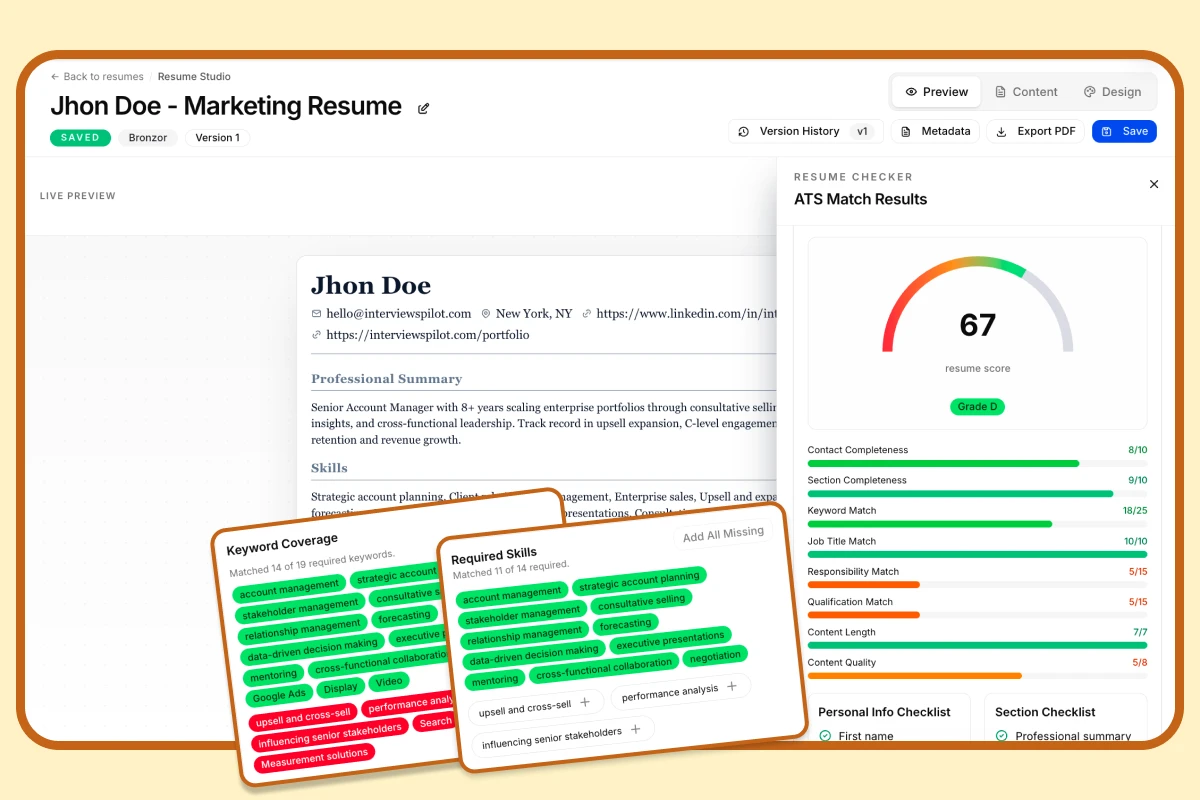
Free ATS Score
Your resume might be invisible to recruiters
Most resumes are filtered out before a human ever sees them. Get your free ATS score and see exactly where your resume falls short — before you hit send.
How Does Career Stage Dictate the Ideal Resume Length?
Your professional experience is the single greatest factor in determining appropriate length, and Rutgers' resume length research reinforces that recruiters care more about substance and clarity than an arbitrary page limit.
For Entry-Level Candidates and Recent Graduates (0-5 Years Experience)
Target Length: One Page. At this stage, your resume is a preview of potential. The focus should be on relevant coursework, academic projects, internships, and transferable skills—not on filling space. A concise, scannable one-page document forces you to prioritize your most impressive and applicable accomplishments. As noted by career experts, a one-page resume for early-career professionals ensures recruiters can quickly grasp your foundational skills without wading through filler.
Actionable Strategy:
- Lead with Education: Place your degree, university, and graduation date prominently.
- Expand on Projects: Dedicate space to capstone projects, relevant coursework, or volunteer work that demonstrates applied skills.
- Curate Experience: If you have multiple part-time jobs or internships, include only the most relevant 2-3, describing them with strong, action-oriented bullet points.
- Utilize a Skills Section: A compact, keyword-rich list of technical and soft skills can efficiently convey your toolkit.
For Mid-Career Professionals (6-15 Years Experience)
Target Length: One to Two Pages. This is the most common and accepted range. You have a proven track record that likely cannot be contained on a single page without sacrificing meaningful evidence. Your resume should detail the last 10-15 years of your career with a strong focus on metrics, leadership, and results. A second page is appropriate when it earns its space and helps the reader evaluate your fit faster.
Actionable Strategy:
- Prioritize Recent Roles: Devote the most space and detail to your current and most recent position (last 5-7 years).
- Quantify Relentlessly: Use numbers, percentages, and dollar amounts to define your impact (e.g., "Grew market share by 15%," "Reduced operational costs by $200K annually").
- Trim Early Career: Summarize roles older than 10-15 years in a single line or small paragraph under an "Earlier Experience" header, or remove them if not relevant.
- Incorporate a Professional Summary: A 3-4 line summary at the top can effectively frame your expertise and career narrative, helping to guide the reader through a two-page document.
For Senior Executives, Specialists, and Academics (15+ Years Experience)
Target Length: Two to Three Pages. Individuals at this level, such as C-suite executives, principal researchers, or tenured professors, may require additional space to list board positions, extensive publications, complex project portfolios, or a history of leading large organizations. A three-page resume is acceptable here, provided every entry is high-value and relevant. For most other senior roles, two pages remain the sweet spot.
Actionable Strategy:
- Showcase Leadership and Scope: Highlight the size of teams managed, budgets overseen, and strategic initiatives led.
- Create Dedicated Sections: For academics, include separate sections for Publications, Research Grants, and Conference Presentations. For executives, consider sections for Board Appointments or Major Transactions.
- Maintain Scannability: Even at three pages, use clear headings, consistent formatting, and bullet points to ensure the document is easy to navigate. Avoid dense paragraphs.
- Focus on Strategic Impact: Emphasize vision, growth, and transformation over routine operational duties.
How Do Industry Norms and ATS Software Impact Resume Length?
While career stage is primary, industry plays a secondary role. A technical professional with numerous patents or publications may need more space than a creative director whose portfolio does the heavy lifting. Crucially, resume length has a direct relationship with ATS (Applicant Tracking System) optimization.
ATS software parses your resume for keywords and relevance. An overly long resume increases the risk of "keyword stuffing" or diluting your core message with outdated information, which can lower your ATS score. Conversely, a too-short resume may miss critical keywords from the job description. The optimal length for ATS is one that allows you to naturally integrate relevant keywords while maintaining a clean, parsable format.
| Factor | Impact on Length & ATS | Actionable Tip |
|---|---|---|
| Keyword Density | Too many pages can lead to irrelevant keywords, hurting your score. | Use the last 10 years of experience. Prioritize keywords from the "Requirements" section of the job ad. |
| File Format | ATS parses .docx and .pdf best, but complex formatting in long resumes can cause errors. | Use standard section headers (e.g., "Work Experience," "Skills") and simple bullet points. Avoid headers/footers for critical info. |
| Relevance | ATS ranks resumes based on relevance to the job description. | Tailor each resume. Remove older, less relevant roles to shorten length and increase focus. Use a keyword scanner tool to check alignment. |
| Parsing Limits | Some older ATS systems may have difficulty with resumes over a certain page count or file size. | Stick to 2-3 pages maximum. Optimize images and save in a compressed PDF format if necessary. |
Industry-Specific Notes:
- Tech & Engineering: Often value project details and technical skills. A two-page resume is common to list specific technologies, methodologies, and project outcomes.
- Academia & Research: CVs (Curriculum Vitae) are expected to be lengthy, often exceeding 3 pages to list all publications, presentations, and grants. For industry research roles, a hybrid resume/CV of 2-3 pages may be appropriate.
- Creative Fields: The resume often supports a portfolio. One to two pages is typical, with a focus on client names, project types, and outcomes.
- Federal Government: Often require detailed, longer resumes following specific formats (e.g., USAJobs), which can legitimately run 3-5 pages.
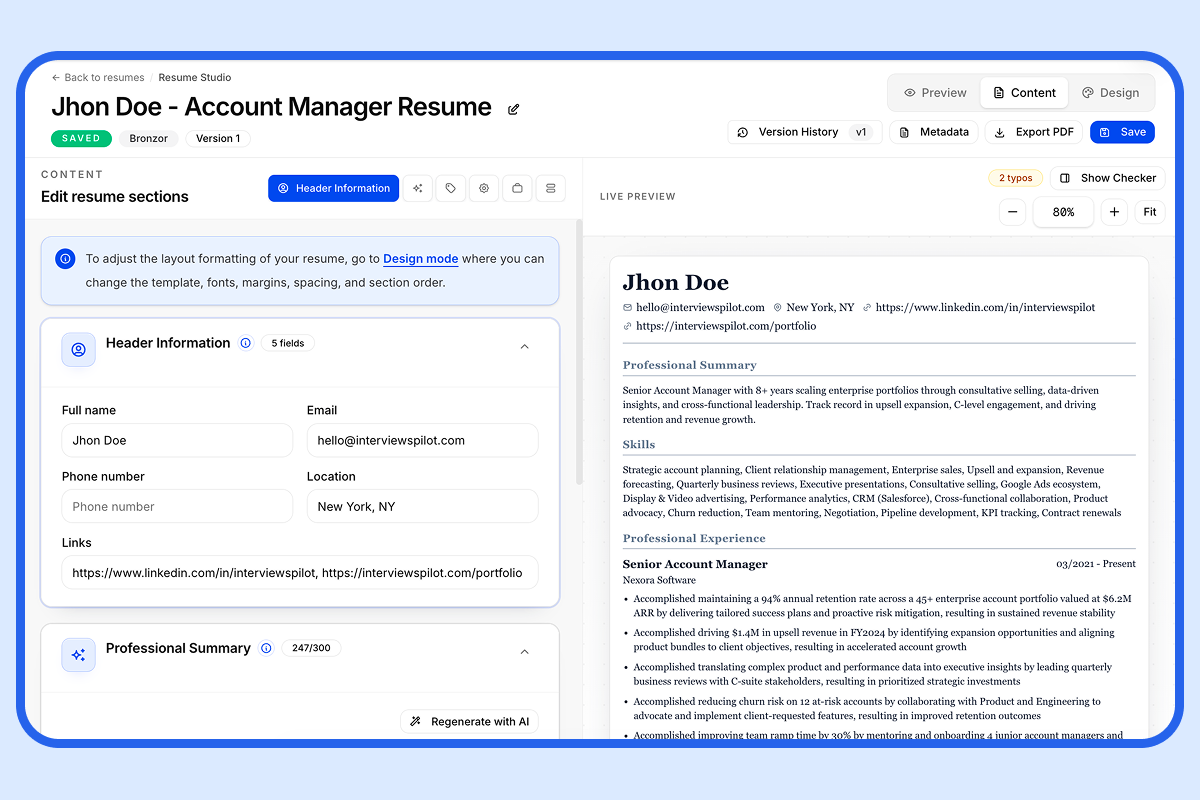
AI Resume Builder
Stop sending the same resume to every job
Paste any job description and InterviewsPilot rewrites your resume around it — keywords, bullets, and summary aligned to what recruiters are actually scanning for.
What Are the Most Common Resume Length Mistakes to Avoid?
- Using Tiny Fonts or Narrow Margins: Attempting to cram content onto one page by making the document physically difficult to read is a self-defeating practice that frustrates both humans and ATS. Stick to 10-12pt fonts and 0.5-1 inch margins.
- Including Irrelevant Early Career Jobs: For a professional with 15 years in marketing, listing your high school retail job adds no value and consumes precious space. Prune ruthlessly for relevance.
- Writing Dense Paragraphs Instead of Bullet Points: Long blocks of text are not scannable. Use bullet points to break down achievements, starting each with a strong action verb (e.g., "Spearheaded," "Optimized," "Negotiated").
- Failing to Tailor for the Role: Submitting a generic, multi-page "career biography" for every application is ineffective. Prune and tailor content to align with each specific job, which often naturally optimizes length.
- Overloading the Second Page: If you go to two pages, ensure the second page is at least half to two-thirds full. A one-and-a-quarter page resume looks like an editing error and should be condensed to one page.
Should Career Changers or Freelancers Use Different Resume Length Rules?
Yes, these scenarios require a strategic approach to length:
-
Career Changers: Your resume may be on the shorter side (one page) as you emphasize transferable skills and relevant accomplishments over chronological depth. A functional or hybrid resume format can help structure this narrative concisely.
-
Strategy: Lead with a powerful summary highlighting your transition. Group skills and achievements thematically under headings like "Project Management Experience" or "Analytical Leadership" rather than by job title. Include only the most recent or relevant past roles, with less chronological detail.
-
Freelancers or Consultants: A two-page resume is often necessary to list key clients, projects, and outcomes without appearing cluttered.
-
Strategy: Consider using a selected "Projects" or "Client Portfolio" section to present this work clearly. You can list clients/projects with 1-2 bullet points each, focusing on the problem solved and the measurable result. A chronological list of contracting roles may also be appropriate.
How Can You Optimize Your Resume's Content Within the Ideal Length?
Follow these pro tips to maximize impact per page:
- Lead with a Strong Summary: A 3-4 line professional summary at the top can frame your expertise and target role, allowing you to potentially shorten detailed explanations later in the document.
- Quantify Everything: Use numbers (e.g., "Increased revenue by 30%," "Managed a team of 12," "Reduced processing time from 4 hours to 30 minutes") to convey scale and results efficiently. Numbers take up little space but carry immense weight.
- Prune Older Roles: Detail fades with time. Give the most space to your most recent and relevant positions. For roles older than 10 years, consider reducing them to a single-line entry with just company, title, and dates.
- Use a Skills Section Wisely: A concise, keyword-rich skills table (grouped into categories like "Technical," "Leadership," "Software") can save space compared to weaving each skill into lengthy job descriptions.
- Leverage Bullet Point Structure: Start each bullet with a powerful verb, include the context or task, and end with the quantifiable result. This "CAR" (Challenge-Action-Result) or "STAR" (Situation-Task-Action-Result) structure delivers maximum information in minimal space.
- Edit Ruthlessly: For every sentence, ask: "Does this directly demonstrate my fitness for the specific job I'm applying for?" If not, cut it.
Final Verdict: Stop stressing over a universal page count. Focus on crafting a targeted, achievement-driven document that is as long as it needs to be to sell your next career step—and not a word more. For the vast majority of job seekers, that means mastering the art of the powerful one or two-page resume. Remember, your resume is a marketing document, not an autobiography. Its length should be dictated by the strength and relevance of its content, ensuring it passes through ATS filters and makes a compelling case to the human recruiter in the critical 6-7 seconds they spend on the initial scan.
Explore this category
Resume
Browse the full resume category for more related playbooks, examples, and tactical guides.
Browse Resume articles →One workflow. Resume to offer.
Build ATS-ready resumes, track every application, and practice interviews — all in one place. Free to start, no credit card needed.
✓ Free plan forever · ✓ No card needed
Related articles
Resume Accomplishments: The Definitive Guide to Quantifying Your Impact
A resume filled with duties is forgettable; one filled with accomplishments is compelling. This guide breaks down how to identify, quantify, and structure your professional achievements to create a resume that gets noticed by both hiring managers and ATS software.
The Biggest Resume Mistakes to Avoid: A 2026 Pragmatic Playbook
Your resume is your first interview. Avoid the common pitfalls—from missing contact details to vague duties—that get your application instantly rejected. This playbook details the biggest mistakes and provides clear, actionable solutions to craft a resume that gets noticed.