





A one-page resume is not about cramming your career into a smaller box. It is about making every line earn its place. For entry-level candidates, career changers, and professionals applying to highly targeted roles, a one-page resume can be the clearest way to show fit quickly. For a neutral baseline on structure and formatting, CareerOneStop's resume guidance is a useful noncommercial reference.
Answer-First Summary: A one-page resume is best when relevance matters more than a full career history. It works well for students, recent graduates, career changers, and many professionals with focused experience. The goal is to highlight your strongest qualifications, use keywords from the job description, and present achievements in a format that is easy for both recruiters and ATS software to scan.
When Should You Use a One-Page Resume?
A one-page resume is a strategic choice, not a rule for everyone. It is usually the best option when.
- You are a student or recent graduate.
- You have less than 10 years of relevant experience.
- You are changing careers and need to emphasize transferable skills.
- You are applying to a role with a highly specific job description.
- You work in industries that value concise communication, such as tech, startups, sales, or finance.
If your experience is deep but not closely related to the job, a one-page resume can still be effective because it forces you to focus on what matters most for the role.
What Should Be Included in a One-Page Resume?
A strong one-page resume should be simple, targeted, and easy to scan. Use these core sections:
-
Contact Information Include your name, phone number, email address, LinkedIn profile, and location.
-
Targeted Job Title Add a headline that matches the role you want, such as “Marketing Coordinator” or “Software Engineer.”
-
Professional Summary Write 3 to 4 sentences that summarize your background, strengths, and most relevant achievements.
-
Core Skills List 6 to 10 skills that align with the job description. Include both technical and workplace skills when relevant.
-
Professional Experience Focus on the most relevant roles. Use achievement-driven bullet points with measurable results.
-
Education and Certifications Include degrees, certifications, and relevant coursework. If you already have a college degree, high school details are usually unnecessary.
Free ATS Score
Your resume might be invisible to recruiters
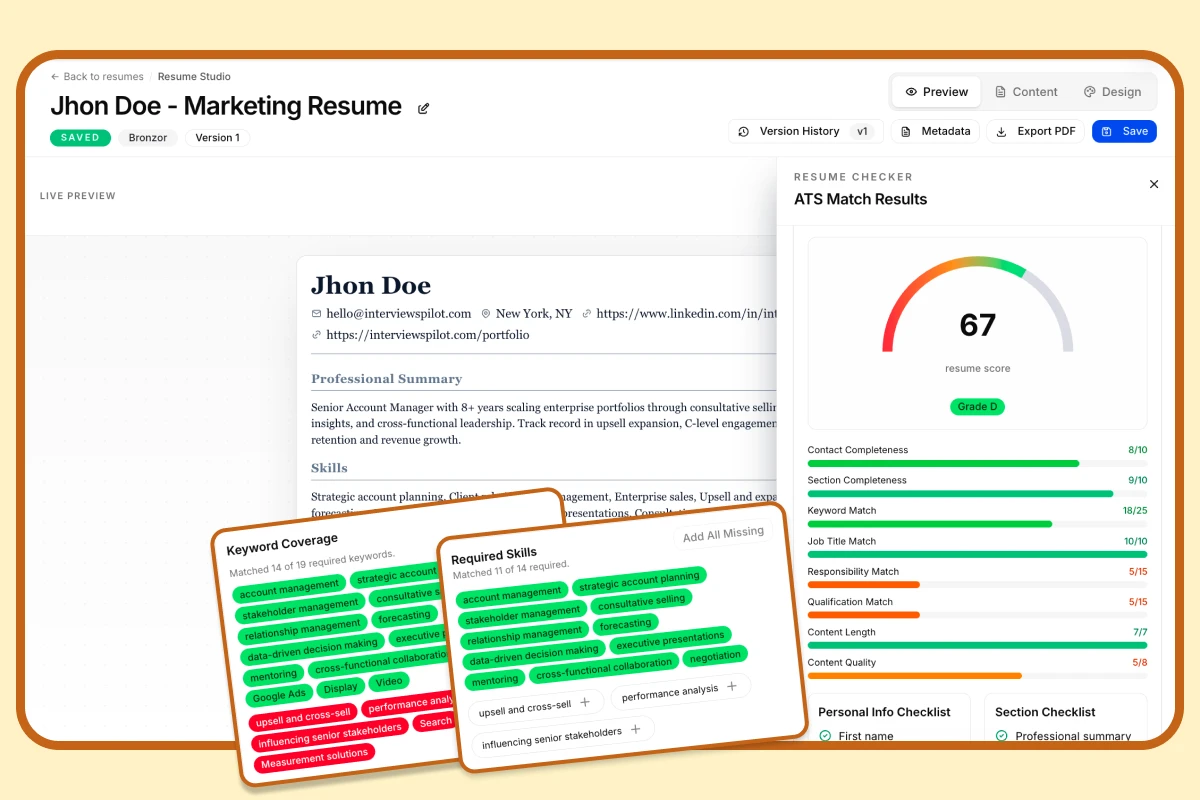
Most resumes are filtered out before a human ever sees them. Get your free ATS score and see exactly where your resume falls short — before you hit send.
How Do You Condense a Two-Page Resume to One Page?
Condensing a resume takes editing discipline. Start by removing anything that does not strengthen your case for the specific job.
Step 1: Remove older or less relevant roles
Cut jobs from 10 to 15 years ago unless they are highly relevant or especially impressive. If needed, you can summarize earlier experience in one short line under an “Additional Experience” section.
Step 2: Replace duties with achievements
A one-page resume should not read like a job description. Instead of writing what you were responsible for, show what you accomplished.
- Weak: Responsible for customer service and reporting.
- Strong: Improved customer satisfaction scores by 18% by redesigning response workflows.
Step 3: Tighten each bullet point
Use strong action verbs and keep each bullet focused on one result. Combine repeated ideas and delete filler words.
Step 4: Cut low-value content
Remove phrases like “References available upon request,” generic soft skills, and hobbies that are not relevant to the role.
Step 5: Adjust formatting carefully
Use white space wisely, but do not rely on design tricks to hide too much content. Keep fonts readable and use standard margins whenever possible.
What Are the Best One Page Resume Tips?
Here are practical one-page resume tips that improve both readability and relevance:
- Tailor the resume to each job.
- Put the most relevant content near the top.
- Use short, specific bullet points.
- Include numbers whenever possible.
- Match your wording to the job description.
- Keep section headings simple and standard.
- Proofread carefully for spelling, grammar, and formatting issues.
If your first draft is too long, do not try to save every detail. Start with the most relevant achievements and build outward only if space allows.
How Do You Optimize a One-Page Resume for ATS?
ATS resume optimization matters even more when your resume is only one page. Because you have less space, every keyword and section title needs to be intentional.
| ATS Optimization Tip | What to Do | Why It Helps |
|---|---|---|
| Keyword matching | Use the same job titles, skills, and certifications found in the job description. | Helps your resume align with the role. |
| Standard formatting | Use clean headings like Work Experience, Skills, and Education. Avoid tables, graphics, and text boxes. | Makes it easier for ATS software to parse your information. |
| Natural keyword placement | Add important terms in your summary, skills, and experience sections. | Improves relevance without sounding forced. |
| Achievements with context | Show how you used a skill in a real result. | Gives ATS and recruiters more useful detail. |
A good ATS-friendly one-page resume is readable for both software and people. Simplicity usually works better than creative formatting.
AI Resume Builder
Stop sending the same resume to every job
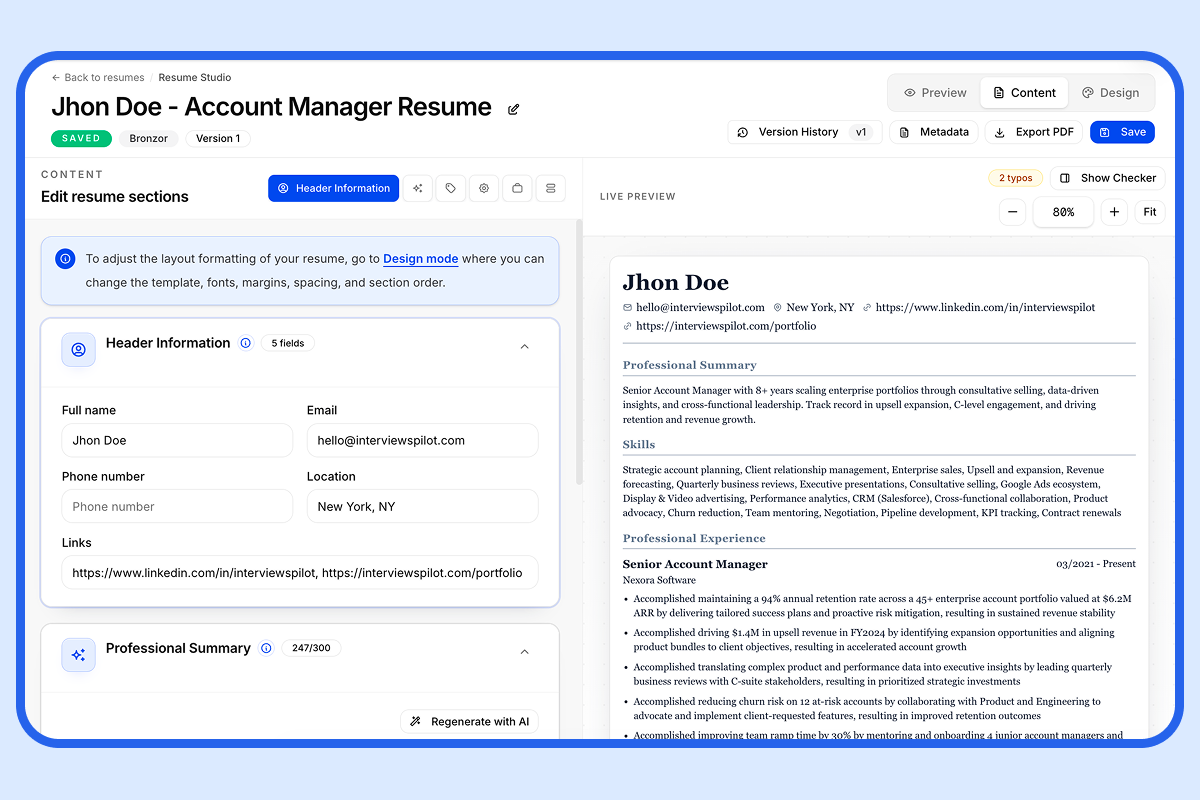
Paste any job description and InterviewsPilot rewrites your resume around it — keywords, bullets, and summary aligned to what recruiters are actually scanning for.
What Are Some One Page Resume Examples?
The best one page resume examples are not overloaded with content. They show how a candidate can communicate value quickly.
Example 1: Recent graduate
A recent graduate might include education first, followed by internships, part-time work, campus leadership, and relevant skills. The resume should emphasize potential, training, and measurable project outcomes.
Example 2: Career changer
A career changer can use a summary and skills section to bridge the gap between past experience and the new role. The most relevant accomplishments should appear near the top, even if they came from a different industry.
Example 3: Experienced professional
An experienced professional can still use a one-page resume if the application is highly targeted. In this case, the resume should highlight only the most relevant roles, select major achievements, and remove older positions that do not support the goal.
When reviewing one page resume examples, look for three things:
- Clear structure
- Strong achievement language
- Tight alignment with the target job
How Does a One-Page Resume Compare to a Two-Page Resume?
A one-page resume and a two-page resume can both work, but they serve different goals.
A one-page resume is usually best when the job is focused, the candidate is early in their career, or the most relevant experience can be shown quickly. A two-page resume may be better when you need to show a wider range of leadership, projects, or specialized accomplishments.
For experienced professionals, the right choice depends on the role. If the job posting is narrow and your strongest qualifications fit on one page, shorter is often better. If you have a long record of relevant, high-value work, a second page may be justified.
Final Checklist Before You Submit Your One-Page Resume
Use this final checklist before sending your application:
- Is the resume tailored to the specific role?
- Does it highlight the most relevant experience first?
- Are the bullet points focused on results, not duties?
- Does it include keywords from the job description?
- Is the format simple and ATS-friendly?
- Can a recruiter understand the resume in a quick scan?
- Has it been proofread carefully?
Conclusion
A strong one-page resume is focused, relevant, and easy to scan. It helps you present your best qualifications without overwhelming the reader. If you choose the right content, use clear structure, and apply ATS resume optimization carefully, a one-page format can be one of the most effective tools in your job search.
Explore this category
Resume
Browse the full resume category for more related playbooks, examples, and tactical guides.
Browse Resume articles →One workflow. Resume to offer.
Build ATS-ready resumes, track every application, and practice interviews — all in one place. Free to start, no credit card needed.
✓ Free plan forever · ✓ No card needed
Related articles
The Biggest Resume Mistakes to Avoid: A 2026 Pragmatic Playbook
Your resume is your first interview. Avoid the common pitfalls—from missing contact details to vague duties—that get your application instantly rejected. This playbook details the biggest mistakes and provides clear, actionable solutions to craft a resume that gets noticed.
How Long Should a Resume Be? The Definitive, Data-Backed Guide for 2026
Forget rigid rules. The ideal resume length is determined by your experience, industry, and the ATS. This guide provides clear, evidence-based guidelines for entry-level to executive professionals.
How Many Bullet Points per Job on Resume? A Practical Guide
The usual rule is 3 to 5 bullet points per job on a resume. This guide shows when to use fewer or more, how to prioritize recent roles, and how to write bullets that are clear, results-driven, and ATS-friendly.