





Your resume skills section is a critical component that serves as a quick-reference guide for hiring managers and a keyword hub for Applicant Tracking Systems (ATS). Done right, it doesn't just list abilities—it strategically argues for your candidacy. This section is a dedicated space to list both hard skills (technical, measurable abilities like Python or data analysis) and soft skills (interpersonal attributes like communication or leadership) that are tailored to the specific job you want. Its core functions are to help employers instantly gauge your qualifications, optimize your resume for ATS with relevant keywords, complement your work history with concrete expertise, improve readability, and differentiate you from other applicants.
What is the difference between hard skills and soft skills on a resume?
Understanding this distinction is fundamental to building a balanced and persuasive skills profile.
- Hard Skills are technical, teachable abilities often acquired through education, training, or specific experience. They are typically quantifiable and job-specific. Examples include programming languages (Python, Java), data analysis tools (SQL, Tableau), project management methodologies (Agile, Scrum), and foreign languages.
- Soft Skills are interpersonal or "people" skills that relate to how you work, communicate, and solve problems. They are transferable across roles and industries. Key examples are communication, teamwork, leadership, problem-solving, adaptability, and time management.
A strong resume showcases a blend of both, using hard skills to prove you can do the job and soft skills to show you can excel in the workplace environment.
How many skills should I include in my resume skills section?
The guiding principle is quality and relevance over quantity. Aim for a focused list of 5-10 skills that are most pertinent to the job you're applying for. A sprawling list of every skill you possess dilutes your core strengths and can make your resume appear unfocused. Curate your list meticulously for each application.
Should I list all my skills or only the most relevant ones?
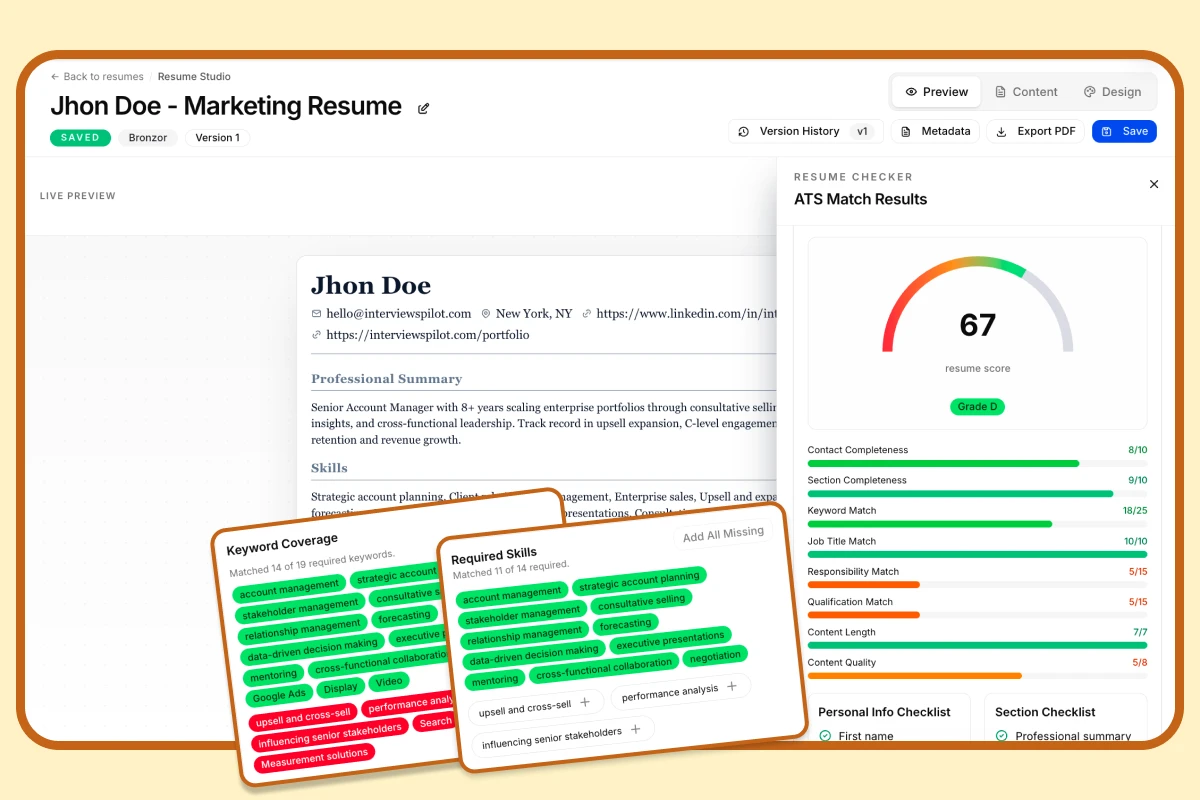
Always prioritize the most relevant skills. Your resume is a marketing document, not an exhaustive autobiography. Scrutinize the job description and identify the key requirements. Your skills section should mirror those needs, highlighting the abilities that make you a perfect match. This targeted approach is crucial for both human readers and ATS software, which scans for specific keywords from the job posting.
Free ATS Score
Your resume might be invisible to recruiters
Most resumes are filtered out before a human ever sees them. Get your free ATS score and see exactly where your resume falls short — before you hit send.
How do I organize skills in my resume for maximum impact?
Organization enhances readability and allows the most critical information to stand out. Here are effective methods:
- Dedicated Section with Bullet Points: The most common and clean approach. List skills in a simple bulleted list under a "Skills" or "Core Competencies" heading.
- Grouped by Category: For roles requiring diverse skill sets, group them into subcategories. For example:
- Technical Skills: Python, SQL, AWS, Docker
- Project Management: Agile/Scrum, JIRA, Budget Forecasting
- Languages: Fluent in Spanish, Conversational in French
- Order by Relevance: Place the skills most critical to the target job at the top of the list or category. If applying for a cybersecurity role, list SIEM tools and penetration testing before more general IT skills.
Where should I place the skills section on my resume?
Placement can vary based on your experience level and resume format:
- For Most Professionals: Place the skills section below your professional summary and above your work experience. This gives recruiters a high-level snapshot of your capabilities before they dive into your career history.
- For Technical or Skills-Based Roles: Consider a prominent "Key Skills" section at the very top, just beneath your contact information, as a quick-reference highlight reel.
- Integrated Approach: You can also feature a concise, 1-2 line skills highlight within your professional summary for immediate impact, supported by a more detailed section later.
How do I tailor my skills section to a specific job description?
Tailoring is non-negotiable for a modern job search. Follow this process:
- Analyze the Job Posting: Circle or highlight every required and preferred skill, tool, and competency mentioned.
- Match and Mirror: For each item you identified, list a corresponding skill you possess. Use the same terminology (e.g., if the posting says "CRM software," write "Salesforce" or "HubSpot CRM" instead of just "customer management tools").
- Prioritize: Order your list so the skills that appear most prominently in the job description are at the top of your section.
What are examples of high-value hard skills versus soft skills?
| Hard Skills (Technical/Measurable) | Soft Skills (Interpersonal/Behavioral) |
|---|---|
| Data Analysis (SQL, Python, R) | Communication (Written & Verbal) |
| Digital Marketing (SEO, Google Analytics, PPC) | Leadership & Team Management |
| Financial Modeling (Excel, Bloomberg Terminal) | Problem-Solving & Critical Thinking |
| Project Management (Asana, JIRA, Scrum) | Adaptability & Flexibility |
| Graphic Design (Adobe Creative Suite, Figma) | Collaboration & Teamwork |
| Cloud Computing (AWS, Azure, GCP) | Time Management & Organization |
This table illustrates the balance employers seek. Common high-value soft skills across nearly all industries include communication, teamwork, leadership, and problem-solving.
AI Resume Builder
Stop sending the same resume to every job
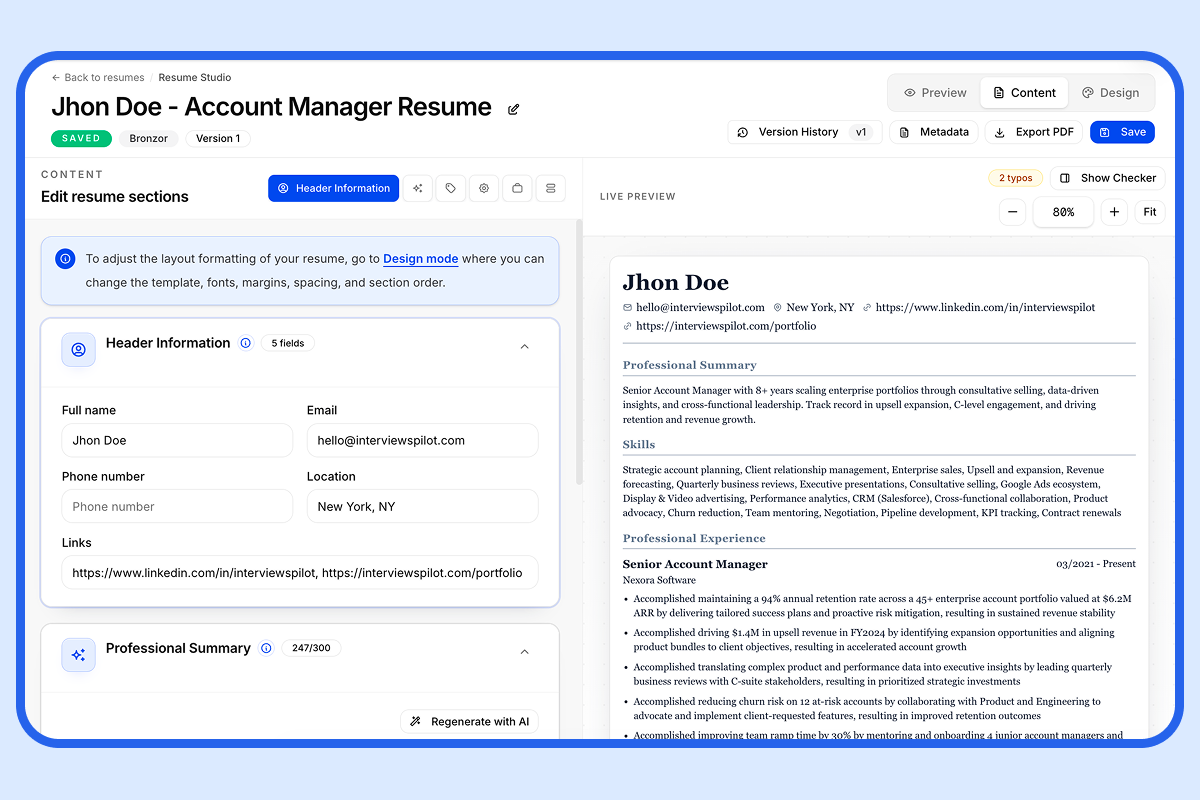
Paste any job description and InterviewsPilot rewrites your resume around it — keywords, bullets, and summary aligned to what recruiters are actually scanning for.
How can I optimize my skills section for Applicant Tracking Systems (ATS)?
ATS optimization is directly tied to tailoring. These systems parse your resume for keywords that match the job description.
- Incorporate Keywords: Ensure the exact hard skills and key phrases from the job ad are present in your skills section.
- Use Standard Titles: Spell out acronyms initially (e.g., "Applicant Tracking Systems (ATS)") to cover variations.
- Avoid Graphics and Columns: Use a simple, text-based format. ATS may not read text embedded in images or complex tables correctly.
- Context is Key: While the dedicated skills section is vital, also integrate these keywords naturally into your work experience bullet points to show application.
Should I include both technical and soft skills?
Absolutely. A resume with only hard skills may present you as competent but potentially difficult to work. A resume with only soft skills lacks the concrete proof of ability. Including both creates a holistic picture of you as a professional who has both the technical expertise to perform tasks and the interpersonal intelligence to drive results and collaborate effectively.
How do I demonstrate skills in my work history beyond the skills section?
The skills section tells, but the work experience section shows. Use the action verb + skill + result formula in your bullet points.
- Instead of listing "Project Management" in skills only, write: "Led (action verb) a cross-functional Agile project (skill) that reduced time-to-market by 15% (result)."
- Instead of listing "Data Analysis," write: "Analyzed customer behavior data using SQL and Python to identify a new market segment, increasing lead generation by 25%." This proves you can apply your skills to achieve tangible outcomes.
What are transferable skills and why do they matter?
Transferable skills are versatile abilities relevant across different jobs and industries. They often bridge hard and soft skills. Examples include research, writing, analytical thinking, public speaking, and customer service. They are especially crucial for career changers or recent graduates. Highlighting transferable skills demonstrates your adaptability and potential to succeed in a new role, even if your direct experience isn't a perfect match.
What is the final checklist for formatting my skills section?
Before you submit, ensure your skills section is:
- Relevant: Meticulously tailored to the job description.
- Concise: Limited to 5-10 of your most powerful, role-specific skills.
- Readable: Formatted with clear bullets or grouped categories.
- Strategic: Positioned prominently on the page based on your background.
- Balanced: Includes a mix of hard, soft, and transferable skills.
- Integrated: Supported by evidence in your work experience bullet points.
- ATS-Friendly: Free of graphics and full of necessary keywords.
Your resume skills section is your strategic arsenal. By carefully selecting, organizing, and contextualizing your abilities, you transform a simple list into a compelling argument for your next career opportunity.
Explore this category
Resume
Browse the full resume category for more related playbooks, examples, and tactical guides.
Browse Resume articles →One workflow. Resume to offer.
Build ATS-ready resumes, track every application, and practice interviews — all in one place. Free to start, no credit card needed.
✓ Free plan forever · ✓ No card needed
Related articles
The Biggest Resume Mistakes to Avoid: A 2026 Pragmatic Playbook
Your resume is your first interview. Avoid the common pitfalls—from missing contact details to vague duties—that get your application instantly rejected. This playbook details the biggest mistakes and provides clear, actionable solutions to craft a resume that gets noticed.
How Long Should a Resume Be? The Definitive, Data-Backed Guide for 2026
Forget rigid rules. The ideal resume length is determined by your experience, industry, and the ATS. This guide provides clear, evidence-based guidelines for entry-level to executive professionals.
How Many Bullet Points per Job on Resume? A Practical Guide
The usual rule is 3 to 5 bullet points per job on a resume. This guide shows when to use fewer or more, how to prioritize recent roles, and how to write bullets that are clear, results-driven, and ATS-friendly.