






Resume bullet points are the critical, actionable evidence that transforms a list of duties into a compelling narrative of achievement. Their primary function is to demonstrate your unique impact and fit for a role, moving beyond what you were responsible for to showcase what you accomplished. To be effective, they must serve three masters: the human recruiter skimming for relevance, the Applicant Tracking System (ATS) parsing for keywords, and your own need to stand out in a competitive field. Success hinges on a structured approach that prioritizes role-fit evidence, concise and powerful communication, and quantifiable proof of progress. This guide provides a tactical, step-by-step playbook to systematically improve your resume bullet points, turning them from passive descriptions into powerful career marketing tools.
For related next steps, use ATS optimization checklist, resume accomplishment examples, and resume skills section guide.
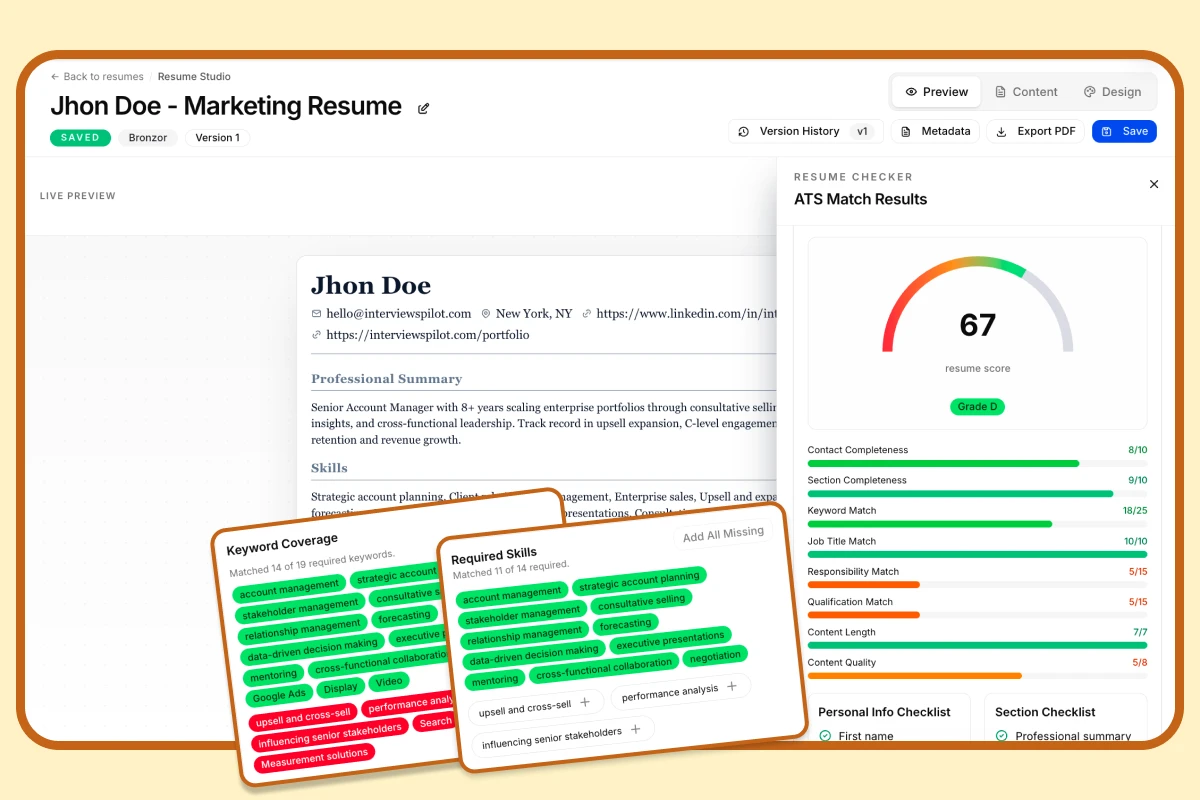
Free ATS Score
Your resume might be invisible to recruiters
Most resumes are filtered out before a human ever sees them. Get your free ATS score and see exactly where your resume falls short — before you hit send.
What Matters Most for Resume Bullet Points?
Effective resume bullet points are built on a foundation of three core principles: demonstrating role-fit with evidence, communicating with precision and power, and anchoring claims in measurable outcomes. These elements work in concert to satisfy both automated systems and human evaluators.
1. Role-Fit Evidence and Keyword Integration: Your bullet points must speak the language of the job description. This isn't just about using industry jargon; it's about strategically incorporating the specific skills, tools, and outcomes mentioned in the posting. This practice, known as ATS optimization, ensures your resume passes through initial digital filters. As highlighted in resources from InterviewsPilot and Yale's Office of Career Strategy, tailoring your language to match the job description is non-negotiable for modern job applications. It signals to both the software and the recruiter that your experience is directly relevant.
2. Concise and Powerful Communication: Brevity is power. Recruiters spend seconds on an initial scan, so every word must earn its place. This means:
- Starting with strong action verbs: Lead with verbs like "Spearheaded," "Orchestrated," "Optimized," or "Pioneered" to immediately convey agency and impact. Avoid weak phrases like "Responsible for" or "Helped."
- Eliminating vagueness: Replace generic statements with specific, outcome-focused language. Instead of "Managed social media," write "Grew Instagram following by 37% through a targeted content calendar and influencer partnerships."
- Keeping it scannable: Use a consistent, parallel structure for your bullets to make them easy to read quickly.
3. Measurable Progress and Quantifiable Results: Numbers provide objective proof of your contributions. Whenever possible, anchor your achievements with metrics—percentages, dollar amounts, time saved, or scale impacted. Quantifiable results answer the "so what?" question for the hiring manager. For example, "Improved customer satisfaction scores" is weak, while "Boosted CSAT by 15 percentage points within one quarter by revamping the support ticket process" is compelling and credible. Resources from Growth Hack Your Career and Resume Worded provide extensive examples of how to effectively quantify achievements across various roles.
How Do You Execute Resume Bullet Points Step by Step?
Transforming your experience into high-impact bullet points is a process, not a one-time task. Follow this structured workflow to build, refine, and tailor your content.
Step 1: Define Goal and Role Context (The Foundation)
Before writing a single bullet, you must clarify your objective.
- Analyze the Target Job Description: Meticulously dissect 2-3 ideal job postings. Highlight all action verbs, required skills, software names, and desired outcomes. This list becomes your primary keyword bank.
- Identify Your Core Narrative: What is the central story you want your resume to tell? Are you a growth hacker, a process optimizer, a team builder? Your bullet points should collectively support this narrative.
- Audit Your Current Resume: Review your existing bullets. Flag any that are vague, duty-focused, or lack measurable results. Be prepared to rewrite them entirely.
Step 2: Prepare Examples and Proof Points (The Brainstorm)
Move from generalities to specific evidence.
- Conduct a Career Inventory: For each past role, list every project, responsibility, and achievement. Don't filter for importance yet—just brainstorm.
- Apply the STAR/CAR Method: For each inventory item, frame it using the Situation/Task-Action-Result or Challenge-Action-Result framework. Focus intensely on the Action (what you specifically did) and the Result (the quantifiable outcome).
- Draft Bullets Using the "Verb + Task + Metric + Impact" Formula: Combine your brainstormed items with your target keywords. A strong template is: [Strong Action Verb] [Specific Task/Project] that resulted in [Quantifiable Metric], leading to [Broader Impact]. Example: "Orchestrated a migration to a new CRM platform that resulted in a 25% reduction in data entry time, leading to improved sales team productivity."
Step 3: Practice Delivery and Timing (The Refinement)
Great bullets are written, then ruthlessly edited.
- Prioritize and Prune: You have limited space. Select only the 3-5 most relevant and impressive bullet points for each role. Remove redundancy.
- Optimize for ATS and Readability: Use standard fonts (e.g., Arial, Calibri), avoid graphics/text boxes, and sprinkle keywords naturally throughout the bullets, not just in a "skills" section. Tools like InterviewsPilot's Resume Keyword Scanner can help identify gaps.
- Tailor for Every Application: This is the most critical step. Adjust the language and emphasis of your bullet points to mirror the priority keywords in each specific job description. A generic resume is an ineffective resume.
Step 4: Review Outcomes and Adjust (The Iteration)
Treat your resume as a living document.
- Seek External Feedback: Have mentors, peers, or professionals in your field review your bullets. Do they understand your impact? Are they impressed?
- Track Application Success: Are you getting more interview callbacks after implementing these changes? If not, revisit your keyword targeting and the clarity of your metrics.
- Continuously Update: As you complete new projects or achieve new results, immediately draft a bullet point for your master resume document. This makes future tailoring much faster.
AI Resume Builder
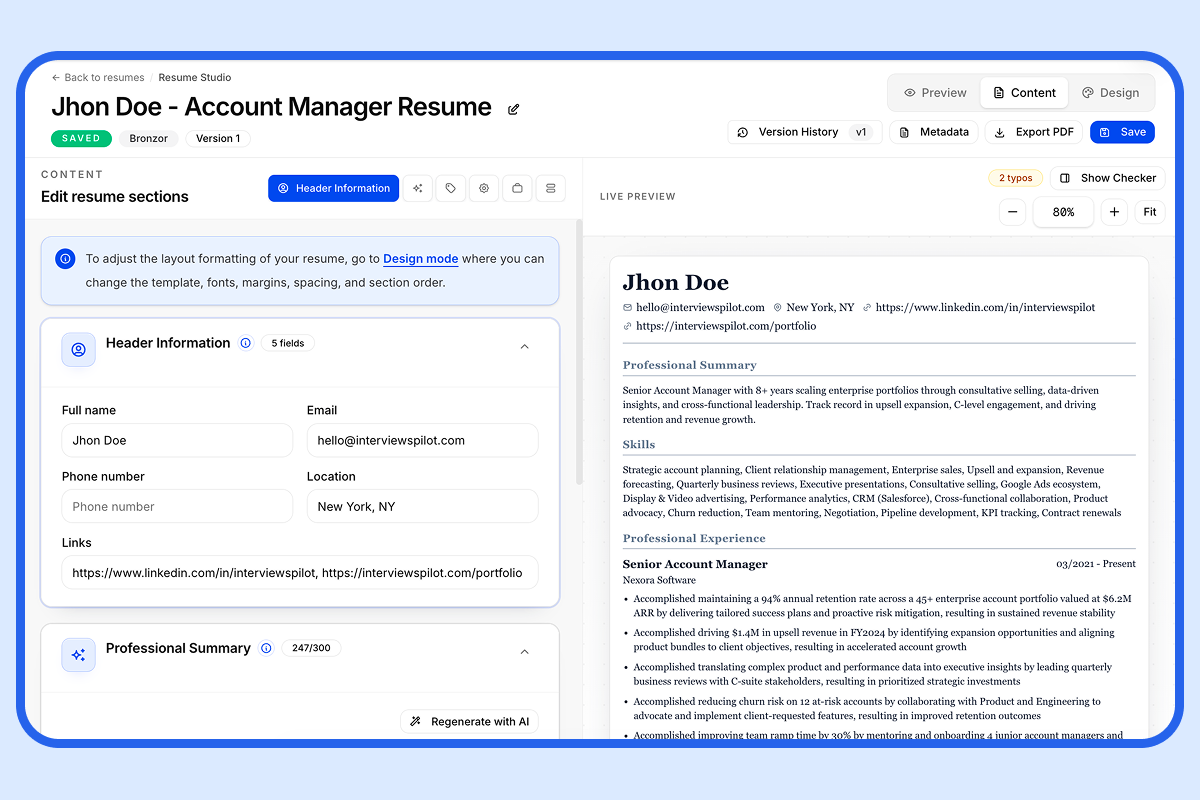
Stop sending the same resume to every job
Paste any job description and InterviewsPilot rewrites your resume around it — keywords, bullets, and summary aligned to what recruiters are actually scanning for.
Which Mistakes Should You Avoid?
Steering clear of common pitfalls is as important as following best practices.
- Using Generic Answers Without Evidence: Bullet points that simply list duties ("Responsible for customer service") are dead weight. They tell the employer what your job description was, not what you accomplished. Always push for the specific, evidence-based result.
- Skipping Role-Specific Preparation: Sending the same generic resume to every application is a recipe for failure. The lack of tailored keywords will cause your resume to be filtered out by ATS, and recruiters will immediately see it's not customized for their specific role.
- Writing Paragraphs Instead of Bullets: Dense paragraphs are difficult to scan. Bullet points exist for a reason—they break information into digestible, impactful chunks. Use them.
- Including Irrelevant or Outdated Information: Every line on your resume should serve the goal of getting the specific job you're applying for. Prune older, less relevant roles to make space for powerful bullets on recent, applicable experience.
- Missing Follow-Up and Reflection: Don't just submit and forget. If a particular version of your resume is successful, note what worked. If it isn't, be prepared to analyze and adjust your approach, perhaps by strengthening your metrics or better aligning with different keywords.
Advanced Tactics and Tools
To further elevate your bullet points, consider these advanced strategies:
- Leverage AI Tools Strategically: Tools like InterviewsPilot's Resume Bullet Point Generator or AI Resume Builder can be excellent for overcoming writer's block or generating metric-focused first drafts. However, they are starting points. You must inject your unique context, verify all metrics, and tailor the output. Never use AI-generated content without thorough personalization and fact-checking.
- Incorporate Soft Skills Through Action: Instead of stating "Excellent leadership skills," demonstrate it: "Mentored a team of 3 junior analysts, resulting in two promotions within the department and a 20% increase in team project delivery speed."
- Address Career Gaps or Transitions Proactively: Use bullet points to frame non-traditional experiences (freelance work, a sabbatical project) in terms of acquired skills and results, just as you would for a standard job.
By adopting this structured, iterative playbook—focusing on evidence, concise power, and measurable results while avoiding common errors—you transform your resume bullet points from a passive list into an active, compelling argument for your candidacy. The fastest path to better interview outcomes is this repeatable system of targeted preparation, clear and quantified examples, and continuous refinement based on real-world feedback.
Explore this category
Resume
Browse the full resume category for more related playbooks, examples, and tactical guides.
Browse Resume articles →One workflow. Resume to offer.
Build ATS-ready resumes, track every application, and practice interviews — all in one place. Free to start, no credit card needed.
✓ Free plan forever · ✓ No card needed
Related articles
Applicant Tracking System Guide: How ATS Works and How to Optimize Your Resume
An Applicant Tracking System can determine whether your resume reaches a human recruiter. Learn how ATS software parses applications, which resume mistakes hurt your chances, and how to optimize keywords, formatting, and content for better results.
Chronological Resume: Structure, Examples, Tips, and ATS Optimization
A chronological resume presents your work history in reverse-chronological order, making it the standard choice for professionals with steady career growth. This guide explains the format, compares it with functional and hybrid resumes, and shows how to optimize every section for recruiters and ATS software.
How to Optimize Your Resume for ATS: Tips, Examples, and a Practical Checklist
Use this ATS resume optimization guide to format your resume correctly, match keywords from job descriptions, and avoid common mistakes that prevent applications from being read properly.