





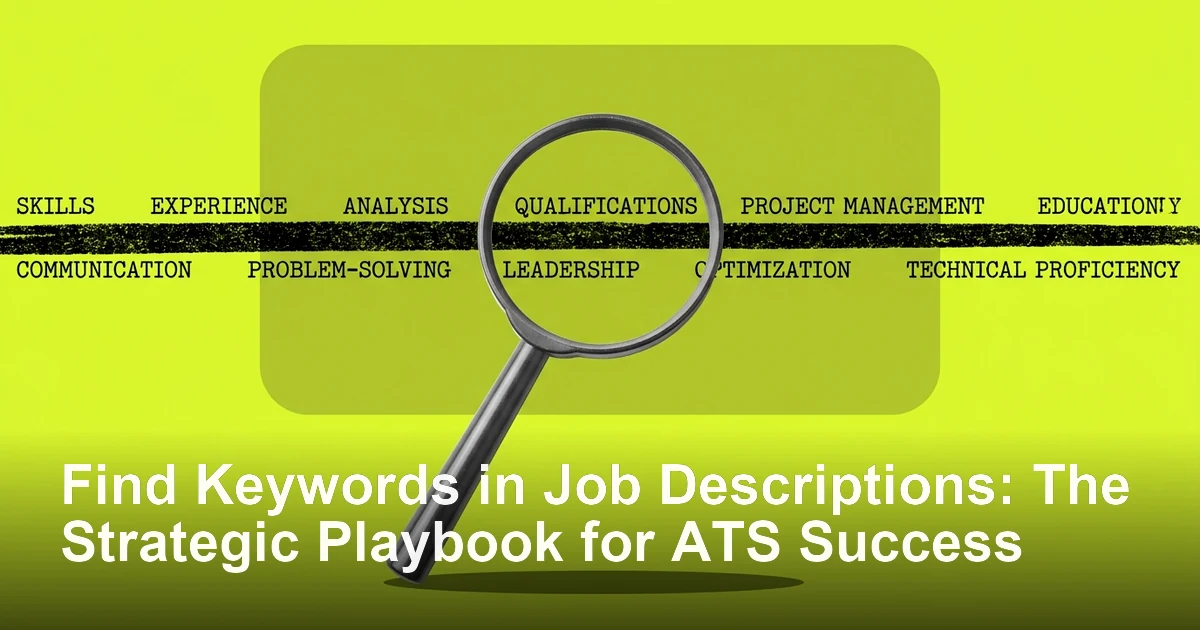
Answer-First Summary: To find keywords in job descriptions, you must systematically analyze the posting to identify the specific hard skills, soft skills, action verbs, and industry jargon that Applicant Tracking Systems (ATS) and hiring managers use to screen candidates. The most effective method involves reviewing 3-5 similar job descriptions to spot recurring terms, then strategically and naturally integrating those high-priority keywords throughout your resume—particularly in the summary and top bullet points—to demonstrate a precise match for the role. This process is non-negotiable for modern job applications, as it directly determines whether your resume is seen by human eyes. For skills language that maps to real occupations, O*NET Online is a useful noncommercial reference.
For related next steps, use ATS optimization checklist.
Why Is Finding Keywords in Job Descriptions So Critical?
Job description keywords are not suggestions; they are the exact terms used as filters in the hiring process. Applicant Tracking Systems (ATS) parse resumes for these terms to rank and shortlist candidates, meaning a resume lacking the right keywords often fails at the first digital hurdle, regardless of a candidate's qualifications. Furthermore, hiring managers scan for these keywords to quickly assess relevance. Therefore, finding and using these keywords is the foundational step in translating your experience into the language of your target role and company.
How Many Job Descriptions Should I Analyze to Find the Right Keywords?
You should analyze a minimum of three to five job descriptions for similar roles. Relying on a single posting is risky, as it may contain unique or overly specific requirements from one hiring manager. By reviewing multiple postings, you can identify patterns and recurring keywords that represent the core, non-negotiable requirements for the position across the industry. This practice helps you separate "must-have" keywords from "nice-to-have" ones, allowing you to prioritize effectively, and validate your shortlist with tools like the Job Description Keyword Finder before updating your resume.
What Are the Main Categories of Keywords I Need to Find?
Keywords in job descriptions typically fall into four distinct categories. A strategic approach involves hunting for each type.
| Category | Description | Examples |
|---|---|---|
| Hard Skills | Technical, teachable abilities and tools. Often non-negotiable. | Python, SQL, Salesforce CRM, GAAP, CNC Machining, Adobe Creative Suite |
| Soft Skills | Interpersonal attributes and behaviors. | Leadership, Communication, Problem-solving, Collaboration, Adaptability |
| Action Verbs | Words that describe achievements and responsibilities. | Managed, Developed, Analyzed, Coordinated, Increased, Optimized |
| Industry Jargon | Specific acronyms, methodologies, or terms unique to a field. | Agile/Scrum, Six Sigma, EHR systems, HIPAA compliance, KPI, SaaS |
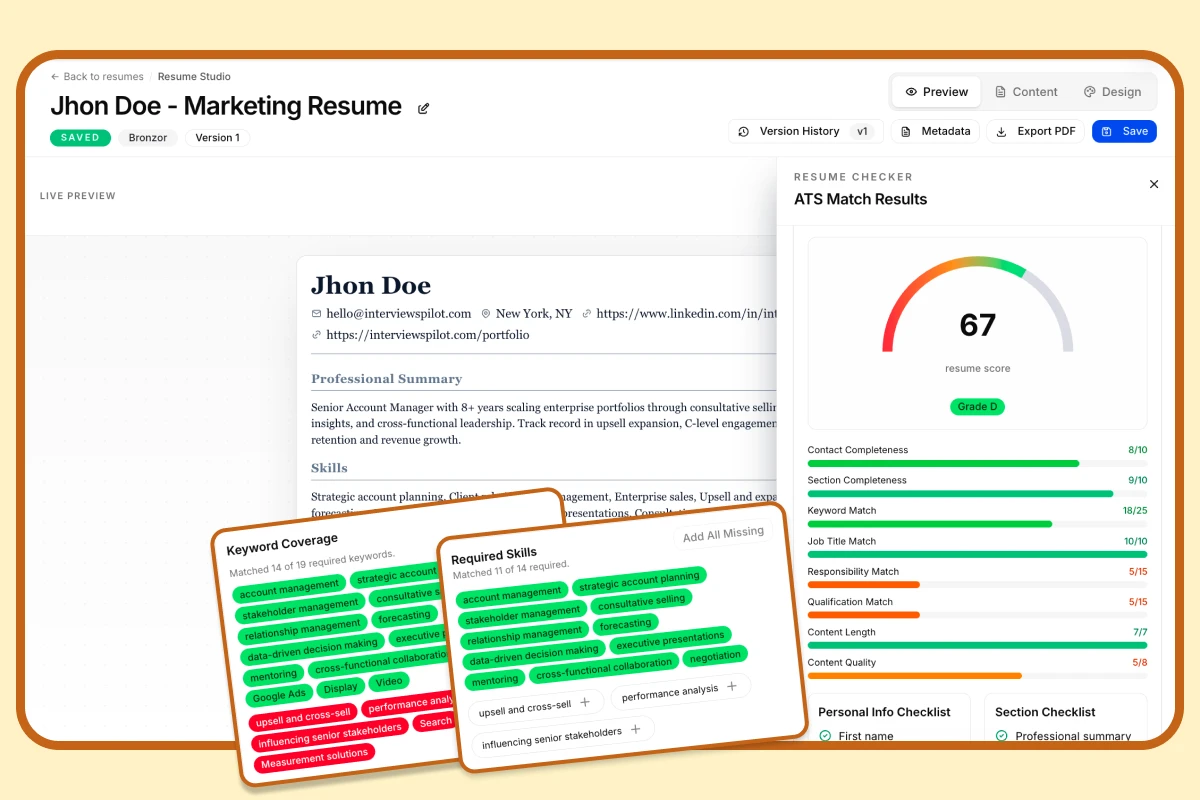
Free ATS Score
Your resume might be invisible to recruiters
Most resumes are filtered out before a human ever sees them. Get your free ATS score and see exactly where your resume falls short — before you hit send.
Should I Use Exact Keywords or Synonyms from the Job Description?
You must use the exact keywords and phrasing found in the job description whenever possible. ATS software is often literal. If the job requires "Salesforce CRM" experience, a resume that only says "Salesforce" may not get full credit. Synonyms are useful for natural writing but should not replace the primary keyword. Lead with the exact term from the job description, then use synonyms only where they make the writing more natural.
What Are the Most Important Keywords to Prioritize on My Resume?
Prioritize keywords based on frequency and placement within the job description.
- Critical Hard Skills: Tools, software, and certifications listed as "required" or mentioned repeatedly.
- High-Frequency Terms: Any word or phrase that appears multiple times across the several job descriptions you've analyzed.
- Job Title & Core Functions: Keywords found in the job title and the opening summary of responsibilities.
Incorporate these priority keywords in high-impact areas: your resume summary/headline and the first two bullet points under your most relevant work experiences.
How Can I Avoid Keyword Stuffing While Still Optimizing for ATS?
Keyword stuffing—overloading a resume with keywords in an unnatural way—can be flagged by sophisticated ATS and always turns off human readers. The key is contextual integration. Every keyword should be woven into a coherent sentence that demonstrates your competency. For example, instead of listing "Python, Data Analysis, Machine Learning," write: "Utilized Python for data analysis to build a machine learning model that improved forecast accuracy by 30%." This provides the keyword and the proof of its application.
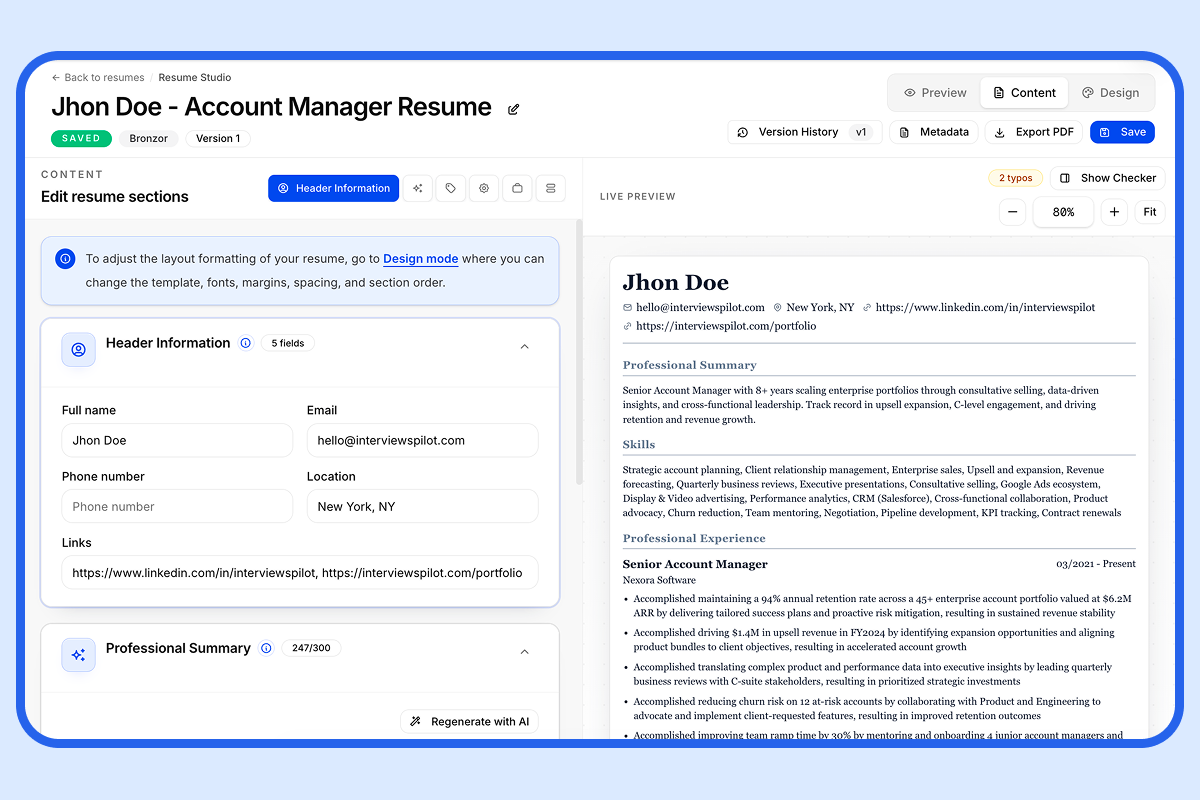
AI Resume Builder
Stop sending the same resume to every job
Paste any job description and InterviewsPilot rewrites your resume around it — keywords, bullets, and summary aligned to what recruiters are actually scanning for.
What Role Do Action Verbs Play in Resume Keyword Optimization?
Action verbs are power keywords that frame your experience proactively. They are critical for passing both ATS filters and the human "skim test." ATS often looks for these verbs to understand the scope of your responsibilities. For humans, strong action verbs (e.g., "Spearheaded," "Engineered," "Transformed") create a more compelling narrative of impact than passive language. They should start the majority of your accomplishment bullet points.
How Do Applicant Tracking Systems (ATS) Actually Use Keywords to Screen Resumes?
ATS software scans your resume, parses its text, and scores it based on keyword relevance against the job description. The system looks for:
- Keyword Presence: Does the resume contain the specific terms from the job description?
- Keyword Density: How often do those terms appear? (Though over-optimization can be penalized).
- Keyword Proximity & Placement: Some systems weight keywords found in recent job titles or recent experience more heavily.
- Context: Advanced systems can assess if keywords are presented within logical context (e.g., "managed a team" vs. a random list). Your resume's score determines if it advances to a human recruiter or is archived.
Are There Free Tools to Help Extract Keywords from Job Descriptions?
Yes, several free online tools can automate the initial extraction, saving you time. You can paste a job description into these tools, and they will generate a list of identified keywords, often categorized by importance (e.g., "Critical," "Secondary"). These tools are excellent for a first pass, but their output should always be validated by your own review of the source material to ensure nothing critical is missed and to understand context.
Where Should I Place Keywords in My Resume: Summary, Bullets, or Skills Section?
A strategic resume uses all three areas for a layered approach:
- Resume Summary/Headline: This is prime real estate. Include 3-4 of the most critical keywords that define your professional identity for this specific role.
- Experience Bullet Points: This is the most important area. Integrate keywords naturally into your accomplishment statements. This proves you've used the skill, not just listed it.
- Skills Section: Use this for a comprehensive, scannable list of hard skills, tools, and methodologies. It acts as a keyword repository for the ATS and a quick reference for the recruiter. By dispersing keywords throughout, you create a strong, consistent signal of relevance to both software and people.
How Do I Identify Industry-Specific Jargon Versus Generic Terms?
Industry jargon consists of acronyms, proprietary methodologies, and specialized terminology that holds specific meaning within a field. To identify it:
- Look for capitalized terms or acronyms on first reference (e.g., "Sarbanes-Oxley (SOX) compliance").
- Note terms that appear consistently in postings for one industry but are absent in others.
- Research any term you don't fully understand. Using jargon incorrectly on a resume is worse than not using it at all. When in doubt, consult industry forums, professional association websites, or network with someone in the role to confirm the term's common usage and importance.
Mastering the process to find keywords in job descriptions transforms your job search from a game of chance to a strategic operation. It requires an analytical eye and disciplined editing, but the payoff—more interviews and job offers—is unequivocally worth the investment. Start by gathering 3-5 target job descriptions today and begin your keyword audit.
Explore this category
Resume
Browse the full resume category for more related playbooks, examples, and tactical guides.
Browse Resume articles →One workflow. Resume to offer.
Build ATS-ready resumes, track every application, and practice interviews — all in one place. Free to start, no credit card needed.
✓ Free plan forever · ✓ No card needed
Related articles
How to Read a Job Description: Tips, Examples, and ATS Resume Optimization
Learn how to read a job description like a recruiter. This guide explains the key sections of a posting, how to judge whether you qualify, and how to use job description keywords to improve ATS resume optimization with real examples tips.
Resume Summary Examples: Professional Summary Examples, Tips, and ATS-Friendly Writing Guide
Use these resume summary examples to write a stronger professional summary for your resume. Learn a simple framework, see examples for different career stages, and get resume summary tips that help your application stand out.
How to Write a Cover Letter: The Ultimate Guide for 2026
Forget generic templates. This ultimate guide provides a clear framework for writing a cover letter that connects your skills directly to the job, highlights your achievements, and demonstrates genuine enthusiasm.