





Behavioral interview questions are a cornerstone of the modern hiring process. Unlike traditional questions that ask about your skills or hypothetical scenarios, behavioral questions probe your past actions and experiences to predict your future performance. Employers use them because past behavior is one of the best indicators of how you'll handle similar situations in a new role. This guide will equip you with the knowledge and strategies to not only understand these questions but to answer them in a way that makes you a standout candidate.
For related next steps, use common interview questions guide and tell me about yourself guide.
What Are Behavioral Interview Questions and Why Do They Matter?
Behavioral interview questions are inquiries that ask you to describe specific past situations where you demonstrated a particular skill, quality, or competency. They typically begin with phrases like:
- "Tell me about a time when..."
- "Describe a situation where..."
- "Give me an example of...".
According to career resources, these questions are favored by employers across industries because they move beyond rehearsed answers and provide concrete evidence of a candidate's abilities. They assess how you think, act, and solve problems in real-world contexts, offering a more reliable prediction of on-the-job performance than theoretical questions.
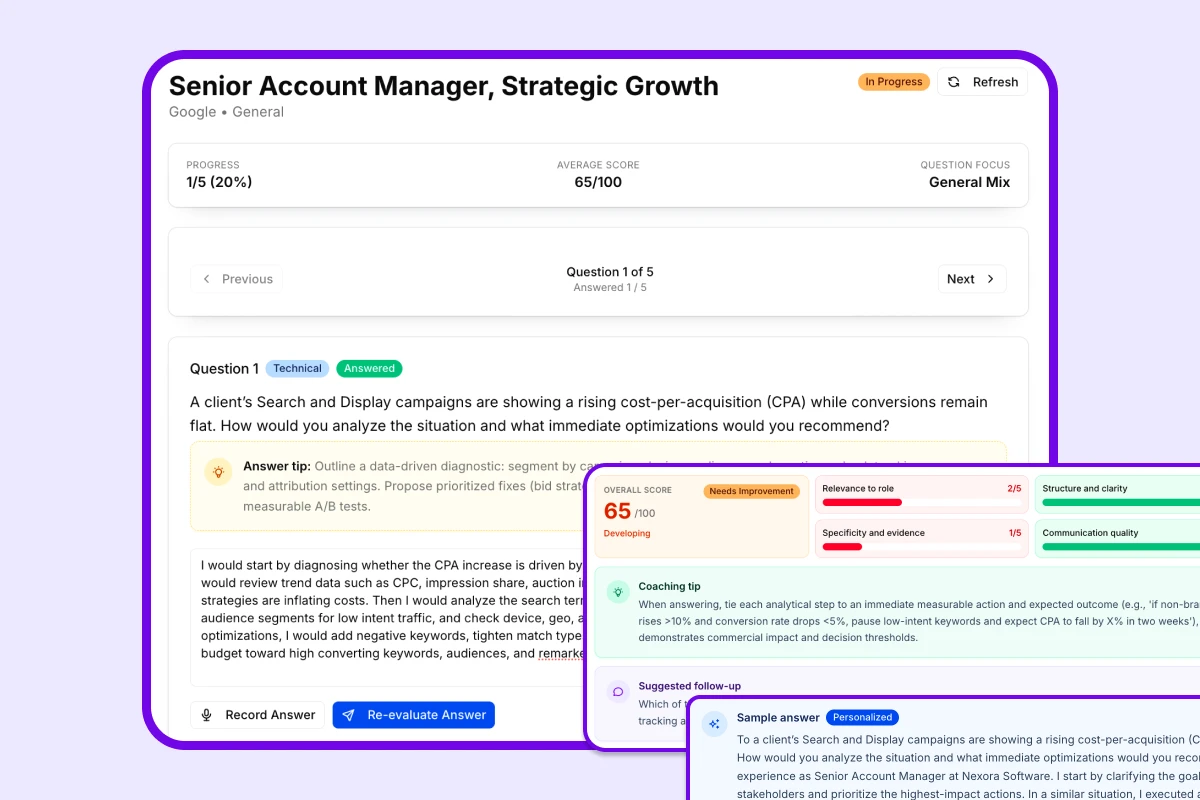
AI Interview Prep
Got the interview? Now make sure you're ready.
Practice the exact questions likely to come up for your target role. Get scored on clarity, structure, and relevance — so you walk in sharp, not winging it.
The Core Categories of Behavioral Interview Questions
While questions can vary, most behavioral interview questions fall into several key competency areas. Understanding these categories helps you prepare systematically.
1. Leadership and Management
These questions assess your ability to guide, motivate, and take charge. Examples include:
- "Tell me about a time you had to lead a project without formal authority."
- "Describe a situation where you motivated a disengaged team member."
2. Teamwork and Collaboration
Here, interviewers want to see how you work with others to achieve a common goal.
- "Give me an example of a successful team project you contributed to."
- "Describe a time you had to resolve a conflict within your team."
3. Problem-Solving and Critical Thinking
These questions evaluate your analytical skills and approach to overcoming obstacles.
- "Tell me about a time you identified a problem your manager had missed and how you handled it."
- "Describe a situation where you had to make a decision with incomplete information."
4. Adaptability and Resilience
Employers seek candidates who can handle change and bounce back from setbacks.
- "Give me an example of a major change at work and how you adapted."
- "Describe a time you failed at a task and what you learned from it."
5. Communication Skills
This category probes your ability to convey information clearly and effectively.
- "Tell me about a time you had to explain a complex idea to a client or colleague."
- "Describe a situation where you received critical feedback and how you responded."
6. Time Management and Prioritization
These questions assess your organizational skills and ability to meet deadlines.
- "Give me an example of how you managed multiple competing priorities."
- "Tell me about a time you completed a project under a tight deadline."
7. Conflict Resolution
Interviewers look for diplomacy and the ability to navigate disagreements professionally.
- "Describe a time you disagreed with your manager's approach."
- "Tell me about a time you mediated a dispute between coworkers."
How to Answer Behavioral Questions: The STAR Method
The most effective framework for structuring your answers is the STAR method. This four-step approach ensures your response is concise, structured, and impactful.
| STAR Component | What It Means | What to Include |
|---|---|---|
| Situation | Set the context. | Briefly describe the background. Who was involved? Where and when did it happen? |
| Task | Explain your responsibility. | What was the specific goal, challenge, or duty you were faced with? |
| Action | Detail the steps you took. | This is the core. What did YOU personally do? Use action verbs. |
| Result | Share the outcome. | Quantify the impact if possible. What did you achieve, learn, or improve? |
Example Using STAR:
- Question: "Tell me about a time you improved a process."
- Situation: "In my previous role as a marketing coordinator, our team spent hours each week manually compiling campaign reports from five different platforms."
- Task: "My task was to reduce the time spent on this administrative work so the team could focus on strategy."
- Action: "I researched automation tools, presented a cost-benefit analysis for a specific dashboard software to my manager, after getting approval, led the implementation. I trained the team on how to use the new system."
- Result: "We reduced weekly reporting time by 70%, saving an estimated 15 person-hours per month. This also minimized human error and allowed our analysts to dedicate more time to interpreting data."
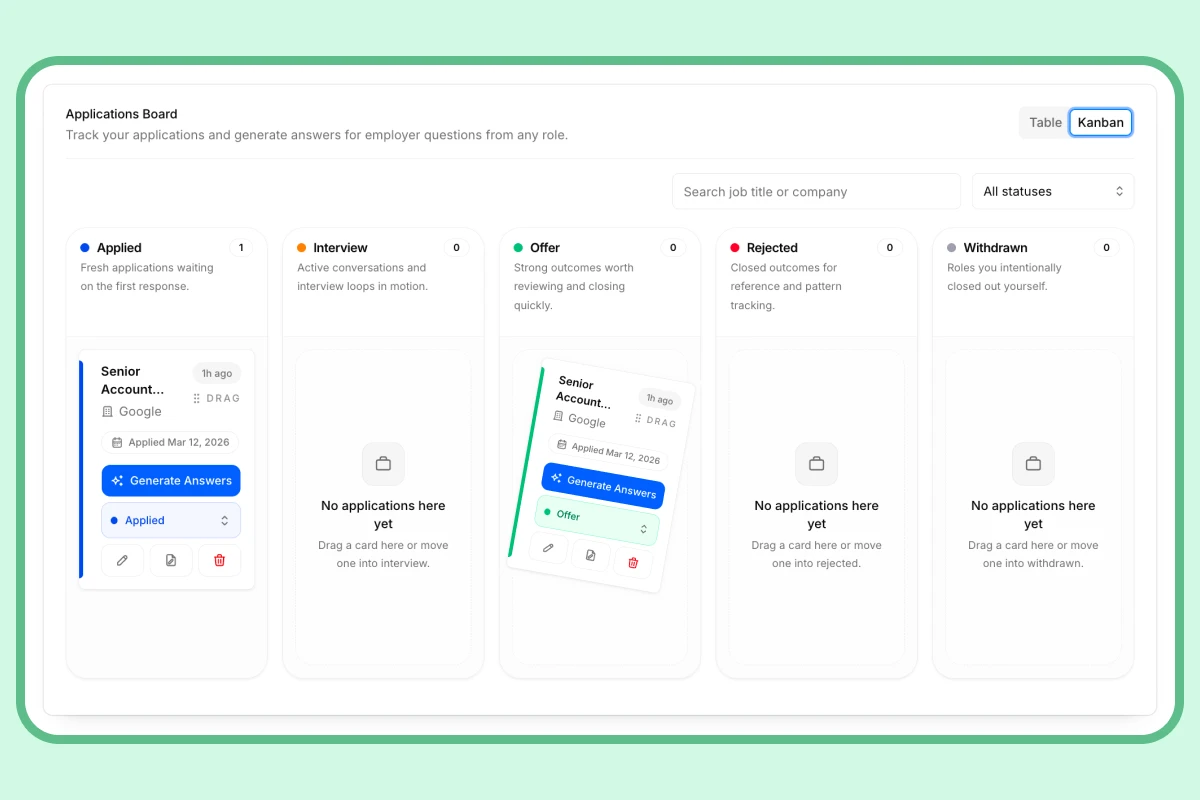
Application Tracker
Applying to 10+ jobs? You need a real system.
No more spreadsheets or lost threads. Track every role, stage, deadline, and follow-up in one dashboard — so you always know exactly where you stand.
Sample Behavioral Interview Questions and Answers
Here are examples of strong answers for common questions, following the STAR framework.
"Tell me about a time you faced a significant challenge at work."
Strong Answer Approach: Focus on a professional challenge, your systematic approach to solving it, and a positive result or key learning. Avoid blaming others or dwelling on negativity.
Situation & Task: "When our primary vendor suddenly went out of business two weeks before a major product launch, my task was to secure a new supplier without delaying our timeline." Action: "I immediately audited our list of backup contacts, scheduled calls with three potential suppliers within 24 hours, and negotiated expedited shipping terms by emphasizing the potential for a long-term partnership." Result: "We secured a new vendor within four days and received the first shipment with only a three-day delay to the launch, which we mitigated by adjusting our marketing rollout. The new vendor relationship proved more cost-effective in the long run."
"Describe a time you made a mistake. How did you handle it?"
Strong Answer Approach: Choose a genuine, moderate mistake (not a catastrophic one). Emphasize accountability, immediate corrective action, and the lesson learned.
Situation & Task: "I once sent a client proposal with an incorrect pricing figure due to a spreadsheet error. My task was to rectify the error and maintain the client's trust." Action: "As soon as I realized the error, I personally called the client to apologize for the mistake. I explained the cause, provided the corrected proposal immediately, and offered a small goodwill discount on the first invoice for the inconvenience." Result: "The client appreciated the transparency and swift correction. They signed the contract and later mentioned that our handling of the error actually increased their confidence in our integrity. I also implemented a new peer-review checklist for all client-facing documents to prevent future errors."
Advanced Preparation Strategies
- Conduct a Personal Audit: Before your interview, brainstorm 5-7 key accomplishments or challenging situations from your past roles. For each, outline the Situation, Task, Action, and Result. These core stories can often be adapted to answer multiple questions.
- Align with the Job Description: Scrutinize the job posting for keywords like "lead cross-functional teams," "resolve client issues," or "manage tight deadlines." Prepare specific stories that directly demonstrate those required competencies.
- Practice Aloud, Not Just in Your Head: Rehearse your stories out loud to ensure they flow naturally and fit within a 1-2 minute timeframe. Practice with a friend or record yourself to critique your delivery.
- Prepare Thoughtful Questions: The interview is a two-way street. Prepare behavioral-style questions for your interviewer, such as, "Can you tell me about a time the team successfully navigated a major change?" or "How would you describe the communication style of the most successful people on this team?"
Common Pitfalls to Avoid
- Being Too Vague: Avoid generalities like "I'm always a good team player." Instead, provide a specific, detailed example.
- Sharing Inappropriate Stories: Never discuss confidential information, speak negatively about former employers or colleagues, or share overly personal anecdotes.
- Forgetting Your Role: In the "Action" step, focus on what you did, not what "we" or "the team" did. The interviewer wants to understand your individual contribution.
- Neglecting the Result: Always conclude with the outcome. What was the impact of your actions? Quantify it with numbers (e.g., "increased sales by 15%") or qualitative results ("which improved team morale").
Mastering behavioral interview questions is about preparation and framework. By understanding the categories, structuring your answers with the STAR method, and practicing your key stories, you transform these questions from daunting probes into powerful opportunities to showcase your proven skills and experiences. Remember, the goal is not to present a perfect past, but to demonstrate your ability to learn, adapt, and deliver results.
Explore this category
Interview Prep
Browse the full interview prep category for more related playbooks, examples, and tactical guides.
Browse Interview Prep articles →One workflow. Resume to offer.
Build ATS-ready resumes, track every application, and practice interviews — all in one place. Free to start, no credit card needed.
✓ Free plan forever · ✓ No card needed
Related articles
The SAR Method: A Concise Framework for Impactful Resumes and Interviews
The SAR Method is a streamlined framework for structuring professional achievements. By focusing on Situation, Action, and Result, it helps you transform generic duties into compelling evidence of your skills and impact, making it ideal for resumes and concise interview responses.
How Do You Sell Yourself During an Interview: A Pragmatic Playbook
Selling yourself in an interview isn't about boasting; it's a strategic process of aligning your proven skills with the employer's needs. This playbook provides the concrete frameworks, scripts, and preparation tactics you need to communicate your value with confidence and authenticity.
How to Answer What Are Your Greatest Strengths in an Interview
Learn how to answer "What are your greatest strengths?" with a concise, tailored response that highlights relevant skills, proves them with examples, and shows fit for the job.