





The question "Are you open to relocating?" is a common part of interviews and job applications, especially when a role is tied to a specific office, region, or growth market. Your answer can shape how a hiring manager sees your flexibility, seriousness, and long-term fit. For a neutral preparation baseline, CareerOneStop's interview tips reinforce the same focus on examples, practice, and clear communication.
For related next steps, use common interview questions guide, behavioral interview questions guide, situational interview questions guide, tell me about yourself guide, professional introduction examples, and greatest strengths answer guide.
For a broader preparation benchmark, compare MIT's STAR method overview.
The best response is simple: show interest in the job first, then answer honestly about your relocation plans. Whether you are fully willing, conditionally open, or unable to move right now, you can still answer in a way that keeps the conversation positive and professional, especially if relocation affects your salary expectations.
Answer-First Summary
When an employer asks about relocation, start by reinforcing your interest in the role and company. Then state your position clearly.
- Yes if you are fully willing to move
- Maybe if relocation depends on location, timing, or support
- No, not at this time if relocation is not possible for you.
Good answers are direct, honest, and focused on the opportunity rather than the logistics alone.
Why Do Employers Ask, "Are You Open to Relocating?"?
Employers ask this question for a few practical reasons:
- To confirm commitment. They want to know whether you are serious enough about the role to consider a major life change.
- To plan logistics. Relocation affects start dates, onboarding, and sometimes travel or housing support.
- To evaluate fit. A candidate who can move may be a better match for a role tied to a particular location.
- To understand flexibility. Hiring teams often value candidates who can adapt to changing business needs.
In other words, your answer is not just about moving. It is also a signal about how you think, communicate, and make decisions.
How to Answer "Are You Open to Relocating?" Based on Your Situation
Your response should match your actual circumstances. Here are the most common approaches.
If You Are Fully Willing to Relocate
If you are ready to move, say so clearly and confidently.
Good approach:
- Lead with enthusiasm for the role
- Confirm that you are open to relocating
- If appropriate, mention why the location or opportunity appeals to you
Example answer:
"Yes, I’m absolutely open to relocating for the right opportunity. I’m very excited about this role and the chance to contribute to your team. I’ve also been interested in the area and think it would be a great fit for both my career and personal growth."
Follow-up questions to ask:
- "What is the expected timeline for relocation?"
- "Does the company offer relocation assistance?"
- "What should I know about onboarding for someone moving to the area?"
If You Are Open, But Only Under Certain Conditions
Maybe you are willing to relocate, but only if the timing works, the package is right, or the location is a good fit. That is normal. The key is to be honest without sounding hesitant or closed off.
Good approach:
- Say you are open to relocation
- Explain any preferences briefly and professionally
- Keep the focus on solving the need together
Example answer:
"I’m very interested in the role and open to discussing relocation. I’d like to understand the timeline and whether there’s any flexibility around a hybrid or remote start, since that would help with the transition. If relocation is the best path, I’d be glad to talk through the details."
Example answer with a location preference:
"I am open to relocating for this position. I do have a preference for the West Coast office, but I’m flexible and happy to discuss what would work best for the team."
This kind of response shows that you are willing to collaborate, not just negotiate.
If You Are Not Able to Relocate Right Now
If relocation is not possible, you can still answer professionally and keep the relationship positive.
Good approach:
- Thank the employer for the opportunity
- State that you are not able to relocate at this time
- Offer an alternative if one exists, such as remote work or a local role
Example answer:
"Thank you for considering me for the role. I’m very interested in the company and the work your team is doing. However, I’m not able to relocate at this time due to personal commitments. If there’s any possibility of remote work or a role based in my current area, I’d be glad to discuss that."
A useful phrase is "not at this time" instead of "never". That keeps the door open for future opportunities.
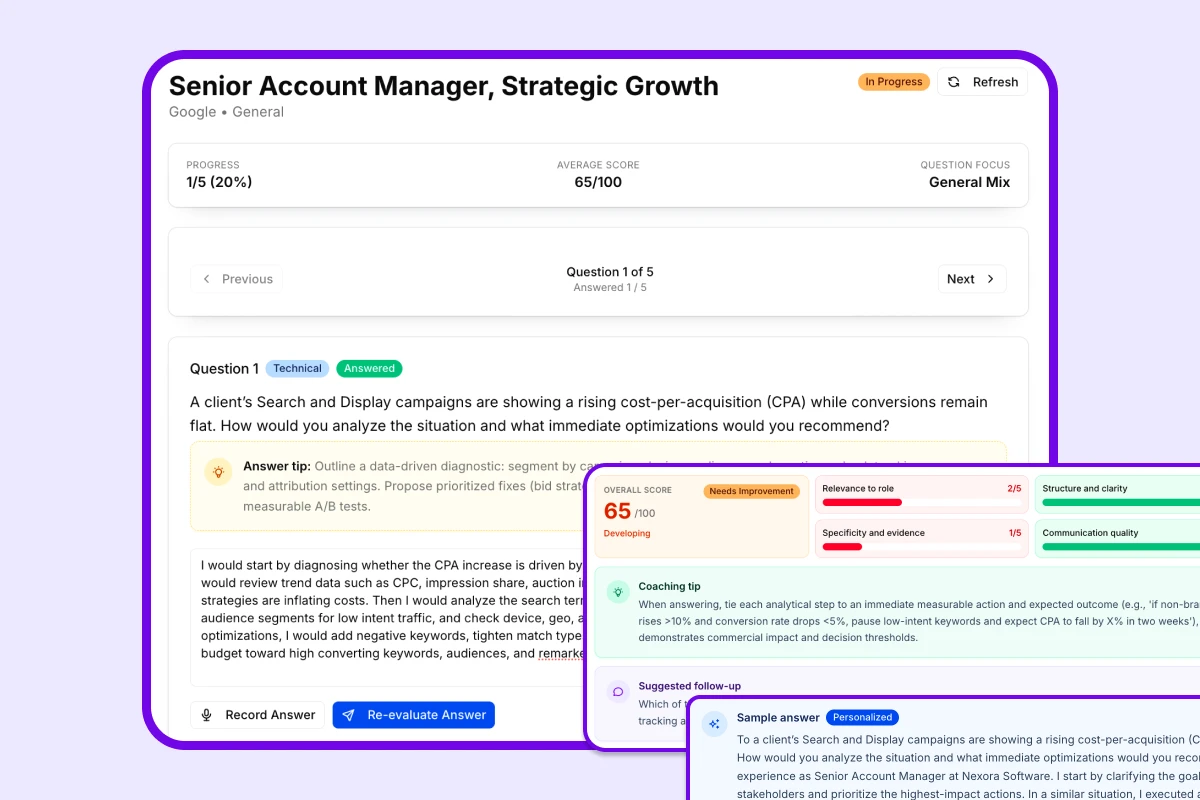
AI Interview Prep
Got the interview? Now make sure you're ready.
Practice the exact questions likely to come up for your target role. Get scored on clarity, structure, and relevance — so you walk in sharp, not winging it.
Are You Open to Relocating Examples for Interviews
Here are a few short Are You Open to Relocating examples you can adapt to your situation.
Example 1: Direct Yes
"Yes, I am open to relocating. I’m excited about this role and would be happy to move for the right opportunity."
Example 2: Conditional Yes
"I’m open to relocating, depending on the timeline and support available. I’d like to learn more about the details before making a final decision."
Example 3: No, Not Right Now
"I’m not able to relocate at this time, but I’m very interested in the role and would be open to discussing remote options."
Example 4: Family Considerations
"Relocation would require some planning on my side because of family commitments, but I’m open to discussing what the transition would look like."
These examples work best when they sound natural, honest, and specific to your circumstances.
Are You Open to Relocating Tips for Stronger Answers
Use these Are You Open to Relocating tips to sound confident and prepared.
1. Lead with the job, not the move
Hiring managers want to know that you want the role, not just a change of scenery.
2. Be honest about your limits
Do not say you are willing to relocate if you are not. Overpromising can hurt trust later.
3. Keep the answer brief
You do not need a long explanation. A short, clear response is usually best.
4. Ask about support and timing
If you are open to moving, ask what relocation help is available and when you would need to move.
5. Use softer language when needed
Phrases like "at this time", "depending on the situation", or "I’m open to discussing it" sound professional and flexible.
6. Prepare before the interview
Think through your real answer ahead of time so you are not caught off guard.
How to Mention Relocation in a Job Application
If you already know you are open to moving, you can signal that early in the process.
On your resume
You can add a short line near your contact information, such as:
- Willing to relocate
- Open to relocation
- Open to roles in [City/Region]
In your cover letter
You can mention it briefly in the closing paragraph:
"I am excited about the opportunity and open to relocating to [City] for the right role."
On job platforms
If the platform allows it, mark yourself as open to relocation so recruiters can find you more easily.
If you include relocation in your application, make sure it is true and current.
Questions to Ask the Employer About Relocation
If relocation comes up in an interview, it is smart to ask a few questions of your own.
What relocation support is available?
This helps you understand whether the company offers moving assistance, temporary housing, or travel reimbursement.
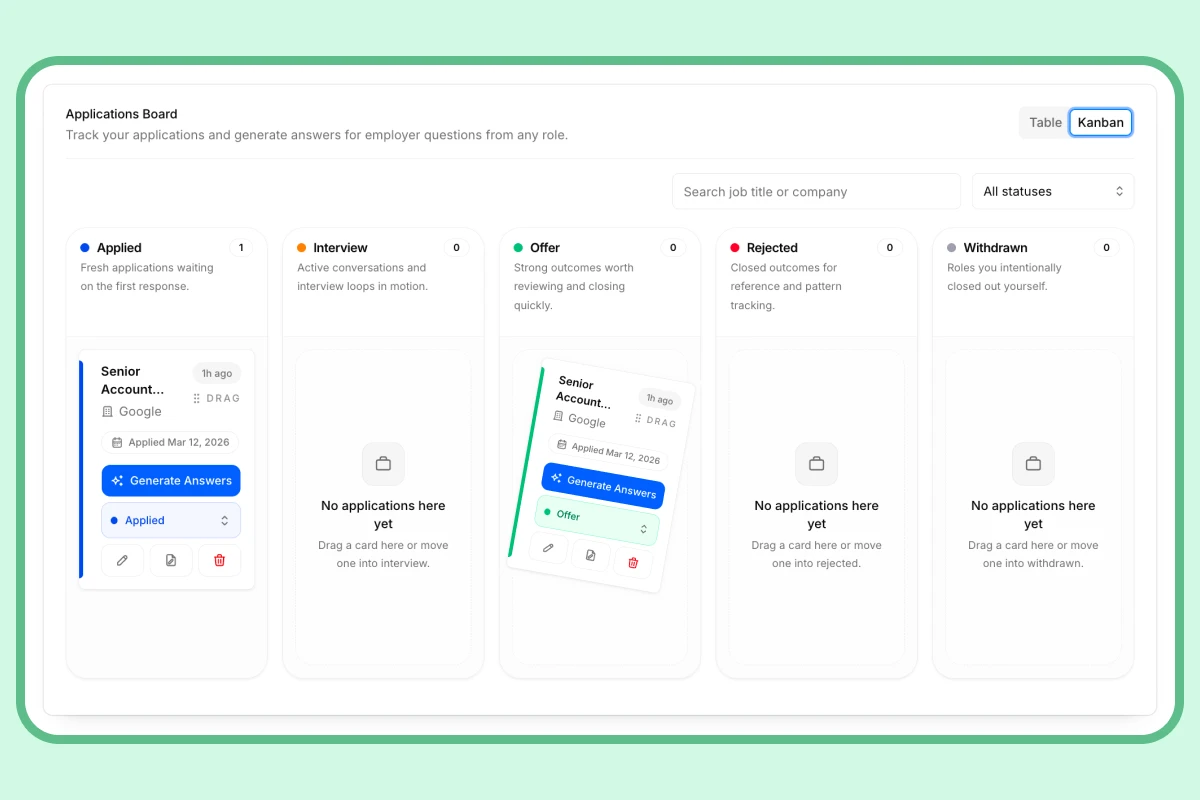
Application Tracker
Applying to 10+ jobs? You need a real system.
No more spreadsheets or lost threads. Track every role, stage, deadline, and follow-up in one dashboard — so you always know exactly where you stand.
What timeline would you expect for a move?
This helps you plan around your current obligations.
Is there flexibility on start date?
Some candidates need extra time to move, finalize housing, or coordinate family arrangements.
Are remote or hybrid options available?
If you are unsure about moving immediately, this question can open the door to alternatives.
What does onboarding look like for someone relocating?
This shows that you are thinking ahead and want to transition smoothly.
How to Handle Common Situations
What if I’m excited about the job but unsure about relocating?
Say that you are interested in the role and need more information before deciding.
Example:
"I’m very excited about this opportunity and open to relocation. I’d like to learn more about the location, support, and timing before making a final commitment."
What if I have family obligations?
Keep it simple and professional.
Example:
"Relocation would require some planning because of family commitments, but I’m open to discussing what would be needed to make it work."
What if I want to negotiate relocation assistance?
Wait until there is an offer, then ask directly but politely.
Example:
"I’m thrilled about the offer. To help make relocation possible, I’d love to discuss whether relocation assistance is available."
How much time can I take to decide?
It is reasonable to ask for a few business days if relocation is involved.
Example:
"Thank you for the offer. Since relocation is involved, may I have until [date] to make my final decision?"
Final Checklist Before You Answer
- Know whether you are fully willing, conditionally open, or unable to relocate
- Prepare a short answer in advance
- Lead with enthusiasm for the role
- Be honest about your constraints
- Ask about relocation support if needed
- Avoid absolute statements like "never"
- Mention relocation in your resume or cover letter only if it is true
Conclusion
Answering "Are you open to relocating?" is really about balancing honesty with enthusiasm. If you are willing, say yes clearly. If you need conditions, explain them briefly. If you cannot move, stay professional and keep the door open for future opportunities.
The best answer is not the one that sounds most impressive. It is the one that is truthful, confident, and aligned with your real situation.
Explore this category
Interview Prep
Browse the full interview prep category for more related playbooks, examples, and tactical guides.
Browse Interview Prep articles →One workflow. Resume to offer.
Build ATS-ready resumes, track every application, and practice interviews — all in one place. Free to start, no credit card needed.
✓ Free plan forever · ✓ No card needed
Related articles
100 Words to Describe Yourself in an Interview: A Practical Playbook
The 'describe yourself' question is a pivotal interview moment. This guide provides a strategic toolkit of 100+ impactful words, categorized for clarity, demonstrates how to weave them into compelling, job-specific answers that showcase your unique value.
How to Answer What Are Your Greatest Strengths in an Interview
Learn how to answer "What are your greatest strengths?" with a concise, tailored response that highlights relevant skills, proves them with examples, and shows fit for the job.
Interview Question: Why Should We Hire You for This Position? Answer Guide
Use this guide to build a strong answer to "Why should we hire you for this position?" with a simple framework, practical examples, and tips for tailoring your response to the role and company.