





Answer-First Summary: The best way to answer strengths and weaknesses interview questions is to use a simple three-part approach: 1) identify traits that are genuinely true for you, 2) match them to the job description, and 3) explain them with a clear structure such as the STAR method (Situation, Task, Action, Result). The goal is not to sound perfect. It is to show self-awareness, role fit, and growth. For broader preparation, compare HBR's common job interview questions, CareerOneStop's interview tips, and NACE's career readiness competencies for employability language around communication and teamwork.
For related next steps, use common interview questions guide and behavioral interview questions guide.
Why Do Interviewers Ask About Strengths and Weaknesses?
Interviewers are not asking for a random list of adjectives. They want to understand several things at once.
- Self-awareness: Can you honestly evaluate your own work style and performance?
- Preparation: Did you review the job description and think about what matters for the role?
- Communication: Can you explain your strengths and weaknesses clearly and professionally?
- Growth mindset: Do you learn from feedback and improve over time?
- Role fit: Do your strengths match what the team actually needs.
That is why this question appears so often in job application answers and interviews. It helps employers see how you think, not just what you say.
How Do You Identify Your Real Strengths and Weaknesses?
Before you answer, you need a short list of traits that are authentic and relevant. Avoid copying generic strengths and weaknesses examples without thinking about your own experience.
1. Review your past work
Look at projects, achievements, performance reviews, and feedback. Ask yourself:
- What tasks do I do especially well?
- Where have I delivered strong results?
- What kinds of work feel natural to me?
- What tasks consistently take more effort?
2. Ask for outside feedback
Former managers, teammates, and mentors can help you spot patterns you may miss. Good questions include:
- What are my top professional strengths?
- What is one area where I could improve?
- What is something I do that adds value to the team?
3. Study the job description
The job posting is one of the best tools for interview prep. Highlight the required skills, responsibilities, and qualities. Then compare those needs to your own experience. This helps you choose strengths that are relevant to the role instead of sounding generic.
What Are Good Strengths and Weaknesses Examples?
The best strengths and weaknesses examples depend on the job, but the list below gives you a strong starting point.
| Trait Category | Example Strengths | Example Weaknesses with constructive framing |
|---|---|---|
| Cognitive & Execution | Problem-solving, analytical thinking, attention to detail, adaptability | Perfectionism, getting too focused on details, difficulty delegating |
| Interpersonal & Leadership | Communication, collaboration, leadership, empathy | Public speaking nerves, hesitating to give difficult feedback, impatience with slow processes |
| Work Style & Management | Time management, organization, proactivity, resilience | Overcommitting, preferring to plan on the fly, needing time to fully learn advanced tools |
A useful rule: choose a weakness that is real, but not a core requirement for the job.
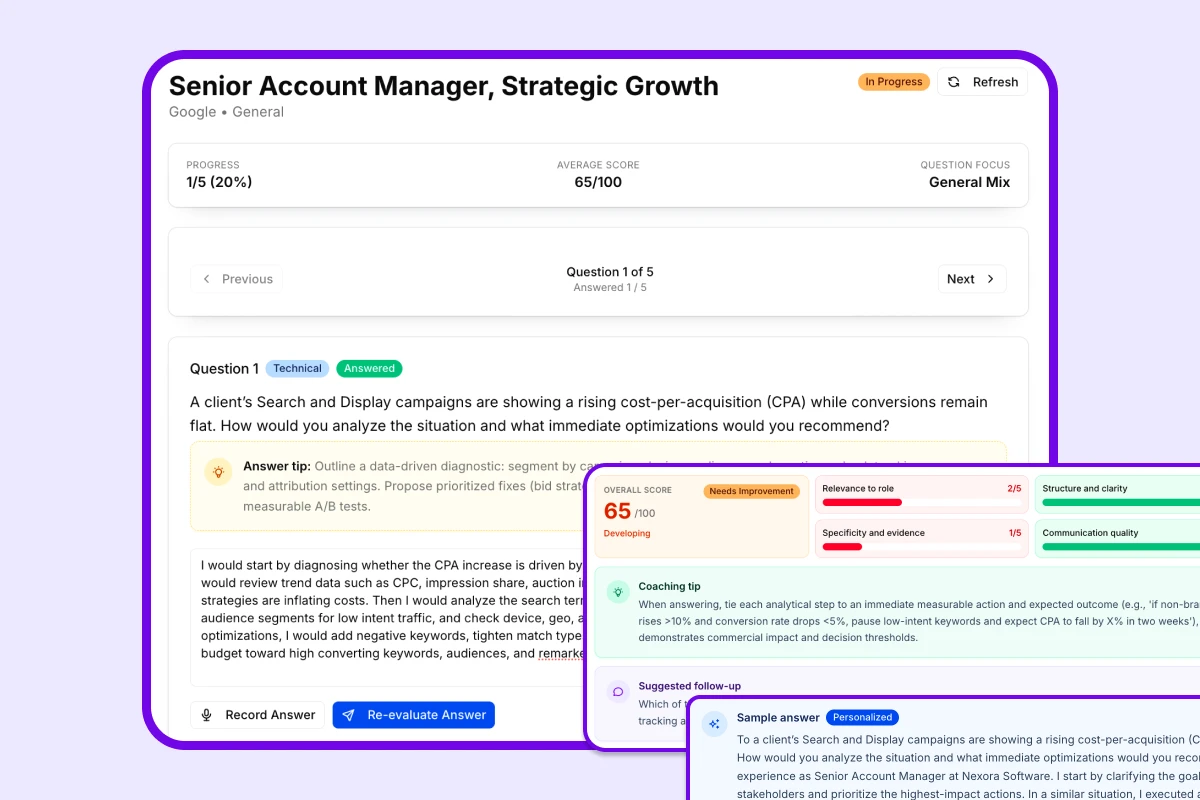
AI Interview Prep
Got the interview? Now make sure you're ready.
Practice the exact questions likely to come up for your target role. Get scored on clarity, structure, and relevance — so you walk in sharp, not winging it.
How Should You Structure Your Answer?
A strong answer is specific, concise, and easy to follow. Two formats work especially well.
Use STAR for strengths
STAR stands for:
- Situation
- Task
- Action
- Result
Strength example: adaptability
"In my last role, our lead developer left during a product launch. I had to help keep the project moving without overloading the team. I quickly organized a knowledge-sharing session, reassigned some work, and worked with leadership to adjust the timeline slightly. We launched only one week later than planned, and the team left with better cross-functional knowledge."
Use Weakness + Action + Improvement for weaknesses
For weakness answers, keep the focus on improvement.
- State the weakness honestly.
- Explain what you are doing about it.
- Show the progress you have made.
Weakness example: delegation
"In the past, I sometimes struggled with delegation because I wanted to make sure the work was done well. To improve, I started giving clearer instructions and setting check-in points earlier in the process. That has helped me trust my team more, focus on higher-level work, and support others’ development."
How Do You Match Strengths to the Job Description?
This step is what makes your answer feel tailored instead of generic.
- Pull out the key skills from the posting.
- Choose matching strengths you can prove with experience.
- Prepare one example for each strength so your answer feels real.
- Lead with the most relevant trait for the role.
If the job emphasizes data, analytics, or decision-making, lead with those strengths. If it emphasizes client work, choose communication or relationship-building. Matching your answer to the role is one of the most important strengths and weaknesses tips to remember.
What Are the Best Strengths to Mention in an Interview?
The best strengths are the ones that align with the role and can be backed up with proof. Common options include:
- Adaptability
- Problem-solving
- Communication
- Collaboration
- Leadership
- Organization
- Time management
- Attention to detail
- Initiative
- Analytical thinking
A good interview answer does more than name the trait. It shows how that strength helped you get a result.
What Are Good Weaknesses to Mention in an Interview?
Good weaknesses are honest, manageable, and not central to the job. Strong options often include:
- Perfectionism
- Public speaking anxiety
- Delegation challenges
- Overcommitting
- Difficulty saying no
- Getting too deep into details
- Preferring independent work over group presentations
The key is to avoid sounding fake. Do not say "I work too hard" or "I care too much" unless you can explain a real, meaningful improvement process.
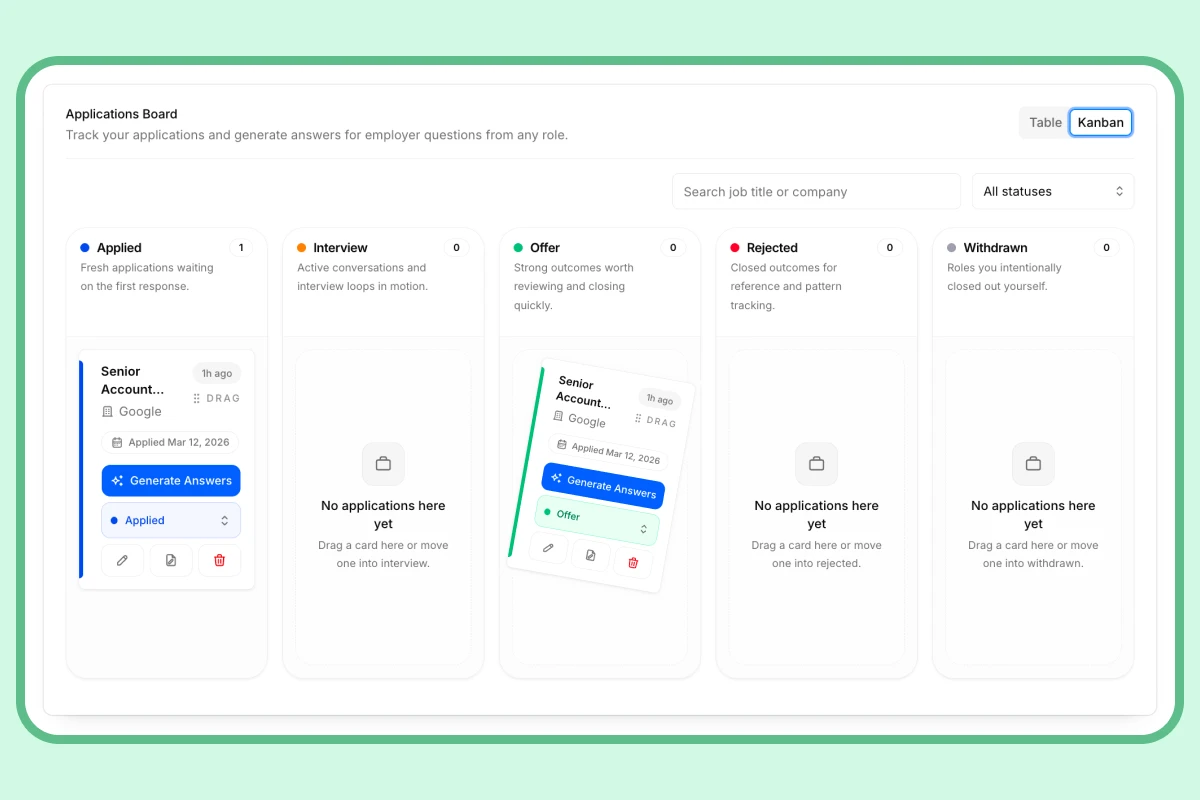
Application Tracker
Applying to 10+ jobs? You need a real system.
No more spreadsheets or lost threads. Track every role, stage, deadline, and follow-up in one dashboard — so you always know exactly where you stand.
What Mistakes Should You Avoid?
Here are the most common problems candidates make when answering this question:
- Choosing a deal-breaker weakness: Do not mention a weakness that is essential to the job.
- Using a humblebrag: Phrases like "my weakness is perfectionism" often sound rehearsed.
- Being too vague: General claims like "I'm a hard worker" do not prove anything.
- Sounding negative: Keep your tone professional and focused on growth.
- Failing to connect to the role: If your answer does not match the job, it weakens your case.
How Can You Practice Job Application Answers?
Practice out loud before the interview. Keep your answers short enough to remember, but detailed enough to be believable.
A good practice routine:
- Write down 3 strengths and 1 weakness
- Match each one to a real example
- Rewrite the answer in plain language
- Practice saying it naturally
- Adjust based on the job description
This helps you build confidence and reduces the chance of sounding scripted.
What Are Some Example Answers?
Example strength answer
"One of my strengths is communication. In my previous role, I worked closely with sales, product, and support teams to keep projects on track. I created clearer update summaries and improved how information moved between teams, which reduced confusion and helped us meet deadlines more consistently."
Example weakness answer
"One area I have worked on is public speaking. I used to get nervous in large meetings, so I started volunteering for smaller presentations first and preparing more structured notes. Over time, I have become much more comfortable presenting ideas clearly in front of groups."
Frequently Asked Questions (FAQs)
What are good examples of strengths to mention in a job interview?
Good examples include adaptability, communication, problem-solving, collaboration, leadership, and organization. The best choice depends on the role, and each strength should be supported by a specific example.
How should you present weaknesses without sounding negative?
Be honest, but focus on what you are doing to improve. Choose a real weakness that is not essential to the job, then explain the action you are taking and the progress you have made.
What is the STAR method for interview answers?
STAR stands for Situation, Task, Action, and Result. It helps you turn a strength into a clear story with context, action, and proof.
Why do interviewers ask about strengths and weaknesses?
They want to assess self-awareness, preparation, communication skills, role fit, and your ability to grow from feedback.
How can you align your strengths with a job description?
Review the posting carefully, identify the most important requirements, and choose strengths that match those needs. Then prepare an example that proves each strength.
What are common mistakes when discussing weaknesses in interviews?
Common mistakes include choosing a weakness that is central to the role, using a fake-sounding answer, failing to show improvement, and speaking too negatively.
Final Takeaway
The strongest strengths and weaknesses interview answers are honest, relevant, and easy to follow. If you identify real traits, match them to the role, and explain them with a clear framework, you will sound prepared and self-aware. That is what hiring managers want to hear in job application answers.
Explore this category
Interview Prep
Browse the full interview prep category for more related playbooks, examples, and tactical guides.
Browse Interview Prep articles →One workflow. Resume to offer.
Build ATS-ready resumes, track every application, and practice interviews — all in one place. Free to start, no credit card needed.
✓ Free plan forever · ✓ No card needed
Related articles
Fun Facts About Me: Examples and Tips for Interviews and Job Applications
Learn how to answer "Fun Facts About Me" with confidence in interviews, resumes, and job applications. This guide includes examples, tips for tailoring your response, and advice for sounding professional, authentic, and memorable.
How Do You Sell Yourself During an Interview: A Pragmatic Playbook
Selling yourself in an interview isn't about boasting; it's a strategic process of aligning your proven skills with the employer's needs. This playbook provides the concrete frameworks, scripts, and preparation tactics you need to communicate your value with confidence and authenticity.
How to Answer What Are Your Greatest Strengths in an Interview
Learn how to answer "What are your greatest strengths?" with a concise, tailored response that highlights relevant skills, proves them with examples, and shows fit for the job.