






"Why did you leave your last job?" is more than a routine inquiry; it's a critical assessment point where hiring managers evaluate your career judgment, professionalism, and fit. Your answer reveals your motivations, problem-solving approach, and whether you see this new role as a strategic step or a mere escape. The core principle is simple: always frame your departure as a positive, forward-looking career move.
For related next steps, use behavioral interview questions guide, situational interview questions guide, and professional introduction examples.
For a broader preparation benchmark, compare CareerOneStop's interview tips.
Answer-First Summary: When answering this question, your goal is to provide an honest, concise, and professional reason that highlights your career ambitions and aligns them with the opportunity at hand. Focus on seeking growth, new challenges, or a better fit for your skills—never on criticizing a former employer. If your departure was involuntary (e.g., a layoff), state it factually and pivot immediately to the skills you gained and your readiness for this next role. The hiring manager's true question is, "Are you a stable, growth-oriented professional who will add value here?".
What Is the Interviewer Really Asking?
Beneath the surface, this question serves multiple purposes for the hiring manager. They are assessing:
- Career Goals and Planning: Are you driven by purposeful growth or reactive impulses?
- Professionalism and Discretion: Can you discuss a past employer without venting or burning bridges?
- Problem-Solving and Resilience: How do you handle and frame challenging transitions?
- Cultural Fit: Do your values and work style align with our organization?
- Long-Term Stability: Is this move part of a logical progression, or does it suggest a pattern of job-hopping or conflict.
Understanding these underlying concerns allows you to craft an answer that addresses them proactively, positioning you as a thoughtful and valuable candidate.
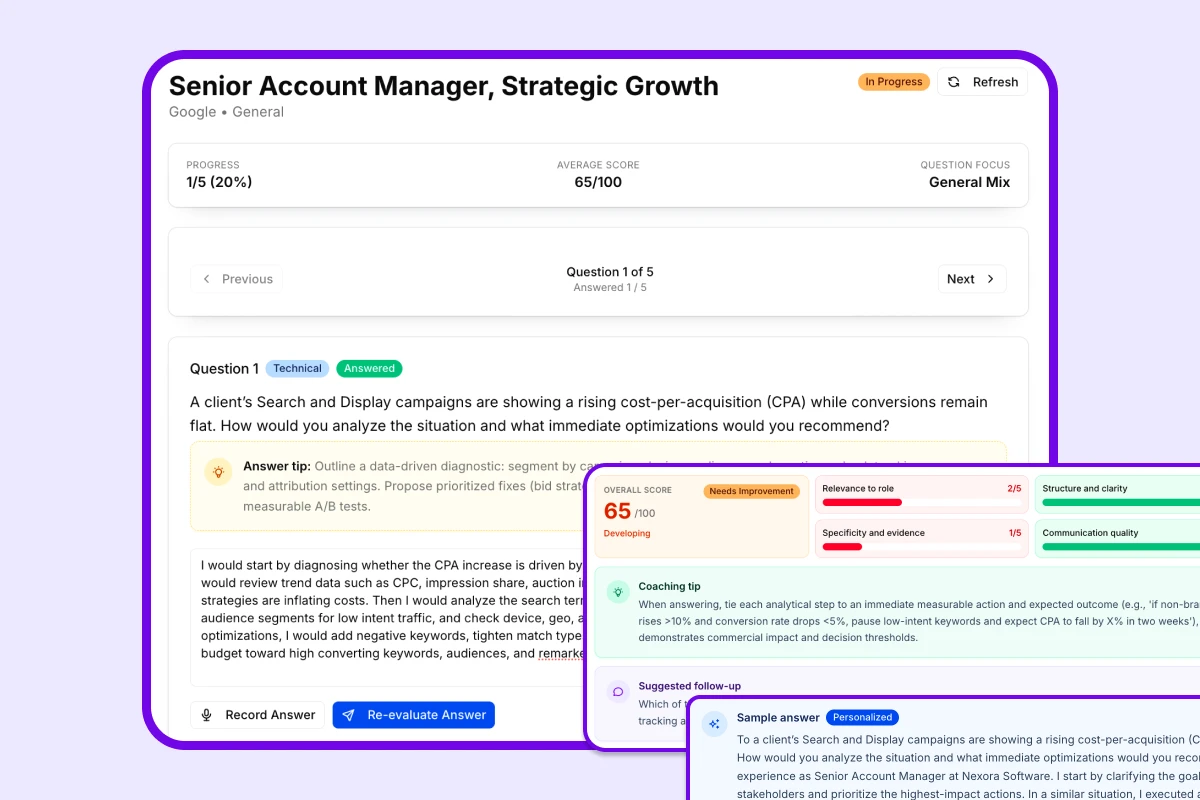
AI Interview Prep
Got the interview? Now make sure you're ready.
Practice the exact questions likely to come up for your target role. Get scored on clarity, structure, and relevance — so you walk in sharp, not winging it.
How to Structure Your Answer: The Positive Framing Formula
A strong answer follows a clear, three-part structure that keeps the focus on the future.
- Acknowledge the Positive (Briefly): Start with a genuine, concise statement about what you gained or appreciated in your last role. This demonstrates gratitude and professionalism.
- Example: "I really valued my three years at [Previous Company], where I developed strong skills in project management and team leadership."
- State Your Forward-Looking Reason: This is the core of your answer. Connect your reason for leaving directly to your professional aspirations.
- Example: "However, I reached a point where I was seeking a role with more strategic responsibility and the opportunity to own a product lifecycle from end-to-end, which is what initially drew me to this position."
- Connect to the New Opportunity: Explicitly link your motivation to the role you're interviewing for. Show you've done your research.
- Example: "Seeing that this role at [Your Company] focuses on leading cross-functional initiatives and has a clear path for impact in the [Specific] market, it feels like the ideal next step for my career."
Best Reasons for Leaving Your Job (With Examples)
The most compelling reasons are those that reflect professional ambition and a desire for greater contribution. Here are widely accepted reasons, adapted from career experts at Robert Walters and Michael Page, with sample phrasing.
| Reason for Leaving | Key Focus for Your Answer | Example Answer Phrasing |
|---|---|---|
| Career Growth & Advancement | Seeking greater challenge, responsibility, or a clear progression path that wasn't available. | "I'm looking for a role where I can take on more leadership and have a direct impact on strategy. My current role has become proficient, and I'm ready for the next level of challenge, which this position clearly offers." |
| New Challenges & Skill Development | Desire to work on different projects, technologies, or in a new industry to expand your skill set. | "I've built a strong foundation in [Skill A], and now I'm eager to deepen my expertise in [Skill B] and apply it in a [e.g., faster-paced, more innovative] environment like yours." |
| Company Restructuring or Layoff | Factual, non-emotional statement. Focus on the skills you honed and your readiness for a new role. | "Unfortunately, my department was restructured, and my position was eliminated. It was a valuable experience where I [mention a key achievement]. I'm now excited to bring those skills to a stable, growing company like this one." |
| Mission & Culture Alignment | Seeking a company whose values, work style, or mission better aligns with your own professional ethos. | "I'm deeply motivated by [e.g., collaborative innovation, data-driven decision making]. I'm looking to join a team where this is a core part of the culture, which I understand is a priority here." |
| Relocation | Personal, understandable, and neutral. Frame it as a positive move for your new location. | "I have relocated to [City/Area] to be closer to family. I'm now eagerly looking to join a leading company in this region where I can contribute my experience in [your field]." |
| Work-Life Balance or Schedule | Frame as seeking a sustainable structure to do your best work long-term. | "I'm looking for a position with a more predictable structure that will allow me to be fully focused and productive during core hours, which I believe this role provides." |
What to Avoid Saying: Common Pitfalls
Certain answers raise immediate red flags about attitude, performance, or stability. Avoid:
- Negativity or Complaints: Criticizing your boss, colleagues, company culture, or workload. It makes you seem difficult and unprofessional.
- Money as the Primary Driver: Leading with "I need more money" suggests mercenary motives rather than commitment to the role or company.
- Admitting You Were Fired for Cause: If you were terminated for performance or conduct, do not volunteer this. Reframe the situation around seeking a "better fit" or "new direction."
- Vagueness or Dishonesty: Answers like "It was time for a change" lack substance and suggest you're hiding something.
- Burning Bridges: Even if true, never say you left because of conflict, boredom, or hating the job.
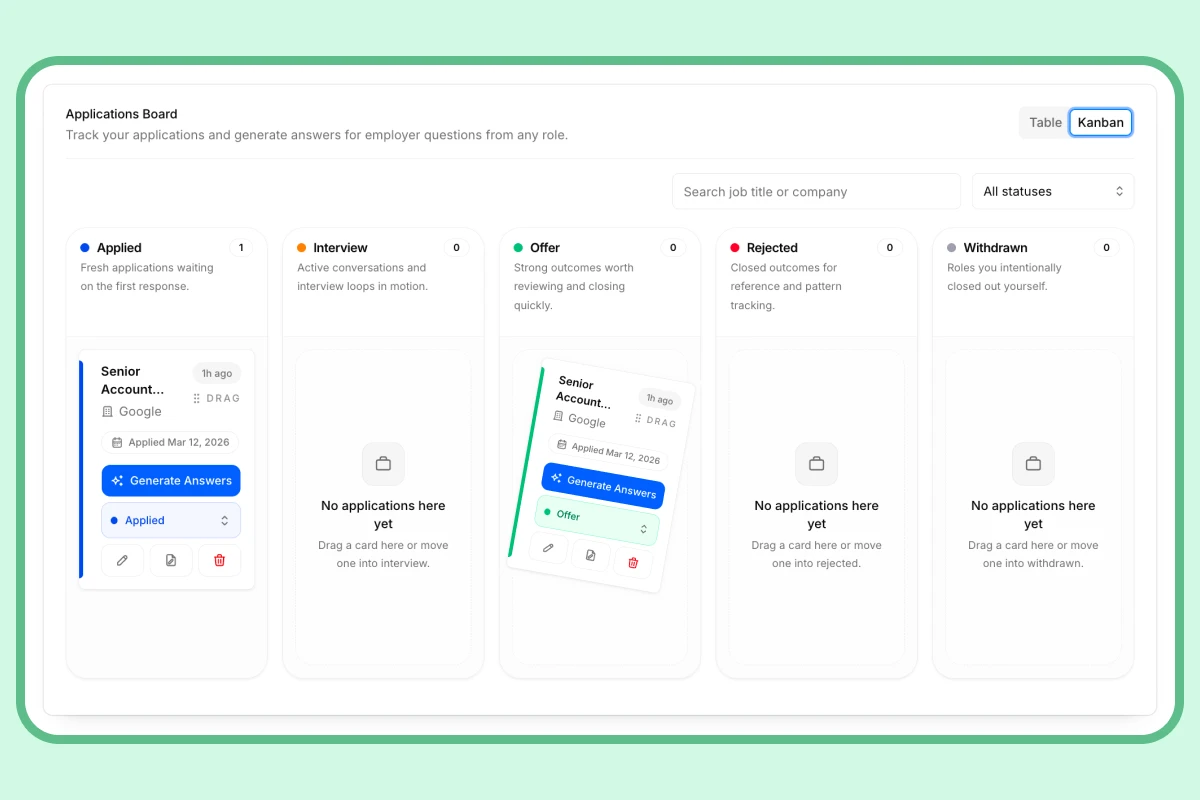
Application Tracker
Applying to 10+ jobs? You need a real system.
No more spreadsheets or lost threads. Track every role, stage, deadline, and follow-up in one dashboard — so you always know exactly where you stand.
How to Handle Difficult Departure Scenarios
If You Were Laid Off or Part of a Restructuring
Be direct, brief, and positive. "My position was eliminated due to a company-wide restructuring" is a complete and acceptable explanation. Immediately pivot: "It was a valuable experience where I [mention key achievement]. I'm now particularly interested in this role because..."
If You Were Fired or Let Go
This requires careful framing. Do not lie, but you can reframe. Focus on a mismatch that is now corrected. For example: "Ultimately, it wasn't the right fit for my skills and long-term goals. I've taken time to reflect and clarify what I need in my next role, a collaborative environment where I can focus on your strengths, which is exactly what I see here." Practice this to sound confident, not defensive.
If You Had a Short Tenure
For a job you left quickly, combine reasons. Perhaps the role was misrepresented, and you quickly realized it didn't align with your career path. Emphasize the clarity it gave you: "I took the role expecting to focus on X, but it quickly became clear the day-to-day was centered on Y. It helped me realize how important [aspect of this new role] is to me, which is why I'm so interested in this opportunity."
Tailoring Your Answer and Final Tips
- Practice, But Don't Memorize: Have a flexible framework, not a robotic script.
- Keep It Concise: Aim for 30-60 seconds. The interviewer can ask for more detail if needed.
- Be Honest: Choose the truest positive reason you can authentically defend.
- Do Your Homework: Research the company so you can convincingly connect your reason for leaving to what they offer.
- Mind Your Non-Verbals: Deliver your answer with calm, confident eye contact and posture.
Frequently Asked Questions
What are the best reasons to give for leaving a job in an interview? The best reasons are forward-looking and professional: seeking career growth, new challenges, a better culture fit, or opportunities for skill development that align with the new role.
How should you answer if you were fired or let go from your last job? Reframe the situation around a mismatch or learning experience. Briefly acknowledge the departure without detail (e.g., "it wasn't the right fit"), then focus on the clarity it provided and how your skills and goals align perfectly with the new opportunity.
Should you mention salary or compensation as a reason for leaving? It's risky as a primary reason. If compensation is a factor, couch it within a broader narrative of seeking a role that values and appropriately rewards the level of responsibility and impact you aim to have.
How do you explain leaving due to personal or family reasons? Keep it simple and professional. "I needed to relocate for family reasons" or "I had to address a personal matter that required my full attention" is sufficient. Assure the interviewer that the situation is resolved and you are fully committed and ready to contribute.
What does a hiring manager really want to know when asking this question? They want to assess your judgment, professionalism, career trajectory, and whether your motivations suggest you'll be a stable, engaged, and valuable employee for them.
Ultimately, "Why did you leave your last job?" is your chance to narrate your career story with purpose. By focusing on growth, alignment, and the future, you transform a potentially tricky question into a powerful demonstration of your professional maturity and ambition.
Explore this category
Interview Prep
Browse the full interview prep category for more related playbooks, examples, and tactical guides.
Browse Interview Prep articles →One workflow. Resume to offer.
Build ATS-ready resumes, track every application, and practice interviews — all in one place. Free to start, no credit card needed.
✓ Free plan forever · ✓ No card needed
Related articles
Interview Question: Why Do You Feel You Are Qualified for This Position? Answer, Examples, and Tips
Discover what interviewers really want to hear, how to structure a confident answer, and how to use examples that prove you are qualified for the role.
How Do You Answer Tell Me About Yourself in an Interview? A Practical Guide
Answer "Tell me about yourself" with confidence using a simple Present-Past-Future framework, 60-90 second timing, and role-specific examples that fit the job.
Interview Question: Why Should We Hire You for This Position? Answer Guide
Use this guide to build a strong answer to "Why should we hire you for this position?" with a simple framework, practical examples, and tips for tailoring your response to the role and company.